
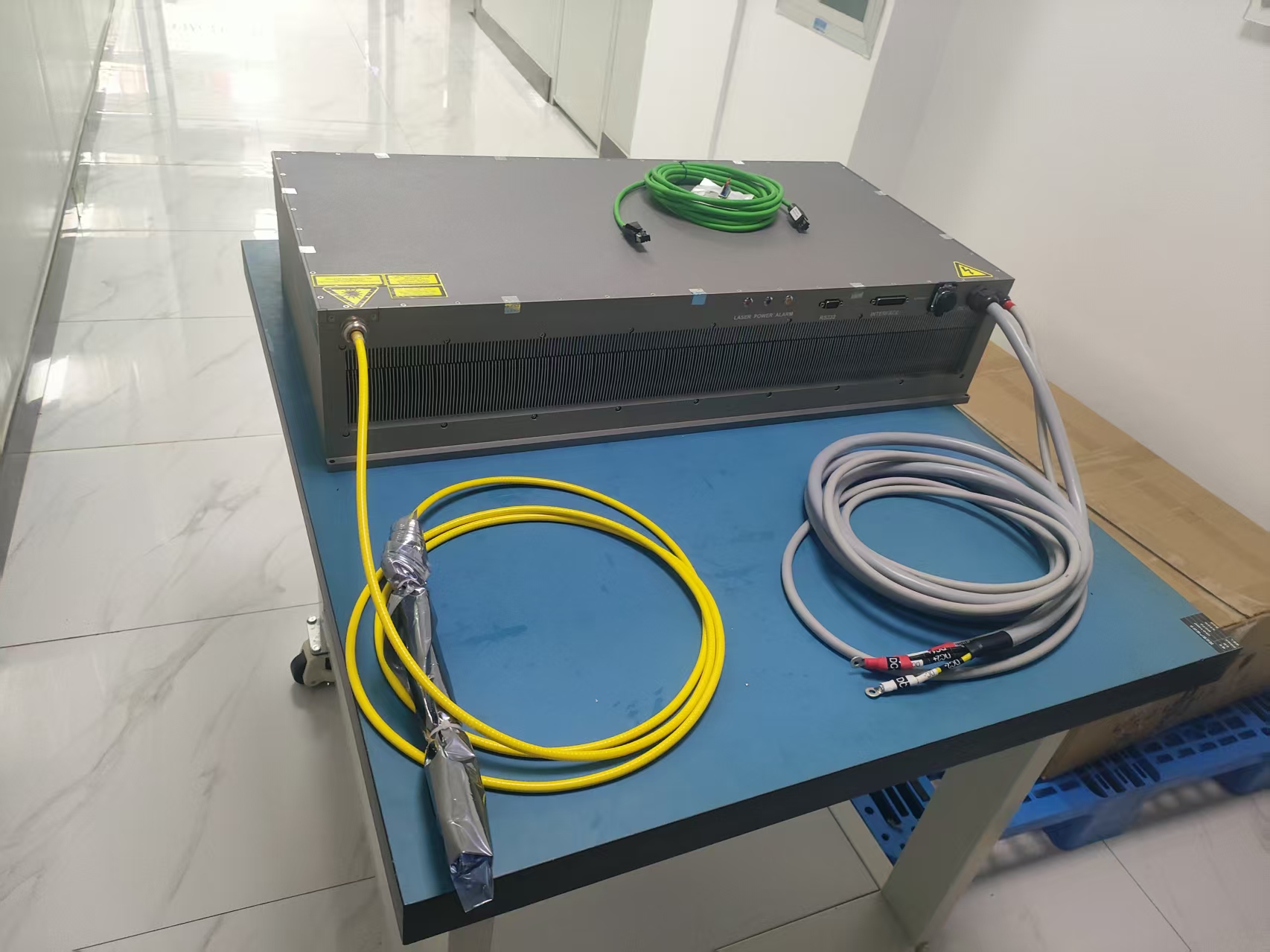
Two fiber laser sources with identical specification sheets can perform very differently over their operational lifetimes — in beam quality stability, pump diode longevity, and resistance to photodarkening. The difference is not visible in the numbers on a datasheet. It originates in manufacturing process decisions made before the source ever ships: which wafer material was used for the pump diodes, how uniformly the ytterbium ions were distributed in the gain fiber, and whether the manufacturer has the capability to trace quality problems to their root cause at the component level. This guide explains the four core components of a fiber laser source, what determines quality in each, and what buyers can do to assess manufacturing quality before purchase.
Why manufacturing process determines performance — not just specifications
A specification sheet describes a source’s output characteristics at a specific point in time, under controlled test conditions. It does not describe how those characteristics were achieved, how they will hold up under 80,000 hours of industrial production, or how consistently they will be reproduced across the hundreds of units a machine builder may integrate over several years of production.
Manufacturing process quality determines all three of those things. The pump diode architecture choice — single emitter or diode bar — determines how a failure in one diode propagates through the ensemble. The gain fiber fabrication method determines whether ytterbium ion distribution is uniform enough to suppress photodarkening over time. The pump combiner splicing quality locks in a coupling efficiency that cannot be adjusted after assembly. None of these process decisions appear on a standard specification sheet, yet each of them has a larger long-term effect on source performance than most of the numbers that do.
Understanding what goes into a fiber laser source at the manufacturing level gives buyers a more useful framework for supplier evaluation than spec comparison alone — and gives machine builders a more credible story to tell their own customers about why source quality matters.
The four core components of a fiber laser source — and where quality is decided
A fiber laser source consists of four core functional components. Each has its own manufacturing process, its own quality failure modes, and its own timeline for how defects manifest in field performance.
| Component | Manufacturing critical process | Quality failure manifestation | Visible on spec sheet? |
|---|---|---|---|
| Pump diodes | GaAs wafer quality; epitaxial growth uniformity; facet passivation; packaging | Premature power degradation; sudden failure events; output instability | Partially (MTBF figure, not architecture) |
| Gain fiber (Yb-doped DCF) | MCVD/CVD deposition; Yb ion distribution uniformity; drawing process control | Photodarkening; beam quality drift; thermal lensing at high power | No |
| Pump combiner / coupler | Fiber fusion splice quality; coupling alignment precision | Insertion loss; coupling efficiency below rated; permanent after assembly | No |
| Fiber Bragg Gratings (FBG) | UV inscription precision; period uniformity; reflectivity accuracy | Output wavelength drift; linewidth broadening; cavity instability | Partially (wavelength spec, not FBG quality) |
Pump diodes — the component that determines reliability more than anything else
How pump diodes are made — from GaAs wafer to fiber-coupled module
Pump diodes are semiconductor lasers that convert electrical current into light at the pump wavelength — typically 915 nm or 976 nm for ytterbium-fiber laser systems. Their manufacturing begins at the wafer level and involves several stages, each of which introduces potential quality variation.
The starting material is a gallium arsenide (GaAs) wafer. The active laser structure — the quantum well or double heterostructure that determines the diode’s wavelength and efficiency — is grown onto this wafer using either molecular beam epitaxy (MBE) or metalorganic chemical vapor deposition (MOCVD). The crystalline quality of this epitaxial layer, including its defect density and compositional uniformity across the wafer, establishes the fundamental reliability ceiling of every diode produced from it. Defects present at this stage propagate into every downstream process and cannot be removed.
After epitaxial growth, the wafer is processed into individual chips through photolithography, etching, and cleaving. The cleaved facets — the mirror surfaces from which the laser emits — are then passivated to prevent oxidation and contamination that would accelerate facet degradation. Facet passivation quality is one of the most consequential manufacturing steps for long-term reliability: poor passivation is a primary contributor to catastrophic optical mirror damage (COMD) events.
Individual chips are then packaged — mounted on heat sinks, wire-bonded to electrical contacts, and in most industrial configurations fiber-coupled to route their output into the laser system. IPG is among very few industrial laser manufacturers with an internal supply of diode pump lasers — all diodes are fully assembled by IPG personnel, enabling the full traceability and quality control only possible through vertical integration, with every individual wafer qualified to ensure unmatched performance across thousands of installations.
Diode bar vs. single emitter architecture — the reliability difference buyers need to understand
The choice between diode bar architecture and single emitter architecture is the most consequential manufacturing decision in pump diode design, and it is one of the most underexplained quality differences in fiber laser source purchasing.
A diode bar is a monolithic chip containing multiple emitters — typically 10 to 100 individual emitting points — fabricated on a single piece of semiconductor material. The emitters share a common substrate, common heat sink interface, and common electrical connections. When any portion of the bar degrades or fails, the entire bar’s output is affected — the failure of one section changes the optical properties of the bar as a whole.
A single emitter architecture uses individual semiconductor chips, each with one emitting point, as independent pump modules. These are then combined optically to achieve the total pump power required. Unlike with bars, the failure of any number of single-emitter diodes does not affect the performance and reliability of the remaining diodes. This scalable, modular design enables lasers that require virtually zero maintenance and have any number of redundant diode pumps to ensure continuous reliable laser performance over the longest lifetimes in the industry.
Diode laser modules based on arrays of single emitters offer a number of advantages over bar-based solutions including enhanced reliability, higher brightness, and lower cost per bright watt. The reliability advantage comes specifically from the independence of failure modes: a defect in one emitter chip is contained to that chip. In a bar, a similar defect propagates through the shared substrate and affects adjacent emitters.
The best solution for fiber lasers may be somewhere between single-emitters and bars — bars are, after all, just emitters monolithically integrated on a single die, and different manufacturers have made different engineering trade-offs based on their design priorities and cost targets. What matters for buyers is understanding which architecture a given source uses, because it determines how the source degrades over time — gradually and predictably in a single-emitter ensemble, or in larger steps as bars degrade.
What “telecom-grade” wafer qualification actually means for industrial buyers
The telecommunications industry imposes some of the most demanding reliability requirements on semiconductor lasers of any commercial application — laser diodes in submarine fiber optic systems are expected to operate continuously for 25 years without maintenance or replacement. The qualification standards developed for telecom applications — covering defect density limits, accelerated life testing protocols, and burn-in screening — are substantially more stringent than what is required for typical industrial laser applications.
IPG single-emitter diodes are manufactured using telecom-proven technology and processes, and each wafer is qualified to rigorous telecommunication industry standards — which sets IPG apart from alternative industrial pump products using short-lived diode bars and bar-stack technologies. The practical meaning of telecom-grade wafer qualification for an industrial buyer is that the starting material for the pump diodes has been screened against defect criteria developed for applications where replacement is literally impossible — a substantially higher bar than screening against industrial production requirements alone.
Not all fiber laser source manufacturers use telecom-grade wafer qualification, and this distinction is not visible on a standard specification sheet. It is, however, a question a buyer can ask directly — and a supplier’s ability to answer it specifically, with reference to their actual qualification process, is itself informative about the depth of their manufacturing quality program.
Gain fiber — the component where optical quality is set permanently
How ytterbium-doped double-clad gain fiber is manufactured
The gain fiber is where laser amplification actually occurs. It is a specialty optical fiber with an ytterbium-doped silica glass core surrounded by an inner cladding that guides the pump light, and an outer cladding that confines it. The optical and chemical properties of the core — particularly the uniformity of ytterbium ion distribution within the glass matrix — determine the gain fiber’s long-term stability under high-power operation.
Ytterbium-doped fiber preforms are manufactured by MCVD (Modified Chemical Vapor Deposition) methods combined with CVD technology for dopant incorporation, followed by drawing the preform to the desired fiber diameter in a high-temperature drawing tower, and applying protective coating layers. The drawing process must maintain precise control of draw speed and tension to preserve the preform’s internal geometry — the core-to-cladding diameter ratio and the dopant distribution profile — through to the final fiber.
The critical quality dimension at this stage is the uniformity of ytterbium ion concentration across the fiber core cross-section and along the fiber length. Non-uniformity introduced during the MCVD deposition process — particularly during the high-temperature collapse step, where volatile dopant compounds can preferentially evaporate from different layers — creates a Yb ion concentration gradient in the core. This gradient becomes the seed of photodarkening under high-power operation.
Once the fiber is drawn, its internal properties are permanent. A gain fiber with non-uniform Yb distribution cannot be corrected by any downstream process. This irreversibility is the defining quality characteristic of the gain fiber manufacturing stage: errors made during preform fabrication are locked into every meter of fiber drawn from that preform.
What photodarkening is and why it separates high-quality from low-quality gain fiber
Photodarkening is an increase in optical absorption in ytterbium-doped silica fiber that occurs during high-power laser operation. As the fiber operates, it becomes progressively more absorbing at the signal wavelength — effectively, the gain medium becomes increasingly opaque to its own laser output over time. This manifests as a gradual decline in output power and an increase in the thermal load on the fiber, which accelerates further degradation through the Arrhenius mechanism.
The root cause of photodarkening is non-uniform ytterbium ion distribution in the fiber core. Regions of high Yb concentration create conditions where energy transfer between neighboring ions produces photodarkening precursor states. The relationship between ytterbium ion uniformity and photodarkening has been directly studied — research using an improved MCVD process with multi-layer gradient deposition to achieve uniform Yb, Al, and P distribution in the fiber core demonstrates that ytterbium-doped fibers produced by this method achieve stable 3.5 kW laser output power for 8 hours with suppressed photodarkening and nonlinear effects.
The practical implication for buyers is that photodarkening is not a wear-out mechanism that all fiber lasers share equally — it is a manufacturing quality indicator. A source built on gain fiber with uniform Yb distribution will show significantly less photodarkening-related power decline over its service life than one built on fiber with non-uniform distribution. This difference is not visible in the source’s initial specification sheet, but it becomes apparent as a diverging power output trend over months and years of operation.
What buyers should ask about gain fiber sourcing
Fiber laser source manufacturers fall into three categories with respect to gain fiber:
Self-manufacturing: A small number of manufacturers — notably IPG, which operates its own fiber production facilities — make their own gain fiber. This enables complete control over Yb doping concentration, distribution uniformity, and drawing parameters, as well as full traceability from raw silica and dopant chemicals through to the finished fiber in a specific source unit.
Sourcing from established specialty suppliers: Manufacturers who do not make their own fiber typically source from a small number of recognized specialty optical fiber producers. Gain fiber quality varies substantially among suppliers, and the purchasing manufacturer’s incoming inspection and batch qualification processes determine whether this supply chain route produces consistent quality.
Sourcing from undisclosed or unqualified suppliers: Particularly at lower price points, gain fiber sourcing may not be disclosed and may change between production batches as manufacturers seek cost reductions. This is the highest-risk scenario for buyers, because fiber batch changes can produce meaningful performance differences between units of the same nominal model.
The question a buyer should ask is not simply “where does your gain fiber come from?” — it is “how do you qualify incoming gain fiber batches, and what specifications do you measure at incoming inspection?” A manufacturer with a serious quality program will have specific answers to these questions. A manufacturer without one typically will not.
Pump combiner and beam delivery — where coupling efficiency is locked in
The pump combiner — also called a pump coupler or tapered fiber bundle (TFB) — is the component that merges the outputs of multiple pump diode modules into the inner cladding of the gain fiber. It is fabricated by precisely tapering and fusing multiple input fibers into a single output fiber using a fusion splicing process that requires micron-level alignment accuracy and careful control of the taper geometry.
The coupling efficiency achieved at the combiner — the fraction of pump light that successfully enters the gain fiber’s inner cladding with the correct angular acceptance — is determined entirely by the manufacturing precision of the taper and fusion process. A combiner with 95% coupling efficiency delivers 5% less pump power into the gain fiber than a perfect combiner; at 6 kW of pump power, this represents 300 W of pump energy converted to heat in the combiner structure rather than delivered to the gain medium.
Critically, coupling efficiency in a fused fiber component is set permanently at fabrication. There is no adjustment mechanism, no trimming, no calibration that can improve a combiner’s coupling efficiency after it has been made and incorporated into a source. A source built with a below-specification combiner will underperform relative to its rated specifications for its entire service life, and this underperformance will not be attributable to any wear mechanism — it is a permanent manufacturing characteristic.
The same principle applies to all fusion-spliced interfaces in the source: the connections between pump diode pigtail fibers and combiner input ports, between the combiner output and the gain fiber, and between the gain fiber and the FBG sections. Each splice introduces a loss that is fixed at fabrication. High-quality sources are built with splice loss budgets that leave margin for the rated output — lower-quality sources may achieve rated output only when all splices happen to be at the favorable end of their tolerance range.
FBG (Fiber Bragg Grating) — the component that defines wavelength and output stability
Fiber Bragg Gratings are periodic refractive index modulations written directly into the fiber core using ultraviolet laser inscription. In a fiber laser, two FBGs form the optical cavity: a high-reflectivity FBG at one end that reflects nearly all of the signal light, and a partially reflective output coupler FBG at the other end that allows a defined fraction of the signal to exit as the laser output.
The period of the refractive index modulation — which must be uniform to within nanometer precision across the full FBG length — determines the wavelength at which the FBG reflects, which in turn determines the laser’s output wavelength. Period non-uniformity produces a broadened or shifted reflection spectrum, which manifests as output wavelength instability and linewidth broadening in the finished source.
FBG inscription quality also determines the stability of the cavity’s reflectivity over time and temperature. An FBG whose refractive index modulation is not fully annealed after inscription — a process step that stabilizes the grating against thermal relaxation — will drift in reflectivity as the source operates and heats up. This thermal drift in the output coupler reflectivity changes the ratio of circulating to emitted power in the cavity, producing output power instability that appears as beam quality fluctuation rather than a clearly identifiable fault.
For most cutting applications, FBG quality is a secondary manufacturing consideration relative to pump diodes and gain fiber. It becomes more critical in applications requiring precise wavelength control, in sources operating at very high duty cycles where thermal effects on the grating are more pronounced, and in multi-source beam combining systems where the wavelength matching between sources is a performance requirement.
Vertical integration — why it matters more in fiber laser manufacturing than most industries
Vertical integration — the degree to which a manufacturer controls its own supply of critical components rather than sourcing them from external suppliers — is more consequential in fiber laser manufacturing than in most industrial product categories. The reason is specific to the physics of fiber laser performance: the dominant failure modes and performance variations all trace back to component-level properties that are only fully controllable by the entity that manufactures the component.
A fiber laser source manufacturer that purchases pump diodes from an external supplier is dependent on that supplier’s wafer qualification standards, their process consistency across production lots, and their willingness to disclose process changes that might affect diode performance. If the diode supplier substitutes a wafer vendor, changes an epitaxial growth recipe, or modifies a packaging process, the laser source manufacturer may not learn of this change until it appears as increased field failure rates — months or years after the affected units have shipped.
IPG’s proprietary designs are based on innovative pumping techniques and high-performance components perfected over decades of intense investment. IPG is among very few industrial laser manufacturers with an internal supply of diode pump lasers — all diodes are fully assembled by IPG personnel, enabling the full traceability and quality control only possible through vertical integration. The traceability point is the key one: with vertically integrated production, every unit that exhibits a field failure can be traced to the specific wafer lot, the specific gain fiber drawing run, and the specific assembly batch that produced it. This traceability enables root cause analysis and process correction that is simply not possible when critical components arrive from external suppliers without component-level traceability.
For buyers evaluating fiber laser source suppliers, vertical integration is not a marketing claim to be taken at face value — it is a specific question about specific components. Which components does the manufacturer make internally? Which do they source externally, and from whom? What is their incoming inspection process for externally sourced components? A manufacturer who can answer these questions specifically is one who has genuinely thought through their quality control chain. One who responds with generalities about “quality control” without being able to specify what is controlled at which stage is providing less useful information than the question requires.
What the GaAs wafer supply chain means for fiber laser source quality and availability
Gallium arsenide wafers — the substrate material for pump diode epitaxial growth — are produced by a small number of manufacturers concentrated in a limited number of geographic regions. This supply concentration has quality and availability implications that connect directly to the fiber laser sources that industrial buyers purchase.
The concentration of GaAs wafer production in limited geographic regions creates supply vulnerability — recent trade restrictions caused 15–20% price fluctuations in specialized pump diodes, and lead times for specialized pump diodes have extended to 26–32 weeks. For a fiber laser source manufacturer that buys pump diodes from external suppliers, supply chain disruptions at the GaAs wafer level can translate into production delays and, in some cases, substitution of alternative diode sources with different performance characteristics.
For vertically integrated manufacturers who control their own diode production, supply chain risk management happens at the wafer level — they can maintain wafer inventory, qualify multiple wafer suppliers, and control the transition between wafer lots with their own incoming quality processes. For manufacturers who buy finished pump diodes, supply chain risk management depends on the diode supplier’s practices, which may not be fully transparent.
The practical implication for machine builders is that supply chain resilience — a supplier’s ability to maintain consistent source production through supply disruptions — is partly a function of how deeply integrated their manufacturing is. A source supplier who experiences pump diode supply disruptions and responds by substituting an alternative diode source may produce machines that perform differently from earlier deliveries without any specification change being documented. This is a risk that is difficult to detect from specifications alone but can be assessed through supplier interviews about their supply chain structure and qualification processes.
What manufacturing quality actually looks like on a spec sheet — and what it doesn’t
Bringing together the manufacturing quality dimensions covered in this guide, the useful distinction for buyers is between quality indicators that appear in documentation and those that do not — and what to do about the ones that don’t.
| Manufacturing quality dimension | Spec sheet visibility | Alternative verification method |
|---|---|---|
| Output power at rated conditions | Direct (rated power) | Request test data at rated power, not reduced test power |
| Beam quality (M², BPP) | Partial (value stated, test conditions often not) | Request measurement at full rated power, per ISO 11146 |
| Wall-plug efficiency | Direct (if stated) | Request efficiency curve across operating range, not just peak |
| Pump diode architecture (bar vs. single emitter) | Not stated | Ask directly; request architecture documentation |
| Wafer qualification standard | Not stated | Ask whether telecom-grade or industrial qualification standards are applied |
| Gain fiber source and batch qualification | Not stated | Ask for gain fiber supplier identity and incoming inspection specification |
| Photodarkening susceptibility | Not stated | Ask for long-term power stability test data (1,000+ hours) |
| Pump combiner coupling efficiency | Not stated | Request insertion loss specification for the combiner |
| Component-level traceability | Not stated | Ask whether individual units are traceable to component lot |
| Supply chain resilience | Not stated | Ask about GaAs wafer sourcing strategy and diode inventory policy |
The right frame for using this table is not adversarial — it is diagnostic. A supplier who can answer the right-column questions specifically and confidently has the manufacturing quality infrastructure these answers require. A supplier who cannot answer them is not necessarily producing poor-quality sources, but the buyer has no independent way to assess quality beyond the specification sheet — which, as this guide has documented, captures only a fraction of the manufacturing variables that determine real-world performance.
FAQ
Can I tell from a fiber laser source datasheet whether it uses single emitters or diode bars? Not from a standard datasheet — pump diode architecture is almost never disclosed in published specifications. You need to ask directly. The question to ask is: “Does this source use single-emitter or bar-based pump diodes?” A manufacturer who uses single emitters and understands why it matters will answer directly and explain the reliability implications. A manufacturer who does not disclose or cannot explain their pump architecture is providing less information than the question warrants — which is itself informative about their quality communication practices.
What is photodarkening and should I ask my supplier about it? Photodarkening is a gradual increase in optical absorption in the gain fiber during high-power operation, caused by non-uniform ytterbium ion distribution in the fiber core. It manifests as a slow decline in output power that is faster than pump diode aging alone would predict. The question to ask a supplier is: “Do you have long-term power stability test data for this source model under continuous high-power operation?” Test data showing stable output over 1,000 or more hours at rated power is the most direct evidence that photodarkening has been suppressed through manufacturing process control. A supplier without this data cannot demonstrate that photodarkening is not a factor in their source’s long-term performance.
Does it matter whether a fiber laser source manufacturer makes its own gain fiber? It matters for consistency and traceability, though self-manufacturing is not the only path to quality. A manufacturer who makes their own gain fiber can control Yb doping uniformity, drawing parameters, and batch qualification at every step — and can trace any field performance issue back to a specific production run. A manufacturer who sources gain fiber externally can still achieve high quality if they have rigorous incoming inspection specifications and a qualified supplier relationship. What matters is the depth of quality control, not whether it happens inside or outside the building. The question to ask is: “How do you qualify incoming gain fiber batches?” rather than “Do you make your own?”
What questions can I ask a fiber laser source supplier to assess their manufacturing quality? Five questions that reveal more than any specification comparison: (1) What pump diode architecture do you use — single emitter or bar-based, and why? (2) What wafer qualification standard do you apply to your pump diodes? (3) Where does your gain fiber come from, and what are your incoming inspection specifications? (4) Do you have long-term power stability test data for this model under continuous rated-power operation? (5) If a source fails in the field, can you trace the failure to the specific component lot that produced it? The quality of the answers to these five questions tells you more about manufacturing rigor than a datasheet with perfectly matching numbers.