

You want your industrial parts to last longer and work better. Laser cladding is a great way to help your equipment last longer. Many companies have seen great results:
- Reinforced plow bodies last 2.5 to 3 times longer.
- Hot tools with a laser-clad layer last 1 to 4 times longer.
- GE’s 4140 steel parts last 5 times longer in tough conditions.
Laser cladding gives you exact coatings and better wear resistance. The table below shows the main improvements you can get:
| Improvement Type | Description |
|---|---|
| Precise Deposition | Even coating thickness and steady material spread for better performance. |
| Tailored Surface Properties | Special coatings for more wear and rust resistance, so parts last longer. |
| Improved Wear Resistance | Coatings stick better and parts wear down less, even in hard places. |
Key Takeaways
- Laser cladding helps parts last much longer. Some parts can last five times longer than before.
- This process makes parts stronger against wear and rust. It means you do not need to fix or replace them as often.
- Laser cladding puts on exact coatings for each job. This helps parts work better in many industries.
- Using laser cladding can help save money. It also cuts down on waste, so it is good for the environment.
- The technology works in many fields like aerospace, cars, and oil and gas. It helps parts work well even in hard conditions.
What is laser cladding?
Process overview
Laser cladding is a modern technique that helps you improve the surface of industrial parts. You use a focused laser beam to melt a thin layer on the part’s surface. At the same time, you add a special powder or wire. This material melts and mixes with the surface, creating a new, stronger layer.
You can follow these main steps when you use laser cladding:
- Preparation: Clean the part and choose the right cladding material. Set up the machine with the correct settings.
- Cladding Operation: Aim the laser at the part. The laser creates a small pool of melted metal. Feed the cladding material into this pool. Use gases like argon to keep the area clean and stop rust.
- Post-Processing: Let the part cool in a controlled way. Sometimes, you polish or machine the surface for a smooth finish. You can also check the coating with special tests to make sure it is strong.
Tip: Modern laser cladding machines use sensors to watch the process in real time. This helps you get even better results and avoid mistakes.
Surface improvement
Laser cladding changes the surface in ways you can see and measure. The new layer is often much harder than the original part. You can use materials like iron, nickel, cobalt, or carbide-based powders. These choices let you match the coating to your needs.
- Rapid heating and cooling during laser cladding create tiny grains in the metal. This makes the surface tougher and stronger.
- You can get a coating that is only about 1 to 2 millimeters thick. Even this thin layer gives great wear resistance and corrosion protection.
- Laser cladding works well on many materials, such as stainless steel, aluminum alloys, and carbide composites.
You can use laser cladding for many applications. It helps you fix worn parts, protect new ones, and even build up surfaces for special jobs. With new technology, you can mix different materials or use high-speed systems to finish jobs faster.
Laser cladding gives you a way to make parts last longer and work better in tough places.
How laser cladding extends part life
Wear resistance
You want your industrial parts to last longer in tough places. Laser cladding helps by adding strong coatings to the surface. These coatings protect your parts from rubbing and scraping. The numbers show how well it works. For example, a nickel-based composite coating can lower wear volume by over 85% compared to steel with no coating. The table below shows how different coatings help with wear resistance:
| Coating Type | Wear Volume (mm³·N⁻¹·m⁻¹) | Improvement Compared to 45 Steel (%) |
|---|---|---|
| Ni-based composite coating | 0.56×10⁻⁵ | 85.1 |
| Ni-based composite with 14 mesh | 2.89×10⁻⁵ | 22.9 |
| Ni-based composite with 4 wt.% CeO₂ | 0.56×10⁻⁵ | 80.6 |
Laser cladding makes a hard surface that lasts through many uses. You can use this process to protect gears, shafts, and other parts that wear out a lot. This means you do not have to replace parts as often, so you save time and money.
Corrosion protection
You need your equipment to fight off rust and chemicals. Laser cladding helps by making a thick, strong layer on the surface. This layer keeps out water and harmful chemicals. Here are some ways laser cladding helps stop corrosion:
- The process creates stress that makes the layer stronger.
- It slows down how fast chloride ions can hurt the surface.
- The tiny grain structure forms a network that stops rust from spreading.
You can trust laser cladding to keep your parts safe in tough places like chemical plants or near the ocean.
Repair & refurbishment
You do not have to throw away parts that are worn or broken. Laser cladding lets you fix them fast and easily. You can add new material only where you need it, which saves time and resources. This method works well for fixing things like molds, rollers, and turbine blades.
The table below shows what studies found about laser cladding for repair:
| Study Title | Key Findings |
|---|---|
| Engineering Coatings by Laser Cladding | High energy density and low dilution in coatings, enhancing wear resistance and corrosion properties. |
| Laser coatings to improve wear resistance of mould steel | Significant improvement in wear resistance with AISI M2 laser coatings compared to the substrate. |
| Applications of Laser Cladded WC-Based Wear Resistant Coatings | Crack-free, low porosity coatings with high wear resistance using tungsten carbide mixtures. |
You can use laser cladding to fix worn rotor blades, gear teeth, and roller shafts with rust. This process gives your parts a second life and cuts down on waste. You also make your maintenance work better and faster.
Surface quality
You want your parts to look nice and work well. Laser cladding helps you get a smooth surface with few holes. This means there are fewer weak spots and the part is stronger. The process also makes the surface harder and less likely to get damaged.
The table below shows how laser cladding makes the surface better:
| Measurement Type | Non-Textured Cladding Layer | Pre-Set Texture Cladding Layer |
|---|---|---|
| Sa (μm) | 9.681 | 4.982 |
| Sq (μm) | 12.317 | 6.076 |
| Sz (μm) | 88.707 | 66.178 |
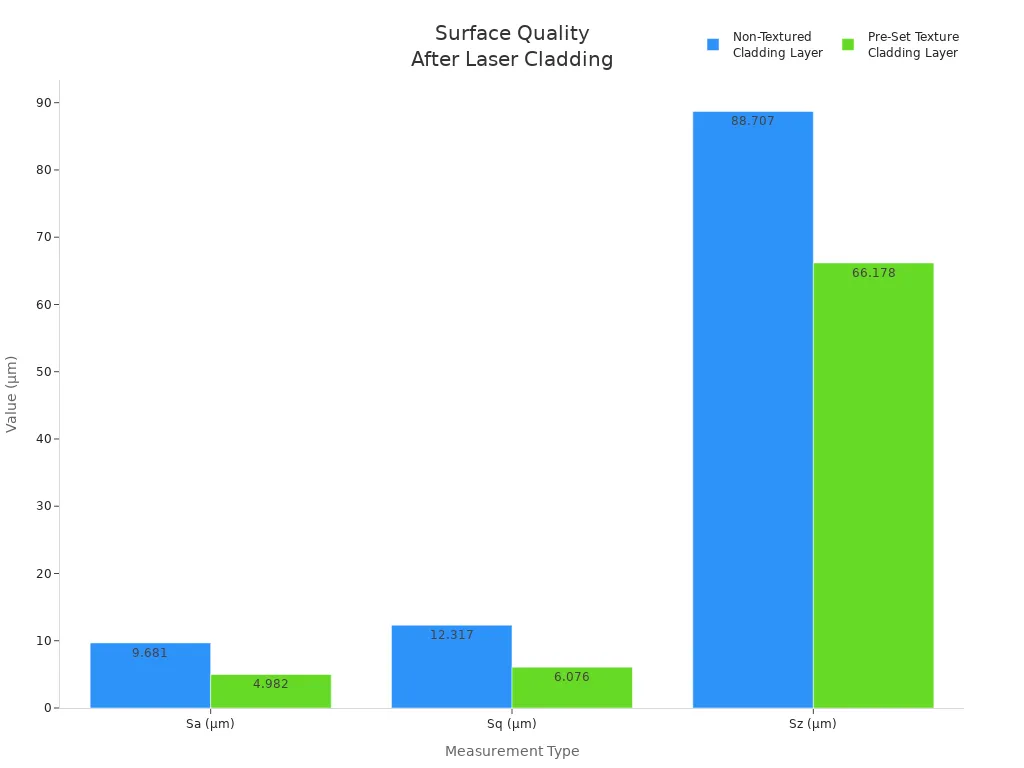
After laser cladding, you might use heat, machining, or finishing to get the look you want. These steps help you reach top standards for strength and rust protection. You can count on laser cladding to give you good results with little extra work.
Tip: When you use laser cladding, your parts last longer and you do not need to fix them as much.
Laser cladding applications in industry

Industrial applications
Laser cladding is used in many industries. It helps parts last longer and work better. The table below shows where laser cladding is used and what it does:
| Industry | Typical Applications |
|---|---|
| Aerospace | Fixing broken or worn-out parts, enhancing surface qualities, applying protective coatings |
| Automotive | Restoring or repairing worn-out engine parts like cylinder heads and camshafts |
| Medical | Manufacturing and repairing medical implants and prosthetics with biocompatible materials |
| Oil and Gas | Repairing and safeguarding drilling equipment, valves, and other machinery |
| Energy | Refurbishing and repairing turbine blades and boiler parts for high-stress conditions |
| Mold and Die | Modifying and repairing molds and dies to increase productivity and reduce rework |
You can use laser cladding to protect many parts. It works on engine parts, turbine blades, molds, and ship propellers. This technology gives strong coatings that last longer in hard places.
Aerospace & oil and gas
Laser cladding is very helpful in aerospace and oil and gas. In aerospace, it repairs turbine blades and engine parts. This keeps planes safe and working well. In oil and gas, it protects tools and valves from damage and chemicals. Laser cladding gives exact coatings and strong protection.
- In aerospace, you can fix cracks and worn spots on important parts.
- In oil and gas, you keep equipment working longer in tough places.
- You get better performance, less downtime, and more safety.
Note: Laser cladding helps you follow strict safety rules in these jobs.
Rapid manufacturing & repair
Laser cladding makes fixing and making parts faster and easier. You can quickly add new material to worn parts. This works for things like turbine blades or pistons. You can fix cracks and damage without buying a new part. Laser cladding also helps make special shapes and saves material.
- You can repair turbine blades with coatings that handle heat.
- You can make aircraft parts stronger, like wings and landing gear.
- You can build new parts with special shapes and coatings.
Most repairs take about 10 work days, but this can change if the part is big. Laser cladding helps you work faster and waste less.
Tip: Special coatings from laser cladding give better wear resistance, corrosion protection, and heat resistance. You can pick the coating that fits your needs.
Laser cladding vs. traditional methods
Lifespan comparison
You want your parts to last a long time. Laser cladding helps parts last longer than old methods. The coating from laser cladding sticks tightly to the part. This strong bond means you do not need to fix or replace parts as often. Old ways, like electroplating, wear out faster and need to be done again, especially in hard places. Laser cladding coatings fight off wear and rust much better, so your parts last longer.
Check out the table below to see how laser cladding does better than old methods:
| Metric | Value | Comparison to Conventional Methods |
|---|---|---|
| Interface Shear Strength | 423.9 MPa | 86% higher than single-layer coating (227.8 MPa) |
| Hardness Transition | 250 HV to 700 HV | Smooth transition from substrate to working layer |
| Volume Wear Rate | 9.88 × 10⁻⁵ mm³/N⋅m | 24.6% lower than substrate |
| Friction Coefficient | 0.30 to 0.32 | Stable performance across tests |
Laser cladding makes the surface harder and stronger. This means you do not have to spend as much time or money fixing parts.
Performance & cost
Laser cladding is very exact and works well. You get coatings that fit your needs, so you use less material and make less waste. Old methods use more material and can pollute more. Laser cladding does not use chemicals, so there is no bad air or dirty water.
Here are some reasons why laser cladding saves money:
- You waste less material and do not need to fix parts as much.
- It works best when you need less than 0.25 inches of new coating, so you save on work and supplies.
- You help the planet by making less pollution and waste.
Laser cladding lets you fix worn parts fast and with less work. The coatings are strong and last a long time. When you pick laser cladding, you work better and save money over time.
Tip: Laser cladding gives you great results with less waste, so it is a smart choice for many jobs.
You want your industrial parts to last longer and work better. Laser cladding puts on strong coatings that help parts last. These coatings make the surface better and cut down on repairs. Many experts pick laser cladding for good reasons:
| Reason for Preference | Description |
|---|---|
| Precise Control | You get the right coating thickness and a strong bond for great results. |
| Durable, Metallurgical Bonding | Your parts last longer even in hard places. |
| Cost-Efficient Repairs | You save money by fixing parts instead of buying new ones. |
| Low Environmental Impact | You make less waste and help the environment. |
- You have fewer breakdowns and less time when machines stop.
- Your equipment keeps working longer and needs fewer repairs.
- You work better and spend less money.
Laser cladding helps you get more use from your parts. Think about using this process for your next project.
FAQ
What materials can you use with laser cladding?
You can use many metals like steel, nickel, cobalt, and carbide powders. You choose the material based on your part’s needs. This helps you get the best results for different applications.
How thick is a typical laser cladding layer?
You usually get a layer between 1 and 2 millimeters thick. This thickness gives strong protection without changing the part’s size too much.
Can you repair damaged parts with laser cladding?
Yes, you can fix worn or broken parts. Laser cladding adds new material only where you need it. This saves you time and money.
Is laser cladding better than traditional coatings?
You get a stronger bond and longer-lasting surface with laser cladding. It also reduces waste and gives you more control over the coating.
Where do you see laser cladding used most?
You find laser cladding in aerospace, oil and gas, and automotive applications. It helps parts last longer in tough jobs.