
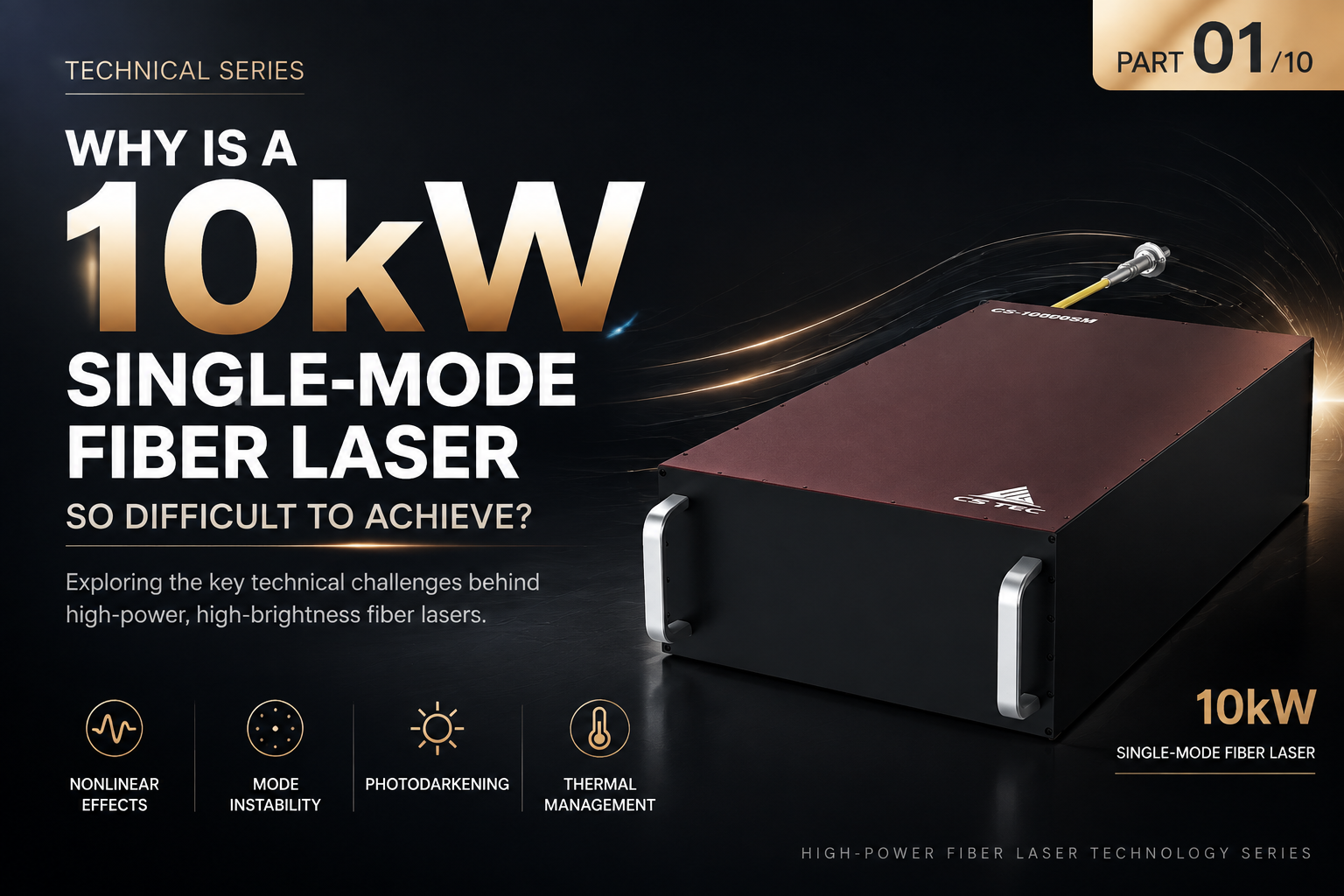
High-Power Fiber Laser Technology Series
PART 01/10
Challenges and Breakthroughs Behind 10kW Single-Mode Fiber Lasers
Introduction
The development of fiber laser technology has transformed modern manufacturing.
From metal cutting and welding to advanced material processing, fiber lasers have become one of the most important industrial laser technologies due to their high efficiency, excellent reliability, and flexible integration.
Over the past decades, fiber lasers have continuously achieved higher output power.
However, increasing power is not the only challenge.
The real challenge is achieving:
High Power + High Brightness + Excellent Beam Quality
A 10kW multimode fiber laser and a 10kW single-mode fiber laser represent completely different levels of technological difficulty.
1. The Difference Between Power and Brightness
In laser systems, output power is only one measurement.
For industrial applications, brightness is equally important.
Brightness determines:
- How tightly the laser can be focused
- How high the energy density can become
- How precisely materials can be processed
A multimode laser can achieve very high output power, but the beam contains multiple spatial modes.
A single-mode laser maintains the fundamental mode:
LP01 mode
which provides:
- Superior beam quality
- Smaller focused spot size
- Higher energy density
- Better processing precision
Therefore, the challenge is not simply:
“How to generate more power?”
The real question is:
“How to maintain excellent beam quality while increasing power?”
2. Why 10kW Single-Mode Output Is Difficult
When optical power increases inside a fiber, several physical limitations begin to appear.
The four major challenges are:
2.1 Nonlinear Effects
At extremely high optical intensity, the interaction between light and fiber material becomes nonlinear.
The main effects include:
Stimulated Brillouin Scattering (SBS)
SBS can reflect part of the laser energy back toward the source, reducing stability and limiting power scaling.
Stimulated Raman Scattering (SRS)
SRS transfers energy into unwanted wavelengths, reducing spectral purity and efficiency.
These nonlinear effects become increasingly significant as power density increases.
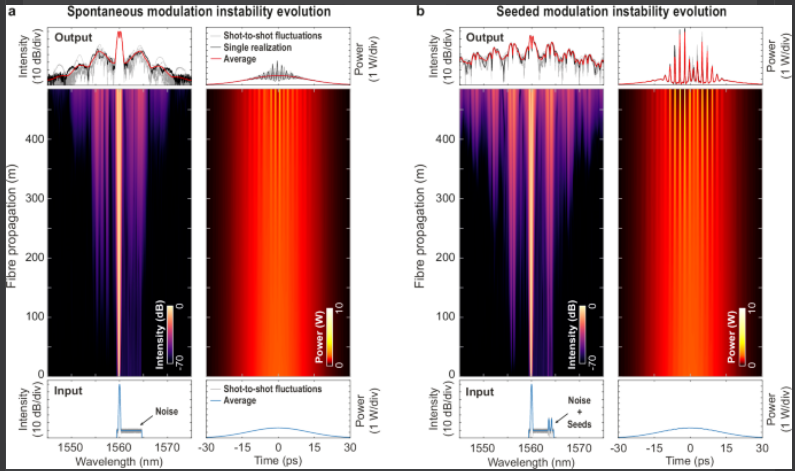
2.2 Mode Instability
Maintaining single-mode operation at high power is another major challenge.
As laser power increases:
- Heat accumulates inside the fiber
- Temperature distribution changes
- Refractive index changes
- Higher-order modes may appear
This phenomenon is known as:
Transverse Mode Instability (TMI)
TMI can cause:
- Beam quality degradation
- Output fluctuation
- Reduced brightness
2.3 Photodarkening
For ytterbium-doped fiber lasers, long-term high-power operation can introduce additional absorption centers inside the fiber.
This phenomenon is called:
Photodarkening
The results include:
- Increased optical loss
- Reduced efficiency
- Output power degradation
For industrial applications, long-term reliability is as important as peak power.
2.4 Thermal Management
At 10kW power levels, thermal effects become unavoidable.
Excessive heat can influence:
- Fiber performance
- Mode stability
- Optical efficiency
- System lifetime
Therefore, advanced cooling design and thermal control are essential for stable operation.
3. The Path Toward 10kW Single-Mode Fiber Lasers
Overcoming these challenges requires a system-level approach.
Key technologies include:
Cascaded Pumping Technology
Improving energy conversion efficiency and reducing nonlinear effects.
Mode Control Technology
Maintaining stable LP01 mode output.
Composite Gain Fiber
Improving power handling capability.
Advanced Thermal Management
Controlling temperature distribution and preventing thermal degradation.
Specialty Fiber Development
Creating optical fibers capable of supporting extreme power density.
4. Beyond Power: The Future of Fiber Lasers
The evolution of fiber lasers is moving from:
Higher Power
toward:
Higher Brightness
Future industrial laser systems will require:
- Higher beam quality
- Better stability
- Longer lifetime
- More precise processing capability
A 10kW single-mode fiber laser represents not only a power milestone.
It represents the integration of:
- Optical physics
- Fiber materials
- Thermal engineering
- Manufacturing technology
Conclusion
Achieving 10kW single-mode fiber laser output requires solving multiple fundamental challenges simultaneously.
The breakthrough is not based on a single technology.
It comes from continuous innovation across the entire laser system.
In the next article:
PART 02
Nonlinear Effects in High-Power Fiber Lasers: When Light Becomes Too Powerful
We will explore why SBS and SRS become critical limitations in high-power fiber laser development.
About CS Tec
CS Tec focuses on high-power fiber laser technology, including single-mode fiber lasers, high-brightness laser solutions, laser components, and industrial laser applications.
Our engineering team continues to explore advanced solutions for higher power, better beam quality, and improved reliability.