


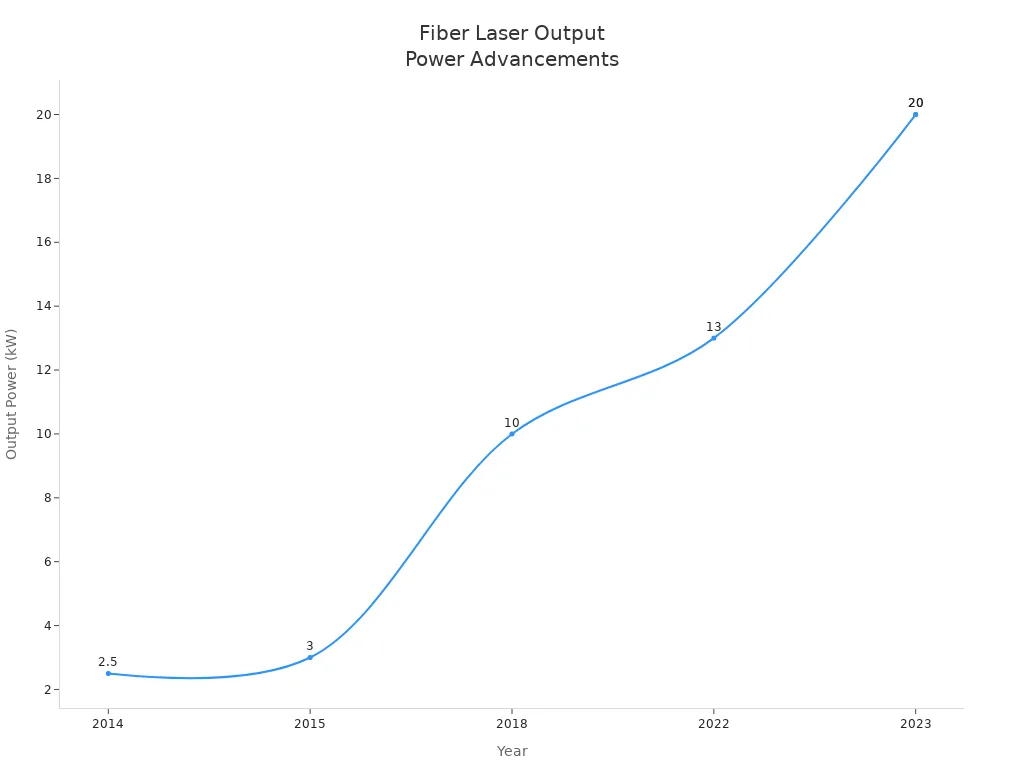
Fiber laser source advancements in 2026 have higher power. They also have better beam quality and smaller designs. AI helps make the process better. The table below shows how output power grew from 2.5 kW in 2014 to 20 kW in 2023. Beam quality also got better.
| Year | Output Power (kW) | Beam Quality (M² Factor) |
|---|---|---|
| 2023 | 20 | < 1.3 |
| 2014 | 2.5 | < 1.3 |
| 2015 | 3 | N/A |
| 2018 | 10 | N/A |
| 2022 | 13 | N/A |
| 2023 | 20 | N/A |
Ultra-compact high-power fiber laser models help the market grow.
- Market size could be USD 2.8 billion in 2026.
- Market might reach USD 5.5 billion by 2035.
- Growth rate is 7.8% CAGR.
These new laser sources work better and use less energy. Fiber laser technology can now work with more types of reflective materials. Laser technology keeps getting better and brings new ideas to many industries.
Key Takeaways
- Fiber laser sources in 2026 have more power and better beam quality. This helps them cut faster and more accurately.
- Small designs and modular systems make setup simple. You can change them easily, so fiber lasers fit in small spaces.
- AI-driven optimization makes lasers work better and use less material. It also helps keep the quality the same every time.
- Fiber lasers can now cut shiny materials like copper and brass. This makes them good for many different industries.
- Regular maintenance is very important for fiber lasers to last longer. It also keeps them working well and safe to use.
Fiber Laser Source Basics
What Is a Fiber Laser Source?
A fiber laser source makes a strong, focused light beam using a special optical fiber. This technology has a few main parts that work together to make the laser. The table below lists the important parts and what they do:
| Component | Description |
|---|---|
| Doped Optical Fiber | A glass fiber with rare earth ions that change how light moves through it. This fiber guides the laser light and helps remove heat. |
| Double-Clad Fiber | A fiber with two layers around the core. It lets more power enter while keeping the beam focused. |
| Mirrors/Optical Components | These parts form a cavity for the light to bounce back and forth. One mirror reflects all the light, while the other lets some light out as the laser beam. |
| Pumping Mechanism | Laser diodes send energy into the fiber. This energy excites the atoms inside, starting the process of making laser light. |
| Output Coupler | This part lets some of the laser light leave the fiber as a strong, focused beam. |
First, laser diodes put energy into the fiber. The atoms inside get excited and give off light. The light bounces back and forth and gets stronger. A special coupler lets some of the light out as a laser beam.
Importance in Modern Laser Technology
Fiber laser technology has changed how lasers are used in many jobs. These lasers make high beam quality, so the light stays focused far away. This helps keep dust and dirt away from the machine’s optics. Fiber lasers work well in hot or shaky places because the fiber keeps the light safe inside.
Many factories use fiber laser sources because they do not need much fixing. Workers do not have to repair them a lot. Fiber lasers cut metal faster than older lasers, like CO2 lasers, especially for thin metal sheets. They also use less energy and last longer. These things make fiber laser technology a great choice for cutting, welding, and marking materials in factories today.
Tip: Fiber lasers often cut thin metals two to three times faster than CO2 lasers, which saves time and energy.
2026 Fiber Laser Technology Advancements
Higher Power Output and Beam Quality
In 2026, fiber laser source technology is stronger and more exact. The 300W 976nm 135μm fiber-coupled diode laser is a big improvement. This model works well in factories and hospitals. It keeps the same wavelength, so the output stays steady. More power means fiber laser machines work faster and cut better. This helps companies save money and get more done.
Beam quality is better now. Experts check beam quality by looking at energy use, how steady it works, and how fast it cuts. These things show how good a fiber laser source is for careful jobs. The single mode continuous wave fiber laser area is growing fast because of these changes. Many businesses, like telecommunications and aerospace, use this technology for its accuracy and speed. Fiber-laser systems use optical fibers with rare-earth elements to make strong, steady beams. These systems use less energy and work better than old laser types.
Note: Better beam quality helps lasers cut or mark with more detail and less waste.
Compact and Modular Designs
Fiber laser technology in 2026 is smaller and easier to set up. These new designs give more power and better beams in tiny sizes. Digital controls and IoT let people watch and change settings right away. This means users can set up and change fiber laser machines fast, even in small spaces.
The market for small fiber lasers is changing quickly. Smaller parts make these lasers easy to move and use where space is tight. Customization is important now. Users can change laser systems to fit their needs, which helps with setup and use. High-power small fiber lasers are used in tough jobs where speed and accuracy are needed.
A modular design gives many benefits:
| Advantage | Description |
|---|---|
| Upgrade stepwise | Add-on modules and retrofits allow for gradual upgrades without full replacement. |
| Investment protection | Hardware longevity ensures that investments are safeguarded over time. |
| Plug-and-play expansion | Easy integration of new components for increased output or new tasks. |
Modern fiber laser machines can be changed to fit different jobs. Makers can pick add-ons like automatic tube loaders or dual exchange tables. This lets them change for different materials and job types.
AI-Driven Process Optimization
AI is making fiber laser source systems smarter in 2026. Artificial intelligence helps these systems be more exact and work better. Machine learning finds the best settings for new materials, so there is less guessing. Adaptive feedback lets the system change itself while marking or cutting, so results stay good.
AI brings clear benefits:
| Measurable Outcome | Description |
|---|---|
| Cutting Precision | Achieves up to 0.02mm accuracy through continuous monitoring. |
| Reduction in Waste | Reduces waste by up to 25% by adjusting laser parameters in real-time. |
| Unplanned Downtime Reduction | Enables proactive maintenance, reducing unplanned downtime significantly. |
AI also makes setup faster and keeps the quality the same. This means fiber laser machines can handle more products. Because of this, fiber laser source technology is very important in big factories.
Tip: AI helps fiber laser machines work smarter, not just harder.
Performance with Reflective Materials
Fiber laser technology in 2026 works well with shiny materials like copper and brass. High-power models use anti-reflection isolators to stop beam reflection. Beam stabilizers keep the beam steady and protect from shiny surfaces.
Makers use pulsed cutting to make the beam more stable and lower damage from reflections. This sends energy in short bursts, so the material cools between pulses. Anti-reflection features and better settings make cutting safer and faster.
Fiber laser sources now have more power in a small size. This means lower costs and better cutting for shiny materials. The shorter wavelength of fiber lasers (1.06μm) helps metals like copper and brass absorb the light better than CO2 lasers. This makes fiber laser machines the best choice for these materials.
| Material Type | Fiber Laser Performance | CO2 Laser Performance |
|---|---|---|
| Reflective Metals (Copper, Brass) | Superior | Challenging |
| Non-Metal Materials | Less Effective | Superior |
Callout: Fiber laser source advancements in 2026 let people cut shiny metals faster and safer than before.
Leading Fiber Laser Brands and Products
Top Manufacturers in 2026
Many companies are leaders in fiber laser technology in 2026. These brands are known for their skill and safety. They have teams that help customers and test products for many uses. Some of the most well-known brands are:
- Laserax
- Trumpf
- Coherent (II-VI Coherent)
- IPG Photonics
- Keyence
- Telesis Technologies
- Han’s Laser
- Lasit
- Amada Miyachi
These companies help factories use fiber laser machines for jobs like cutting and welding. They make sure their machines are safe and fit what factories need. Their teams answer questions fast and help test new materials. Many people pick these brands because they trust the quality and service.
Note: Top brands often have local teams, so fixing and upgrading is easier for customers.
New High-Power Fiber Laser Source Models
In 2026, new high-power fiber lasers have changed how companies work. The 2026 FIBERTEK™ MODEL D is one example. This machine has power from 1000W to 6000W. It can cut metal sheets that are 5 feet by 10 feet. The frame is made from strong steel tubes. The gantry uses special aluminum from airplanes. The table has blade knives for smooth cuts. The machine can cut up to 4000 inches each minute. It stays very accurate at ±0.001 inches for every cut and repeat.
| Specification | Details |
|---|---|
| Model | 2026 FIBERTEK™ MODEL D |
| Laser Power Range | 1000W – 6000W |
| Cut Dimensions | 5ft x 10ft |
| Frame | 1/2″ welded steel tube |
| Gantry | Aviation grade aluminum |
| Table Surface | Blade knife table |
| Cut Speed | Up to 4000 in/min |
| Cut Accuracy | ±0.001″ |
| Repeat Accuracy | ±0.001″ |
| Required Power | 1000W AC220V single phase @ 60A |
| 2000W-6000W AC 220V-600V three phase | |
| Warranty | Lifetime hardware, 2-year parts, 3-year laser source |
| Extras | On-site operation demonstrations |
New products like the UroFiber 150Q help the market grow. The fiber lasers market could go from $4.56 billion in 2025 to $5.15 billion in 2026. This happens because more factories use laser marking and new technology. High-power fiber lasers help companies work faster and with more accuracy. When brands compete, machines get better and users have more choices.
Callout: New high-power fiber laser models let companies cut faster, be more exact, and do stronger work.
Fiber Laser Cutting and Engraving Comparison
Cutting Performance in 2026
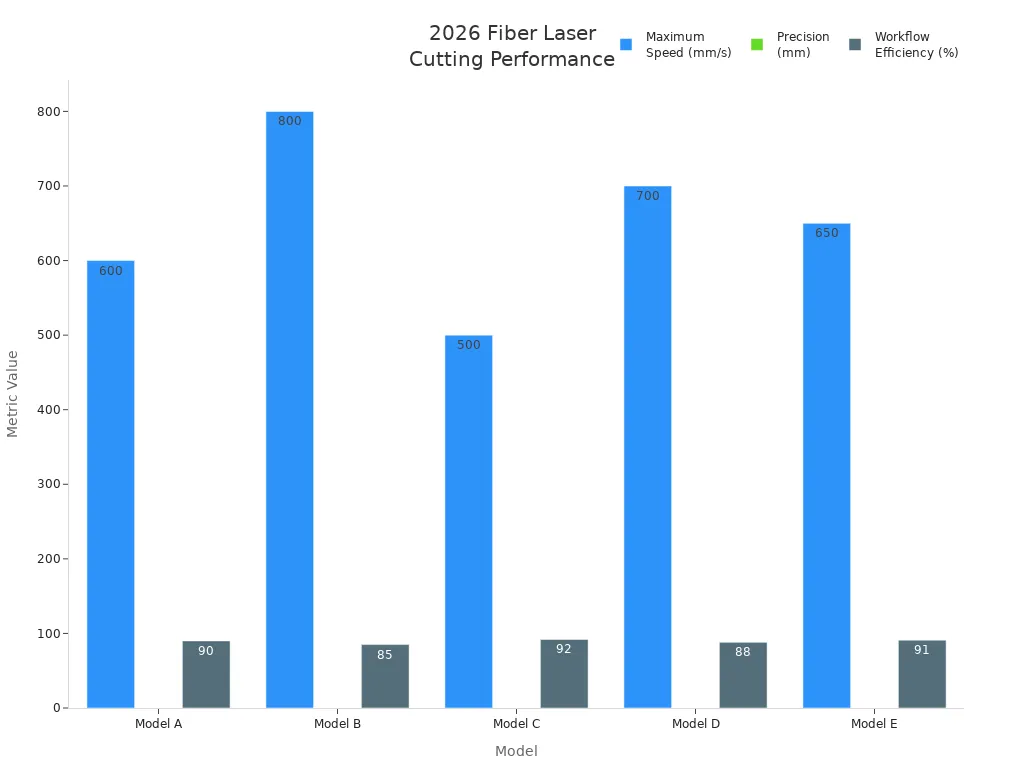
Fiber laser cutting in 2026 is fast and accurate. Many companies use these machines to cut metal and other things. The machines can go very fast and still make clean cuts. The table below shows how different models compare:
| Model | Maximum Speed (mm/s) | Precision (mm) | Laser Power (W) | Workflow Efficiency (%) |
|---|---|---|---|---|
| Model A | 600 | 0.05 | 150 | 90 |
| Model B | 800 | 0.03 | 100 | 85 |
| Model C | 500 | 0.07 | 200 | 92 |
| Model D | 700 | 0.04 | 120 | 88 |
| Model E | 650 | 0.05 | 250 | 91 |
Now, fiber laser cutting uses adaptive optics. These systems change the laser beam for thick or thin materials. They also work well if the room changes. High-power fiber lasers can cut thick things without slowing down or making mistakes. This is important for airplanes and hospitals. Many factories pick fiber laser cutting because it is very exact, costs less to run, and can work by itself. Laser technology now helps with digital factories and hard designs.
Tip: Fiber laser cutting lets companies finish work faster and waste less.
Engraving Quality and Applications
Fiber laser engraving in 2026 is more detailed and flexible than before. Fiber laser machines use new beam delivery systems. These systems keep the beam steady and need less fixing. New laser lenses help make tiny marks and let people use different wavelengths. High precision focusing makes small spots and uses autofocus. This means engravings are sharp and clear, even on tiny parts.
The Global Fiber Optics 2026 Market Report says fiber delivery systems are the top pick for factories. They work well and are good for automatic jobs. The Optical Society of America talks about new metamaterial optics. These optics focus the beam almost perfectly and shape it for special jobs. The Industrial Laser Review says real-time autofocus and dynamic focusing are now normal for lots of detailed engraving.
Fiber laser machines can engrave serial numbers, logos, and small patterns on many things. They are great for electronics, medical tools, and jewelry. People get the same results every time and can switch jobs fast.
Callout: Fiber laser engraving in 2026 lets factories mark products with high detail and speed.
Industry Applications of Fiber Laser Technology
Automotive and Aerospace Uses
Car and airplane companies use laser technology to work faster. They also use it to be more exact. In car factories, fiber lasers weld car parts together. This makes cars stronger and better. Airplane makers use fiber lasers to cut and join hard materials. These lasers help make planes lighter and safer.
Some main benefits are:
- Very exact cutting, welding, and marking
- Faster making of products
- Better quality for things made
- Can work with hard materials
Laser technology helps these companies follow tough safety rules. It also lets them use new materials that were hard to use before.
Electronics and Medical Devices
People who make electronics and medical tools use fiber lasers for small jobs. These lasers cut and mark tiny parts very well. The cuts are clean, so there is less cleaning or fixing. This helps companies save time and money.
| Advantage | Description |
|---|---|
| Enhanced Efficiency | Fiber lasers cut or mark fast and clean, so less extra work is needed. |
| Precision | The beam is always good, so mistakes and waste are less. |
| Cost-Effectiveness | They do not need much fixing, so making things costs less. |
Doctors and engineers trust fiber lasers to make safe tools and parts. The high accuracy means fewer mistakes and safer things.
Emerging Sectors
Many new fields are starting to use fiber lasers. Defense companies use strong lasers for new weapons and talking systems. Research teams work together to make better fiber lasers. Car and airplane companies use these lasers for strict rules. Phone companies use them to make talking systems better. Hospitals use fiber lasers for surgery and making tools.
| Sector | Applications |
|---|---|
| Defense | Strong laser fibers for new weapons and talking systems. |
| Research & Development | Teams work together to make fiber lasers better and more efficient. |
| Automotive | Very exact making of parts because of tough rules. |
| Aeronautics | New ways to make airplane parts. |
| Telecommunications | Better talking systems using fiber laser technology. |
| Medical | Used for surgeries and making medical tools. |
Note: More companies want fiber laser machines because they are faster, cleaner, and use less energy.
Maintenance Tips for New Fiber Laser Sources
Routine Care for 2026 Models
Taking care of fiber laser sources helps them last longer. Workers look at the optical parts every day. They clean the lens and mirrors with a soft cleaner. They use special tools or software to check if everything lines up right. Cooling systems need to be checked daily too. Workers watch the coolant level and make sure the temperature is okay.
Each week, workers put oil on moving parts. They use the right oil from the manual. They also check wires and tighten any that are loose. Once a month, teams look at nozzles and windows that protect the machine. If these parts are worn out, they change them. Every three months, workers check if the machine is still accurate. They test how strong the laser is and fix the settings.
Once a year, workers change the coolant and check big parts for problems. Teams look at their notes and see how well the machine works. Doing these things helps factories stop breakdowns and keeps the laser working well.
| Frequency | Maintenance Task | Procedure |
|---|---|---|
| Daily | Inspection of Optical Components | Clean the lens and mirrors using a non-abrasive solution. Check alignment with tools or software. |
| Daily | Cooling System Check | Inspect coolant levels and monitor temperature continuously during operation. |
| Weekly | Lubrication | Apply lubricants to moving parts as specified in the manual. |
| Weekly | Check and Tighten Connections | Inspect electrical connections and tighten any loose ones. |
| Monthly | Examine and Replace Consumables | Inspect nozzles and protective windows for wear and replace if necessary. |
| Quarterly | Calibrate the Machine | Perform a full calibration and test laser output power. |
| Annually | Replace Long-Term Consumables | Change coolant and inspect major components for wear. |
| Annually | Review and Update Maintenance Logs | Maintain detailed records of maintenance activities and evaluate performance over the year. |
Tip: Doing regular care makes fiber laser sources last longer and keeps people safe.
Troubleshooting and Optimization
Troubleshooting helps workers find and fix problems fast. If the laser beam gets weak, they look for dust or parts that are not lined up. If the cooling system is not working, the machine can get too hot. Teams check the coolant and add more if needed. If there are electric problems, workers look for loose wires and fix them.
Optimization makes the machine work better. After changing parts, workers check and adjust the machine. They use software to watch how the laser works and change settings. Keeping good notes helps workers see problems early. Fiber laser technology gets better when teams do these steps.
- Look for dirt or scratches on optical parts.
- Check the coolant and add more if needed.
- Tighten wires often.
- Calibrate after fixing or changing parts.
- Write down what you do for next time.
Callout: Fixing problems quickly and checking the machine often helps fiber laser sources work their best.
Future Trends in Laser Technology
Market Growth and Adoption
The market for laser technology is getting bigger every year. Many experts think fiber laser machines will be used even more in factories and shops. Companies believe the market will keep growing for many years. The table below shows what different groups think about the market:
| Source | Projected Growth Rate | Timeframe |
|---|---|---|
| SNS Insider | 12.2% CAGR | 2025 to 2035 |
| Market Research Future | USD 5 billion | By 2026 |
| 4.3% CAGR | 2026 to 2033 |
There are a few reasons why the market is growing:
- The market might go from USD 5.1 billion in 2026 to USD 15.1 billion by 2036.
- More companies use fiber laser machines because they help make things with more accuracy and use robots.
- These machines are popular because they save energy and cut fast.
- Factories want machines that are easy to use, do not break often, and do not need much fixing.
- Good design and steady work also help more people use them.
Note: More businesses pick laser technology because it saves time and makes products better.
Anticipated Innovations
Experts think there will be many new things for fiber laser machines soon. These new ideas will help people work faster and do better work. Some of the coolest changes are:
- Ultra-short pulse lasers that can cut and engrave very carefully without making things too hot.
- Green and UV wavelength lasers that work well with shiny metals and plastics.
- AI-driven process optimization that helps get better results and change settings right away.
- More power and better beams so factories can make things faster and waste less.
- Small and easy-to-carry lasers for tight spaces or moving around.
- Ultrafast lasers for tiny jobs and science labs.
Laser technology will keep getting better. New tools will help factories make things faster and with more detail. Fiber laser machines will be even more important for airplanes, hospitals, and electronics.
Callout: The future for fiber laser machines is exciting, with new tools and smart systems coming soon.
Fiber laser source technology in 2026 helps factories in many ways. Companies get better results, spend less money, and use these lasers in more places.
| Benefit | Description |
|---|---|
| Enhanced Performance | High-brightness sources and new cooling methods boost efficiency. |
| Reduced Operational Costs | Software-driven controls lower expenses for operation and maintenance. |
| Increased Adoption | Microelectronics, medical devices, and additive manufacturing use fiber lasers more often. |
New ideas make the beam better and help control heat. These lasers use less energy. Smaller designs and AI make them useful for more jobs.
- Safety is important because broken machines can cause accidents.
- Training helps workers stay safe and not make mistakes.
- Fixing and caring for lasers can cost up to 15% of the yearly budget.
Learning about new models with good safety, training, and support helps companies do better work and keep their machines working longer.
FAQ
What makes high-power fiber laser source technology important for industrial laser equipment?
High-power fiber laser source technology helps machines work faster and more exact. Factories use these lasers to cut and weld things. They finish jobs in less time and use less energy. High-power lasers help companies make strong things with less waste.
How does engraving improve with ultrafast lasers in industrial laser equipment?
Ultrafast lasers make engraving look sharper and more detailed. Industrial laser equipment uses these lasers to mark small parts. Ultrafast lasers make clear lines and patterns. Factories get the same results every time. Engraving is quicker and works better.
Why do factories choose high-power lasers for high-speed cutting and welding applications?
Factories pick high-power lasers because they cut and weld fast. Industrial laser equipment uses high-power lasers to cut thick things and weld strong joints. Workers finish jobs quickly and keep the quality high.
What are the main laser industry trends for ultrafast lasers and industrial laser equipment?
Laser industry trends show more factories use ultrafast lasers and industrial laser equipment. Ultrafast lasers help with engraving and cutting. Companies want machines that work fast and do not need much fixing. These trends lead to new designs and better work.
How do maintenance routines help industrial laser equipment with high-power lasers and ultrafast lasers?
Maintenance routines help machines work well for a long time. Workers clean parts and check settings often. High-power lasers and ultrafast lasers last longer with regular care. Factories stop breakdowns and keep cutting and engraving on time.
Tip: Doing regular care helps industrial laser equipment stay safe and work well.