


Beam parameter product, or BPP, measures how well a laser beam can be focused to a small spot. BPP matters more than power because it describes beam quality, which affects the precision of laser work. In industrial settings, a lower BPP leads to cleaner cuts and improved efficiency, while a higher BPP results in less precision. The table below shows how beam quality relates to processing accuracy:
| M² Value | Beam Quality | Processing Accuracy Impact |
|---|---|---|
| Low | High | Cleaner cuts, reduced kerf widths, improved efficiency |
| High | Poor | Less precision, larger spot sizes, lower energy density |
Understanding BPP helps users choose lasers that deliver better results for demanding applications.
Key Takeaways
- BPP measures laser focusability, crucial for precision tasks.
- Lower BPP leads to cleaner cuts and higher efficiency.
- Beam quality often matters more than power in laser applications.
- Check BPP and m² values for better laser performance.
- High beam quality saves energy and improves results.
Beam Parameter Product (BPP) Explained

What Is BPP?
The beam parameter product is a key measurement that describes how well a laser beam can be focused. It combines two important features: the radius of the beam at its narrowest point (called the waist) and the far-field divergence angle, which shows how much the beam spreads out as it travels. Mathematically, the beam parameter product is defined as:
This value helps users understand the focusability of a laser. A lower beam parameter product means the laser can be focused to a smaller spot, which is important for tasks that need high beam quality. In laser cutting or engraving, a small spot size leads to cleaner edges and more precise results.
How BPP Is Calculated
To calculate the beam parameter product, you need two measurements:
- The radius of the laser beam at its waist (the narrowest point)
- The half-angle of the beam’s divergence in the far field
The formula is:
BPP = w × θ
where w is the waist radius and θ is the far-field divergence angle. For an ideal Gaussian laser beam, the beam parameter product reaches its lowest possible value, which is determined by the wavelength of the light. This minimum is given by:
BPP_ideal = λ / π
Different types of laser beams have different BPP values. The table below shows how Gaussian and non-Gaussian beams compare:
| Beam Type | BPP Value | Characteristics |
|---|---|---|
| Gaussian | λ/π | Achieves theoretical minimum value |
| Non-Gaussian | Higher than λ/π | More divergence, larger waist, less focusability |
Manufacturers often list the beam parameter product in their datasheets, usually in units of mm·mrad. They measure this value at the rated power, following standards like ISO 11146. The BPP can also depend on the type of delivery fiber used in the laser system.
BPP and Beam Quality Factor
The beam quality factor, also known as the m² value, is closely related to the beam parameter product. The m² value is calculated by dividing the BPP by the minimum possible value for a given wavelength (λ/π). This gives a standard way to compare laser beam quality across different systems and wavelengths. An m² value of 1 means the beam is diffraction-limited and has the best possible focusability. Most real-world lasers have an m² value slightly above 1, but some high-power lasers can have much higher values.
A lower beam parameter product always means higher beam quality and better focusability. This leads to smaller spot sizes and higher energy density at the focus point, which is essential for applications that require precision. For example, fiber lasers often have a BPP around 0.344 mm·mrad, while CO2 lasers may have a BPP of about 3.38 mm·mrad. The lower BPP of fiber lasers allows them to achieve finer cuts and more detailed work.
Tip: When choosing a laser for tasks that need high beam quality, always check the beam parameter product and m² value, not just the power rating.
| Concept | Explanation |
|---|---|
| Beam Parameter Product (BPP) | A lower BPP indicates better focusability and smaller spot sizes, essential for high-quality laser applications. |
| Constant Relationship | The product of beam size and beam divergence is constant, affecting focusability and depth of field. |
| Minimum BPP | The minimum BPP for coherent light is determined by the wavelength, impacting the achievable focusability. |
BPP vs Wattage
Beam Quality vs Power Output
Many people believe that higher power always means better laser performance. This is not always true. The beam parameter product, or BPP, often has a greater effect on results than power alone. BPP describes how well a laser can focus its energy into the smallest spot size. Power tells you how much energy the laser produces, but it does not show how precisely that energy can be delivered.
A laser with high beam quality can focus its energy more tightly. This means it can cut, weld, or engrave with more detail. For example, in fiber lasers, a low BPP allows for faster and cleaner cuts, even at lower power levels. In contrast, a high-power laser with poor beam quality may produce rough edges and waste energy.
Note: The far-field divergence angle is a key part of BPP. It shows how much the beam spreads out as it travels. A smaller angle means the beam stays tighter and more focused.
Why BPP Matters for Applications
BPP is often the deciding factor in many advanced applications. The ability to focus energy into a small, precise spot is critical in fields that require accuracy and efficiency. Here are some scenarios where high beam quality and BPP matter more than power:
- In microelectronics, uniform energy distribution is essential for making semiconductors and for laser-based imaging.
- In medical technology, shaping the beam improves safety and targeting, such as in eye surgeries like photocoagulation for retinal repair.
- In advanced manufacturing, a well-shaped beam increases precision in welding and 3D printing. This helps keep materials strong and reduces waste.
In industrial settings, fiber lasers are a good example. These lasers focus on achieving a low BPP rather than just increasing power. Tools like Amada/JDSU fiber laser cutters use high beam quality to deliver fast, reliable, and efficient cutting. The technology behind these lasers aims to keep the BPP low, which leads to better performance and easier system design.
A low BPP also improves energy efficiency. Advanced fiber laser systems can use up to 70% less energy than older CO2 lasers. Smart power management and closed-loop cooling systems can further reduce energy and water use. This makes high beam quality not only important for results but also for saving resources.
BPP in Different Laser Types
Different types of lasers have different BPP values and beam quality factors. These differences affect how each laser performs in real-world tasks.
- Fiber lasers can reach high beam quality with M2 values as low as 1.1. This means they can focus energy very efficiently.
- CO2 lasers usually have larger spot sizes. This can be useful for processing wide areas but may reduce detail.
- Diode lasers have BPP values that change based on their design. This affects how well they can focus and what jobs they can do.
High-power fiber laser modules can reach 2 kW with a typical BPP of 0.9 mm-mrad. By combining modules, power can increase to 4 kW or even 6 kW, while still keeping a low BPP. This balance is important for fast, high-quality cutting.
Traditional laser systems often work at 40-60% efficiency. Newer systems with high beam quality can improve this. Features like waste heat recovery and smart cooling can make laser manufacturing even more efficient.
Tip: When choosing a laser, look at both the beam quality factor and BPP. Do not focus only on power. The right combination will give you better results and save energy.
| Laser Type | Typical BPP (mm·mrad) | Beam Quality Factor (M2) | Application Strengths |
|---|---|---|---|
| Fiber Laser | 0.9 | 1.1 | Fine cutting, high efficiency |
| CO2 Laser | 3.0+ | 1.5+ | Wide-area processing |
| Diode Laser | Varies | Varies | Flexible, depends on design |
Choosing Lasers by Beam Quality Factor
BPP for Precision Applications
Selecting the right laser for precision work means looking beyond just power. The beam parameter product, or BPP, and the beam quality factor are more important for tasks that require accuracy. A lower BPP allows the laser to focus its energy into a smaller spot, which is essential in micromachining and fine cutting. This leads to a smaller minimum spot size, making the process more efficient at different depths. A high beam quality ensures that the laser delivers a consistent beam profile, which is critical for uniform results.
The M² parameter measures how close a laser beam is to an ideal Gaussian shape. When M² equals 1.0, the beam is perfect. BPP is calculated as BPP = (λ/π)×M². This means that the beam quality directly affects the BPP. Expanding the beam does not improve its quality; it only makes any flaws more visible.
When choosing optics, the type of beam expander also matters. The table below compares two common types:
| Beam Expander Type | Advantages | Disadvantages |
|---|---|---|
| Keplerian | – Creates internal focus for spatial filtering – Ideal for high-quality beam applications | – Risk of plasma damage in high-power systems |
| Galilean | – Compact design – No internal focus, reducing breakdown risk | – Higher alignment sensitivity – Cannot accommodate spatial filtering |
Tip: Always check the BPP and beam quality factor before considering power for precision applications.
Evaluating Laser Performance
BPP is a key metric for evaluating overall laser performance, especially in industrial environments. It shows how closely a laser beam matches an ideal Gaussian beam. This is important for applications that need high accuracy and repeatability. A lower BPP means the laser can focus better and use energy more efficiently.
Laser wavelength also influences BPP and beam quality factor. Shorter wavelengths usually result in a smaller beam waist and lower divergence, which improves beam quality. The divergence angle increases with wavelength, so lasers with longer wavelengths may have higher BPP values.
The chart below compares M² and PiB ranges for different laser types:
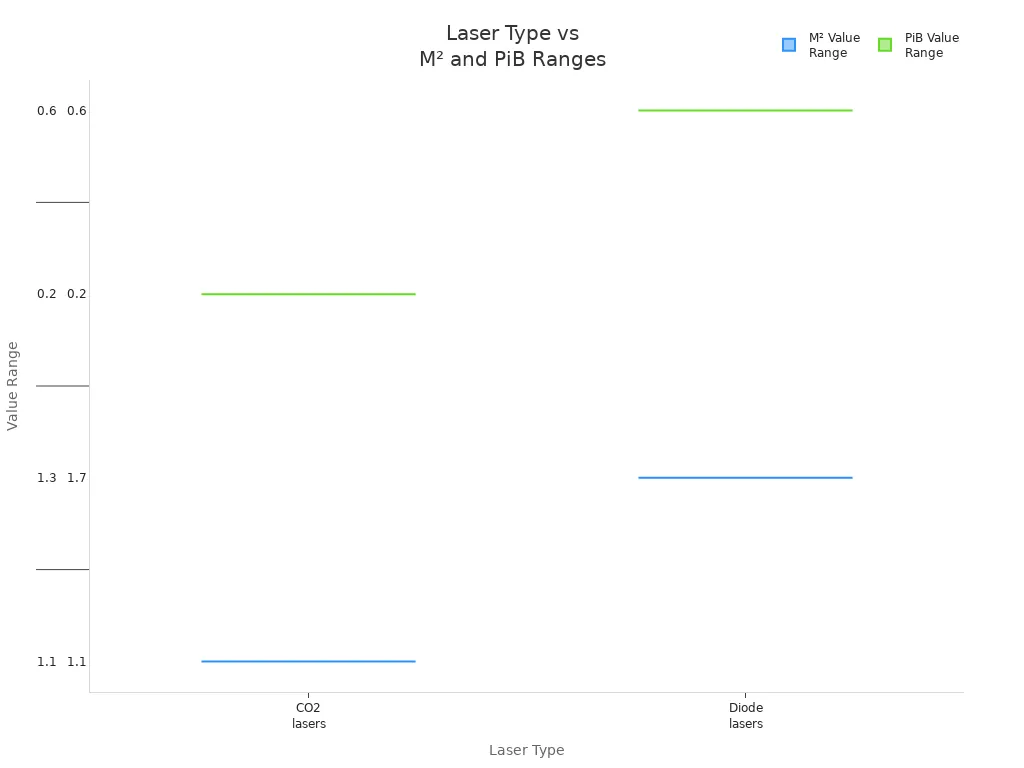
| Laser Type | M² Value Range | PiB Value Range |
|---|---|---|
| CO2 lasers | 1.1 – 1.3 | 0.2 – 0.6 |
| Diode lasers | 1.1 – 1.7 | 0.2 – 0.6 |
| High-energy | 3 – 4 | 0.2 – 0.6 |
Beam profilers help measure the beam radius and spatial structure, ensuring the laser maintains a consistent beam profile. This is vital for reliable and repeatable results in manufacturing.
Remember: High beam quality and a low BPP are more valuable than just increasing power. These factors lead to better focus, higher efficiency, and improved results.
Understanding BPP and the beam quality factor is essential for making smart choices in laser applications. Many buyers believe higher power always means better results, but this is not true. Common mistakes include choosing power for the biggest job instead of typical needs and thinking more power guarantees better marks. A lower BPP leads to better focus, smoother cuts, and less waste. The table below shows how BPP also improves safety and efficiency:
| Benefit Description | Why It Matters |
|---|---|
| BPP measures beam quality | Optimizes laser use for safety and efficiency |
| High-quality beams need better protection | Ensures safe operation in intense zones |
Consider beam quality metrics, not just power, when selecting a laser for the best long-term results.
FAQ
What does a low BPP mean for my laser?
A low BPP means your laser can focus to a smaller spot. This gives you cleaner cuts, higher precision, and better energy use. It is important for detailed work.
Is higher wattage always better than a lower BPP?
No. Higher wattage gives more power, but a lower BPP gives better focus and accuracy. For many jobs, beam quality matters more than raw power.
How do I find the BPP of a laser?
Check the laser’s datasheet or manual. Manufacturers usually list BPP in units like mm·mrad. If not, ask the supplier or use a beam profiler to measure it.
Does BPP affect laser safety?
Yes. A lower BPP creates a smaller, more intense spot. This can increase the risk of burns or eye injury. Always use proper safety gear and follow safety rules.