
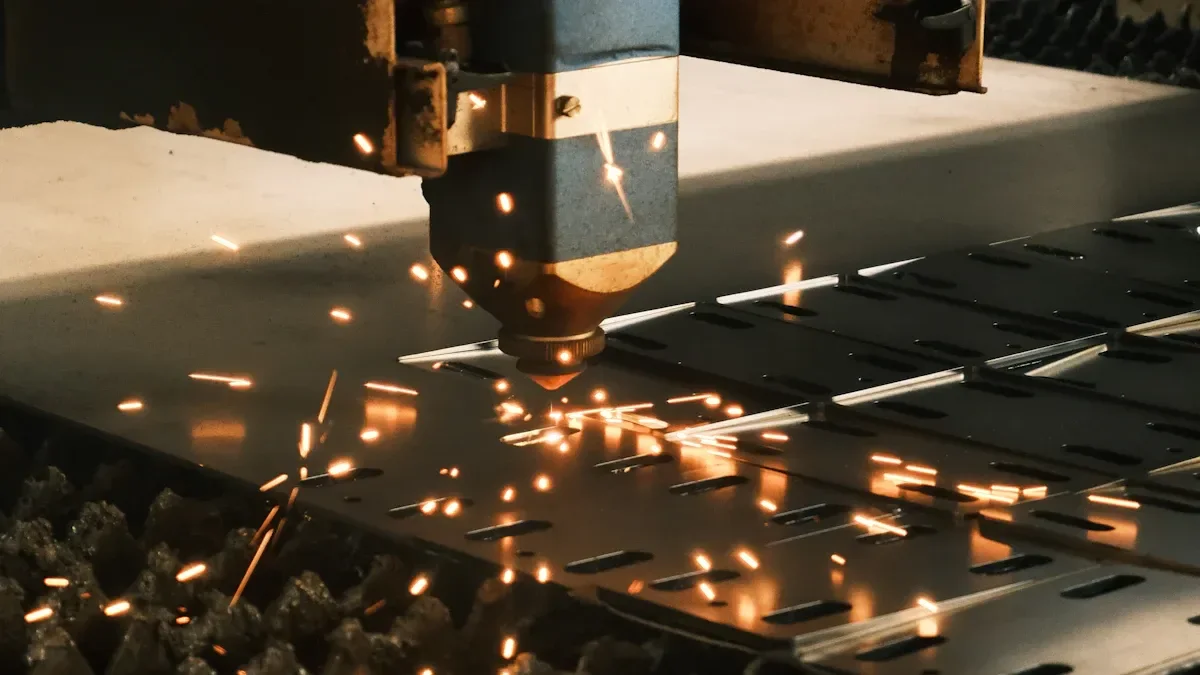
You get many benefits from fiber laser source technology. It gives you high efficiency. It also gives you precise results. You can trust its performance. When you look at fiber lasers and CO2 lasers, you notice some differences. Fiber lasers cost less to run. They also need less maintenance. The table below shows how fiber lasers save you money in five years.
| Metric | Fiber Laser (4kW) | CO2 Laser (4kW) | Notes |
|---|---|---|---|
| Initial Purchase Price | $150,000 | $120,000 | CO2 is often cheaper at first. |
| Electricity Cost | $25,000 | $85,000 | Fiber lasers use less energy. |
| Chiller Power Cost | $5,000 | $15,000 | Fiber lasers need less cooling. |
| Maintenance & Service | $5,000 | $30,000 | CO2 lasers break down more often. |
| Estimated 5-Year TCO | $195,000 | $260,000 | Fiber lasers save you more money over time. |
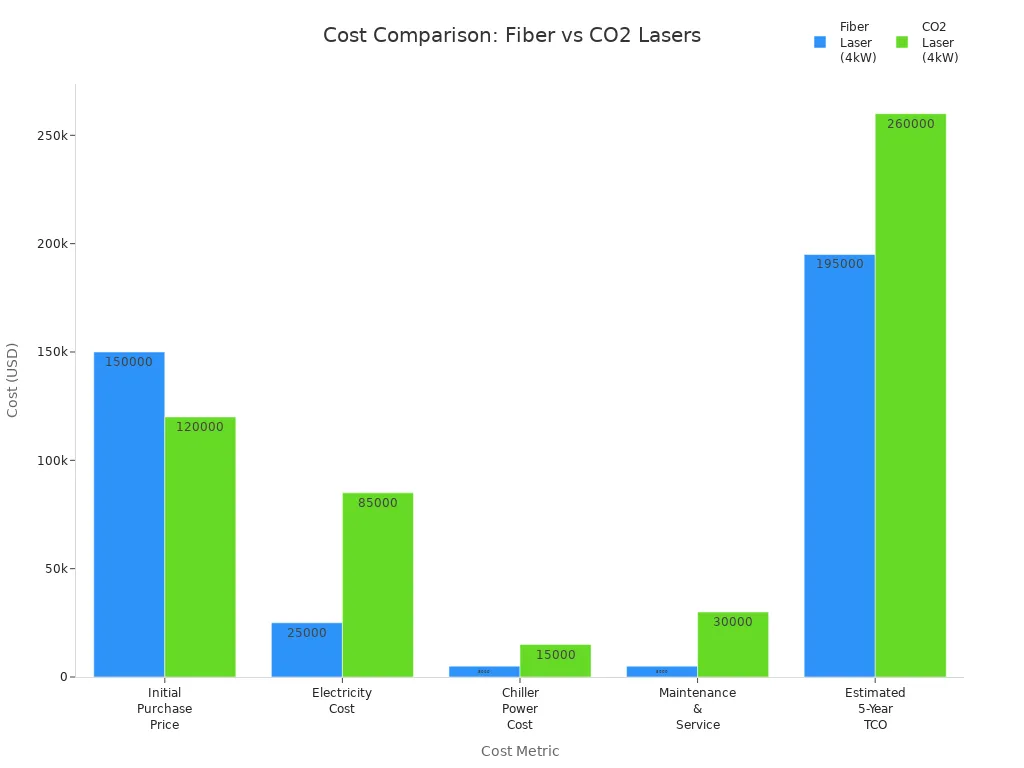
You use fiber lasers for cutting. You also use them for welding. They help with marking and drilling too. These jobs need accuracy. They also need consistency. Fiber lasers give you both.
Key Takeaways
- Fiber laser sources use electricity very well. They can turn up to 42% of electricity into laser light. This helps save energy and lowers costs.
- They are very precise. They can be accurate within +/- 2.5 µm. This makes them great for cutting and engraving.
- Fiber lasers do not need much care. They cost less to run than CO2 lasers. CO2 lasers need more checks and repairs.
- These lasers last a long time. They can work for over 100,000 hours. This means they break down less and help people get more work done.
- Fiber laser sources can do many things. They are used for cutting, welding, marking, and medical jobs. This makes them useful in many kinds of work.
Benefits of Fiber Laser Sources
Efficiency and Power
Fiber laser sources give you many good things for your projects. They are very efficient and have strong power. This makes them stand out in factories and other places.
- Fiber laser sources turn up to 42% of electricity into laser light.
- CO2 lasers only turn 10-20% of electricity into laser light.
- YLS-ECO fiber laser sources can reach over 50% energy efficiency, which is much better than other types.
Some main benefits are:
- They change electricity to laser light with little waste.
- The beam is very good for doing careful work.
- The small size means less fixing and more trust.
Double-clad fiber amplifiers help fiber laser sources use high-power diode lasers. This design moves the light well and keeps the beam strong. You get more power for your jobs and save energy too. High efficiency means you spend less money and help the planet.
Precision and Beam Quality
You need to be exact for jobs like cutting, drilling, and marking. Fiber laser sources give you great accuracy and beam quality. You can get as close as +/- 2.5 µm in tiny jobs. This helps you make medical tools, ceramic chips, solar cells, and fuel nozzles.
Here is a table that compares beam quality (M2 value):
| Laser Type | M2 Value |
|---|---|
| Fiber Laser | < 1.1 |
| CO2 Laser | > 1.5 |
| Nd:YAG | > 1.5 |
A fiber laser source gives you a cleaner and more focused beam. This helps you make fine cuts and tiny marks. The design is steady and has no moving parts, so it works better and breaks less.
Durability and Reliability
You want your machines to last a long time. Fiber laser sources last longer and work well. Most fiber laser sources can last up to 100,000 hours. CO2 lasers last only 2,000 to 10,000 hours. The solid-state design means fewer problems and less fixing.
- Fiber laser sources can work for over 100,000 hours before breaking.
- CO2 lasers work for about 8,000 hours before breaking.
- Solid-state YAG lasers work for about 12,000 hours before breaking.
| Metric | CO₂ Laser | Solid‑State YAG | Fiber Laser Source |
|---|---|---|---|
| Mean Time Between Failures | 8,000 h | 12,000 h | >100,000 h |
You get fewer stops and more work done. No moving parts means less wear and longer life. You do not need to change parts often, so you save time and money.
Low Maintenance and Operating Costs
You save money with a fiber laser source because it needs little care. The strong, closed design keeps it working well. You do not need to check mirrors, fix it often, or worry about gas.
- Fiber laser sources need almost no care.
- CO2 lasers need regular checks and gas tests.
- Nd:YAG lasers need a lot of care.
| Laser Type | Maintenance Requirements | Cost Implications |
|---|---|---|
| Fiber Laser | Needs little care because of strong, solid design | Lower running costs |
| CO2 Laser | Needs mirror checks, fixing, and gas tests often | At least $20,000/year for a 1000W system |
| Nd:YAG Laser | Needs a lot of care | Highest costs |
Fiber laser sources cost the least to run. They use only 20-30% of the energy that CO2 lasers use. You spend about half as much on running costs compared to CO2 lasers. You also use fewer parts and have less downtime.
Tip: If you pick a fiber laser source, you get high efficiency, strong power, and good performance. You also save money on care and running costs. These things make fiber laser sources a smart choice for many businesses.
Applications of Fiber Laser Sources
Fiber laser sources help you do many jobs better. You use them in factories, hospitals, electronics, and for sending data. They have great beam quality. They are very accurate. They work the same way every time. This makes them useful for many things.
Fiber Laser Cutting
Fiber laser cutting shapes metal, plastic, and other stuff fast. It works well for thin and thick pieces. You get smooth edges and good cuts. This method uses less energy than old ways. You save money and help the planet.
Here are some ways you use fiber laser cutting:
- You cut metal sheets for cars and machines.
- You make tiny parts for electronics.
- You cut thick steel for buildings.
Fiber laser cutting is faster than CO2 lasers. You also get smoother edges. New fiber lasers like Corona keep edges nice and reduce rough spots, even on thick pieces.
| Parameter | Description | Impact on Performance |
|---|---|---|
| Laser Power | How much energy the laser makes. | Decides how thick you can cut and how fast. |
| Cutting Speed | How quickly the laser moves. | Changes how deep it cuts and how wide the cut is. |
| Focus Position | Where the laser points on the material. | Changes the spot size and power strength. |
| Assist Gas | Gas helps clear melted stuff and changes the cut. | Different gases change cut speed and quality. |
| Nozzle | Sends gas to the cutting spot. | Helps keep the gas steady and makes cuts more exact. |
Tip: You can use fiber laser cutting for small parts or big sheets. You get fast cuts, good beams, and lower costs.
Welding and Drilling
Fiber laser sources help you join and shape things with care. You use them to weld metals like stainless steel, aluminum, copper, and titanium. You also drill tiny holes in electronics, medical tools, and airplane parts.
| Material | Applications and Advantages |
|---|---|
| Stainless Steel | Does not rust, good for cars, planes, and medical tools. |
| Carbon Steel | Strong welds, used in building and making things, bends less. |
| Aluminum | Light and strong, used in planes and cars, needs special settings. |
| Copper | Good for wires, needs careful power because it reflects light. |
| Brass | Used for machines and decorations, good for small details. |
| Titanium | Very strong and light, used in planes and medical tools, needs careful heat. |
| Nickel Alloys | Handles heat and rust, used in planes and chemical places. |
| Tool Steel | Makes strong welds for tools, keeps them hard and tough. |
| Precious Metals | Makes clean joints for jewelry and electronics, keeps value. |
| Dissimilar Metals | Joins different metals, needs careful settings for good welds. |
You get strong welds and less heat damage. Fiber laser welding makes deep welds with less bending. You can drill tiny shapes with good quality every time.
| Advantage | Description |
|---|---|
| Minimal Heat-Affected Zone | Makes less heat than arc welding, so things bend less. |
| Deep Penetration Welding | Makes strong, deep welds, even in thick pieces using special ways. |
Note: You use fiber laser sources for drilling and welding in cars, planes, electronics, and jewelry. You get good quality and accuracy each time.
Marking, Engraving, and Etching
You use fiber laser sources to mark, engrave, and etch metal, plastic, and ceramic. These jobs help you add numbers, logos, and codes to things. Fiber laser marking is quick, clean, and lasts a long time. You get sharp marks that stay.
Fiber laser marking is used in many places:
| Industry | Application Description |
|---|---|
| Automotive | Marks parts for tracking (VIN, part numbers, logos). |
| Aerospace | Marks parts with numbers and important info. |
| Electronics | Marks boards and devices with numbers and logos. |
| Medical Devices | Marks tools and implants with codes for tracking. |
| Military | Marks weapons and gear for rules and inventory. |
You can mark tiny details with great care. The marks do not rub off and last a long time. Fiber laser engraving and etching are faster and better than old ways.
- You mark things quickly with sharp details.
- You engrave small designs on jewelry and electronics.
- You etch codes and logos for tracking and rules.
Tip: Fiber laser marking, engraving, and etching give you strong, fast, and high-quality results for many jobs.
Medical and Scientific Uses
Fiber laser sources help doctors and scientists. You use them for surgery, removing tumors, and treating kidney stones. You also use them to study materials and take pictures in labs.
| Procedure | Laser Type | Outcomes |
|---|---|---|
| Ureteroscopic Lithotripsy | Superpulse Thulium Fiber Laser (SP TFL) | Safer surgery, fewer problems, better results |
| Ureteroscopic Lithotripsy | Holmium Laser (HO:YAG) | Usual results for checking |
| Bladder Tumor Resection | Thulium Fiber Laser (TFL) | Better safety, no bleeding, higher success rates |
| Bladder Tumor Resection | Traditional TURBT | Usual results for checking |
You use fiber laser sources for studying chemicals, looking at cells, and checking the environment. These jobs need careful work and good beams.
- You get great accuracy and good beams for medical and science jobs.
- You test samples with little damage and good results.
Telecommunications
Fiber laser sources are important for sending data today. You use them in fiber optic networks. They have great beams and handle heat well. You can use high power without losing signal.
- Erbium-Doped Fiber Amplifiers (EDFAs) help send data at 1550 nm with low loss.
- Ytterbium-Doped Fiber Amplifiers (YDFAs) give strong power for factories and telecom.
- Raman Fiber Amplifiers (RFAs) give wide gain and flexible wavelengths.
Fiber laser sources help you send data fast and far. You get low-loss signals over long distances. Special modules use fiber lasers to change electric signals to light signals. This keeps signals strong and data fast.
Note: You need fiber laser sources for good, fast, and safe data in telecom and internet.
You can see fiber laser sources help with many jobs in making things, health, electronics, and sending data. Their great beams, high accuracy, and steady work make them a top pick for good results everywhere.
Fiber Laser Source Innovation
Advanced Manufacturing
Fiber laser sources are changing how factories work. These lasers give strong power and work well for a long time. You can make more things with fewer mistakes. You can cut shiny metals like copper and aluminum fast. The software is easy to use, so you do not need much training. Machines can run by themselves all night. This means you make more products each year. It also helps you do better in world markets.
Here is a table that shows new fiber laser source ideas:
| Innovation Type | Description |
|---|---|
| Improved Marking Speeds | You can mark things faster, which helps when making lots of products. |
| Enhanced Precision and Quality | You get better and finer marks, which is good for small details. |
| Expanded Material Compatibility | You can mark more kinds of materials, so you have more choices. |
| Integration with Industry 4.0 | You can connect machines to smart systems for better checks and work. |
You save money because fiber lasers use less energy and fewer parts. Small companies can grow by using CNC systems that keep quality high. Fiber lasers help the planet because they do not use bad gases and need less power.
Wide Wavelength Tuning
Fiber laser sources let you pick from many wavelengths. Different doping agents like erbium, thulium, and ytterbium help you choose the best one for your job. This makes fiber lasers useful in many areas, like medicine and sending data. New fiber lasers can make many wavelengths at once or even shorter ones than before. This makes them even more helpful.
Sometimes, tuning is hard because you cannot always get every wavelength. New ideas like fiber optical parametric oscillators and soliton self-frequency shift help you get more choices. These ways let you use fiber lasers for more jobs and keep them working well.
Future Trends
Fiber laser sources will keep getting better. New laser ideas will make them work even better. AI will help you do your work faster and easier. You will see more green ways to make things. Better fiber design and pulse control will save money and make lasers last longer.
Governments want more new laser systems, especially in Asia-Pacific, Europe, and North America. You will see more systems that let you change the beam for different metals and save money. Fiber lasers will help with big jobs and new ways to use different wavelengths. The market will grow because people want more speed and better results.
Tip: You can trust fiber laser sources for strong power, good work, and many uses. These things will help you do well in factories and other jobs.
You notice fiber laser sources are changing many industries. They work with high efficiency and strong power. People use them for metal cutting, fiber laser welding, and engraving. Many factories now use these lasers for automated jobs. This helps things go faster and makes products better.
- Efficiency rates are higher than 80%. This means fiber lasers work better than old systems.
- Factories use fiber lasers 35% more than before.
- The global market may reach $13.08 billion by 2034. This is because cars, electronics, and planes need fiber lasers.
You will see more new ideas and uses for fiber lasers soon.
FAQ
What materials can you cut with a fiber laser source?
You can cut metals like steel, aluminum, copper, and brass. You can also cut plastics and some ceramics. Fiber lasers work best on reflective metals. You get clean edges and fast results.
How long does a fiber laser source last?
Most fiber laser sources last over 100,000 hours. You do not need to replace parts often. You save time and money because the design is solid and reliable.
Do you need special training to use a fiber laser source?
You do not need much training. Most machines have easy software. You can learn basic controls quickly. Many systems have safety features to help you work safely.
Can you use fiber lasers for marking and engraving?
Yes, you can mark and engrave metals, plastics, and ceramics. You get sharp, permanent marks. Fiber lasers work fast and give you high-quality results.
What makes fiber laser sources better than CO2 lasers?
Fiber lasers use less energy and need less care.
You get better beam quality and longer life.
You spend less money on running costs.
Fiber lasers work well for cutting, welding, and marking.