
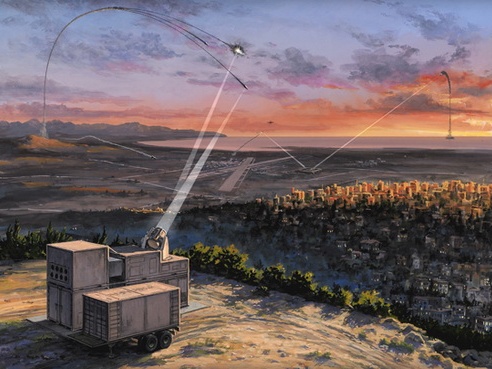
In recent years, with the rapid development of unmanned aerial vehicle (UAV) technology, its application in military reconnaissance, logistics transportation, aerial photography and other fields has become increasingly widespread. However, the abuse of drones has also brought about security risks, such as illegal reconnaissance, terrorist attacks, and airport interference. To address this challenge, the Laser Defense System (LDS), with its advantages of high precision, rapid response and low cost, has become one of the key technologies in the field of Counter-Unmanned Aerial vehicle (C-UAS).
As a manufacturer of high-power lasers, we are committed to providing efficient and reliable laser anti-laser solutions to help customers deal with low-altitude security threats. This article will provide a detailed introduction to the working principle, core advantages and typical application scenarios of the laser defense system.
1. How does a laser defense system work?
The laser defense system is a Directed Energy Weapon (DEW) that precisely strikes target unmanned aerial vehicles (UAVs) through high-energy laser beams. It is mainly divided into three stages: detection, tracking, and strike.
(1) Target detection
The system first uses radar, photoelectric sensors or radio detection equipment to detect unmanned aerial vehicles and identify their flight trajectories, speeds and threat levels.
(2) Laser aiming and tracking
Through a high-precision servo control system, the laser emitter locks onto the target and adjusts the beam direction in real time to ensure that the laser continuously illuminates key parts of the unmanned aerial vehicle (such as rotors, fuselage or photoelectric equipment).
(3) High-energy laser strike
The laser beam is focused on the target, generating a high-temperature ablation effect in a short period of time, which damages the structure or electronic system of the unmanned aerial vehicle, causing it to lose control or crash directly.
2. The core advantages of the laser defense system
Compared with traditional air defense means (such as missiles or jamming guns), laser anti-missile systems have the following advantages:
High-precision strike: The laser beam travels in a straight line, unaffected by wind speed, and can precisely destroy the target, avoiding accidental injury.
Fast response: Light-speed strike with almost no delay, suitable for high-speed moving drone targets.
Low-cost operations: The cost of a single launch of laser weapons is extremely low, consuming only electricity, which is much lower than that of missiles or artillery shells.
No ammunition limit: As long as the power supply is sufficient, it can operate continuously and is suitable for dealing with swarm drone attacks.
Silent operation: Laser emission is noise-free and highly concealed, making it suitable for defense in sensitive areas.
3. Typical application scenarios
Laser defense systems are widely applied in both military and civilian fields:
Military defense
Frontline base protection: Intercept enemy reconnaissance drones or suicide drones.
Critical facility protection: Safeguarding key targets such as nuclear power plants and command centers.
(2) Civil security
Airport no-fly zone: Preventing drones from interfering with civil aviation take-offs and landings (such as the Gatwick Airport incident in the UK in 2018).
Security for large-scale events: Preventing potential threats during the Olympic Games and international summits.
Border patrol: Drones used to combat smuggling and illegal border crossing.
(3) Maritime defense
Warship anti-drone: Dealing with unmanned reconnaissance aircraft or attack unmanned vessels at sea.
4. Future development trends
With the increase in laser power and the decrease in cost, laser defense systems will be further popularized:
Higher power: Increase strike range and damage capability to deal with larger drones.
AI intelligent recognition: By integrating artificial intelligence, it achieves automatic target classification and the optimal strike strategy.
Modular design: It is convenient to integrate into existing air defense systems, such as vehicle-mounted, shipborne or fixed deployment.