
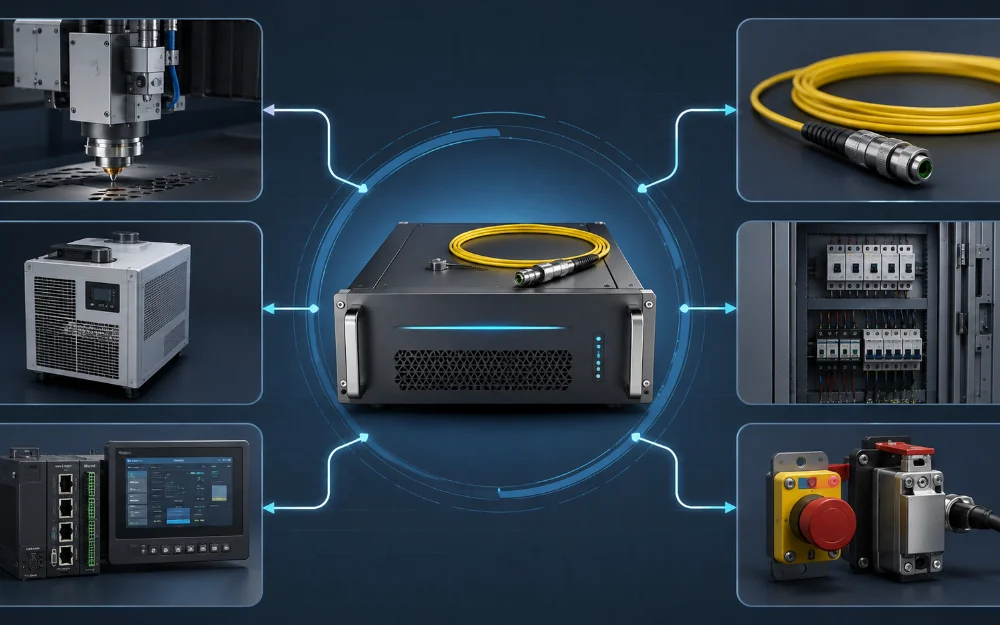
A replacement fiber laser source is compatible only when its optical output, beam delivery, control system, cooling requirements, electrical supply, mechanical interfaces, and safety behavior fit the existing machine. Matching the original source by rated power or connector name alone is not enough.
The safest way to evaluate a replacement is to compare three things side by side: the old laser source, the proposed replacement, and the limits of the existing machine. The result should then be classified as a direct replacement, a replacement requiring process retuning, a replacement requiring peripheral upgrades, or an incompatible configuration that needs further engineering review.
How Do You Know the Fiber Laser Source Actually Needs Replacing?
No emission, low cutting power, unstable processing, or repeated alarms do not automatically prove that the laser source itself has failed. The machine should be diagnosed before a replacement is ordered.
Several faults outside the source can produce similar symptoms:
- Contaminated or damaged protective optics
- A damaged processing head or output connector
- Incorrect focus position
- Loss of coolant flow or a chiller interlock
- An open external safety interlock
- Incorrect laser-enable or emission signals
- A damaged control cable
- Incorrect analog power command
- Delivery-fiber damage
- Electrical supply problems
Before removing the original source, record its operating state and all active alarms. If possible, also verify whether the machine controller is sending the expected enable, emission, reset, and power commands.
What Information Should You Record Before Removing the Old Source?
Document the existing installation while it is still intact. The model name and rated power rarely contain enough information to select a replacement.
Record:
- Manufacturer, model, and serial number
- Rated output power and operating mode
- Wavelength
- BPP or M²
- Delivery-fiber core diameter
- Output connector type
- Delivery-fiber length
- Minimum bending requirements, if available
- Input voltage, phase, and connected load
- Cooling capacity, flow, pressure, and temperature requirements
- Control connector and complete pinout
- Analog power-command range
- Communication protocol
- Firmware and source-control software
- External dimensions and weight
- Mounting points and service clearances
Photograph the electrical connectors, control wiring, coolant hoses, fiber route, mounting arrangement, and processing-head connection. These records are especially useful when the original source is discontinued or the replacement comes from another manufacturer.
Can You Replace a Fiber Laser Source With a Different Brand?
Yes, in some machines, but cross-brand replacement should be treated as an integration project rather than a plug-and-play swap. Each optical, thermal, electrical, control, mechanical, and safety interface must be checked independently.
The replacement does not necessarily need the same manufacturer or exact model. What matters is whether the new source can satisfy the process requirement while remaining compatible with the rest of the machine.
This means a Raycus, MAX, IPG, JPT, Coherent, or another industrial source cannot be approved simply because it carries the same nominal kilowatt rating. A replacement assessment should compare the complete configuration.
Buyers evaluating fiber laser source replacement options should therefore provide the original source specification together with the processing-head, chiller, controller, and machine information.
Does the Replacement Need the Same Output Power?
The new source must meet the required process performance, but identical nominal power does not guarantee compatibility. Conversely, increasing power may force changes elsewhere in the machine.
Can a Higher-Power Fiber Laser Replace a Lower-Power Source?
Potentially, but every downstream subsystem must be checked for the higher optical, thermal, and electrical load. A power upgrade should never be treated as a source-only modification.
For example, the current Coherent EDGE fiber laser specifications show that increasing source power within one industrial product family is accompanied by changes in cooling capacity, water flow, connected electrical load, weight, and in some cases beam-delivery configuration.
Before increasing source power, verify:
- Maximum optical-power rating of the cutting or welding head
- Collimator and focusing-lens ratings
- Protective-window capacity
- Output-connector rating
- Chiller capacity and coolant flow
- Main breaker and electrical distribution
- Control-system power scaling
- Machine enclosure and safety assumptions
Can a Lower-Power Source Replace the Original Source?
It may integrate successfully but still fail the original production requirement. Compatibility includes process capability as well as electrical and mechanical operation.
A lower-power replacement may reduce maximum cutting thickness, piercing capability, welding penetration, process speed, or production throughput. The required material range and cycle time should therefore be validated before approving the substitution.
Do BPP and Fiber Core Diameter Need to Match?
BPP and delivery-fiber core diameter are critical optical compatibility parameters. Changing them changes the beam delivered to the processing optics and can alter the focused spot, energy density, and usable process window.
The Coherent fiber beam-delivery primer defines BPP from beam size and divergence and explains that the BPP of a fiber-delivered beam is related to fiber-core radius and output divergence. It also shows why coupling optics and optical magnification must be considered when transferring the beam into downstream optics.
What Happens If the Replacement Uses a Different Fiber Core Diameter?
A different core diameter may change BPP, power density, focused spot size, and focal tolerance. It can therefore require different process parameters or a different optical configuration.
For example, replacing a 100 μm configuration with a 50 μm configuration should not automatically be regarded as an upgrade. The smaller-core beam may provide higher brightness, but the existing processing head and parameter set may have been developed around the original beam characteristics.
Check:
- Old and new core diameter
- Old and new BPP
- Collimator focal length
- Focusing focal length
- Head manufacturer’s permitted source configuration
- Expected focused spot
- Maximum optical loading
What Happens If the Replacement Has a Different BPP?
A different BPP means the beam will not propagate and focus exactly like the original one. A lower BPP generally allows tighter focusing, while a higher BPP generally produces a less focusable beam under equivalent optical conditions.
The practical consequence is that cutting speed, focus position, piercing settings, gas pressure, weld geometry, or other process parameters may need to be revalidated even when source power is unchanged.
Is Better Beam Quality Always an Upgrade?
No. Beam quality should match the process and optical system rather than simply be minimized.
A tighter spot can increase intensity, but it may also shift the process away from the conditions used to develop the existing machine. Cutting, welding, cladding, and other applications can require different energy distributions and focal tolerances.
Is the Output Connector Really Compatible?
The connector name is only the first compatibility check. Mechanical fit does not prove that the optical, thermal, and safety interfaces are equivalent.
Is QBH-to-QBH Automatically Compatible?
No. Two sources can use the same connector family while having different core diameters, beam characteristics, power levels, cooling arrangements, or head requirements.
Connector compatibility should include:
- Exact connector type and version
- Mechanical interface
- Fiber-core diameter
- BPP or output divergence
- Maximum optical power
- Cooling requirements
- Presence or safety interlocks
- Processing-head approval
High-power beam-delivery connectors may also incorporate dedicated thermal-management features. Coherent’s fiber-delivery documentation, for example, describes internally water-cooled implementations of QBH and QD fiber systems, illustrating why the connector should be treated as part of the complete optical and thermal interface rather than only a mechanical plug.
Can You Use an Adapter Between Different Connector Types?
An adapter may solve a mechanical mismatch but does not automatically solve optical or thermal incompatibility. Any adapter must be validated for the actual power, beam parameters, cooling arrangement, processing head, and safety-interlock system.
Do not install an adapter solely because the two components can be physically connected.
Does the Existing Cutting or Welding Head Support the Replacement Source?
The processing head must support the replacement source’s power, beam delivery, connector, and optical characteristics. This should be confirmed before the new source is installed.
Check:
- Maximum head power rating
- Approved connector type
- Permitted fiber-core diameter
- Permitted BPP or beam-delivery range
- Collimator configuration
- Focusing optics
- Protective-window specification
- Head cooling requirements
- Back-reflection considerations for the intended materials
When the replacement differs optically from the original source, obtain confirmation from the processing-head supplier rather than assuming the existing optical train can use the new beam.
Will the Machine Need New Cutting or Welding Parameters?
Often, yes. A source swap can change more than the maximum available power.
Revalidate parameters when the replacement changes:
- BPP
- Fiber core diameter
- Maximum power
- Power-control response
- Modulation behavior
- Processing-head optics
Depending on the process, this may require new focus positions, power percentages, cutting speeds, piercing stages, gas pressures, welding speeds, or other application settings.
Does the Delivery Fiber Need to Match?
The replacement fiber must fit the existing machine route without tension, excessive bending, twisting, or interference with moving axes. Fiber length and routing are therefore part of compatibility.
Compare:
- Total fiber length
- Fiber exit direction from the source
- Static minimum bend radius
- Dynamic bend radius where applicable
- Available service loop
- Cable-carrier dimensions
- Movement of the gantry or processing head
- Connector access
A shorter fiber may make the replacement impossible to route. A much longer fiber should not simply be wound into a tight coil inside the cabinet; the excess must still comply with the fiber manufacturer’s routing and bending requirements.
What Should You Compare Between the Old and Replacement Fiber Laser Sources?
Use a side-by-side matrix and assign each item a clear engineering decision. Unknown values should be marked as unresolved rather than assumed to match.
| Compatibility item | Old source | Replacement source | Existing machine limit | Decision |
|---|---|---|---|---|
| Rated power | Record value | Record value | Process and head rating | Match / Retune / Upgrade |
| Operating mode | CW/QCW/etc. | Record value | Process/controller requirement | Match / Reject |
| Wavelength | Record value | Record value | Optical-system range | Match / Validate |
| BPP or M² | Record value | Record value | Processing-head design | Match / Retune / Validate |
| Fiber core | Record value | Record value | Head/collimator requirement | Match / Upgrade |
| Output connector | Record type | Record type | Processing-head interface | Match / Engineer / Reject |
| Fiber length | Record value | Record value | Machine routing | Match / Modify |
| Cooling capacity | Record value | Required value | Existing chiller | Match / Upgrade |
| Coolant flow | Record value | Required value | Existing cooling circuit | Match / Upgrade |
| AC input | Record value | Required value | Facility supply | Match / Upgrade |
| Connected load | Record value | Required value | Breaker and cable capacity | Match / Upgrade |
| Control connector | Record type | Record type | Machine controller | Match / Rewire |
| Pinout and logic | Record | Record | Existing PLC/CNC | Match / Remap |
| Communication protocol | Record | Record | Controller support | Match / Software change |
| Interlock behavior | Record | Record | Machine safety system | Match / Revalidate |
| Dimensions and weight | Record | Record | Machine cabinet | Match / Modify |
Can the Existing Chiller Support the Replacement Source?
Cooling compatibility depends on capacity, flow, pressure, coolant temperature, water quality, and circuit design. Chiller model or nominal cooling capacity alone is not enough.
The Coherent EDGE specifications provide a useful example: required cooling capacity and laser-loop flow increase substantially as output power rises. This illustrates why a source power upgrade should trigger a new chiller calculation rather than an assumption that the old cooling system is sufficient.
Compare:
- Required cooling capacity
- Minimum coolant flow
- Maximum and minimum pressure
- Coolant-temperature range
- Temperature stability
- Source and head cooling circuits
- Hose and fitting dimensions
- Cooling-water specification
- Chiller alarm interface
Can You Keep the Existing Cooling Water?
Only if the replacement source permits the same coolant chemistry and the existing water is still within specification. Different source manufacturers or generations can specify different conductivity, pH, additives, filtration, or maintenance requirements.
If compatibility is uncertain, drain and prepare the cooling system according to the new source manufacturer’s procedure rather than circulating the existing coolant through the replacement unit.
Does the Replacement Source Match the Existing Electrical System?
The source must match the available voltage, phase, frequency, current capacity, protective devices, cables, and grounding arrangement. Similar optical power does not guarantee identical electrical requirements.
IEC 60204-1 covers electrical, electronic, and programmable electronic equipment of machines beginning at the point where the supply connects to the machine equipment. Replacing a source with different electrical requirements therefore needs to be evaluated as part of the machine’s electrical system.
Compare:
- Nominal AC voltage
- Permitted voltage range
- Single-phase or three-phase input
- Supply frequency
- Maximum current
- Connected load
- Inrush requirements
- Main breaker and branch protection
- Cable size
- Protective earth and bonding
Does a Higher-Power Source Require a New Electrical Cabinet?
Not necessarily, but the existing cabinet must be checked. A higher-load source can exceed the rating of the original breaker, contactor, cable, transformer, distribution bus, or facility connection even when there is enough physical space for the new unit.
Is the Control Connector and Pinout Compatible?
Identical connector shapes do not guarantee identical electrical behavior. A pin-by-pin comparison should be completed before the replacement source is energized.
Which Signals Should Be Compared?
At minimum, compare:
- Laser ready
- Laser enable
- Emission command
- External interlock
- Power command
- Warning output
- Alarm output
- Fault reset
- Modulation command
- Signal common and ground
For every signal, identify the pin number, voltage, polarity, active-high or active-low logic, timing, and default state.
Can the Existing DB25 Cable Be Reused?
Only after the pinout and electrical logic have been verified on both sources. A DB25 connector identifies the physical connector format; it does not establish that every pin performs the same function.
| Signal | Old source | Replacement source | Machine expectation | Action |
|---|---|---|---|---|
| Laser ready | Pin / logic | Pin / logic | PLC input | Match / Remap |
| Laser enable | Pin / logic | Pin / logic | PLC output | Match / Remap |
| Emission command | Pin / logic | Pin / logic | CNC/PLC output | Match / Remap |
| Power command | Voltage / protocol | Voltage / protocol | CNC output | Match / Scale |
| Alarm | Pin / logic | Pin / logic | PLC input | Match / Remap |
| Reset | Pin / logic | Pin / logic | PLC output | Match / Modify |
| External interlock | Circuit behavior | Circuit behavior | Machine safety logic | Match / Revalidate |
Is the Communication Protocol Compatible?
A replacement source can respond correctly to hardwired enable signals while still losing diagnostics, alarms, remote monitoring, or configuration functions if its digital communication differs from the original.
Check whether the machine uses:
- RS-232
- RS-485
- CAN
- Ethernet
- EtherCAT
- Modbus
- A manufacturer-specific protocol
The Coherent EDGE family, for example, separately specifies 24 V digital signals, a 0–10 V power-control signal, and an EtherCAT fieldbus interface. These are different integration layers and should be compared separately during a replacement.
Also verify:
- Protocol version
- Alarm-code mapping
- Status registers
- Communication timeout
- Source-control software
- Firmware compatibility
- CNC or PLC support
Will the Existing CNC or PLC Recognize the New Source?
Do not assume so. Compatibility depends on how the original machine manufacturer integrated the source.
Some systems use mostly hardwired I/O, while others depend heavily on digital communication, proprietary source-control software, or PLC logic. A cross-brand replacement may therefore require controller configuration or software changes even when the laser can be enabled electrically.
Will the Replacement Source Physically Fit the Machine?
Mechanical compatibility includes dimensions, weight, mounting, connection positions, ventilation, and service access. External size alone is not sufficient.
Verify:
- Length, width, and height
- Mounting-hole positions
- Weight and structural support
- Fiber exit direction
- Coolant port location
- Electrical-connection location
- Airflow and ventilation clearance
- Filter access
- Service-panel access
- Required lifting method
Current industrial source specifications demonstrate that higher-power versions can become substantially heavier or larger even when they belong to the same product family. Mechanical layout should therefore be checked against the exact replacement model.
Can the Replacement Change the Machine’s Safety Validation?
Yes. A change in emission logic, interlocks, reset behavior, fault response, communication behavior, or available optical power can require the machine’s safety functions to be reviewed.
ISO 13849-1:2023 addresses the design and integration of safety-related parts of machine control systems. If the replacement changes the behavior of signals involved in a safety function, the integrator should not assume that the previous validation remains unaffected.
Which Safety Functions Should Be Retested?
Depending on the machine risk assessment, revalidation may include:
- Emergency stop
- Guard-door interlocks
- Laser-emission inhibition
- Processing-head or fiber interlocks
- Chiller fault response
- Controller communication loss
- Source alarm behavior
- Fault reset
- Prevention of unexpected emission after reset
Does a Different Source Change the Machine’s Laser Classification?
Not automatically, but the completed laser product should be reviewed when source power, wavelength, accessible emission, enclosure assumptions, service modes, or safety architecture change.
IEC 60825-1 covers classification and requirements for laser products. The replacement source is only one component of the machine; the completed system remains subject to machine-level evaluation.
What Must Be Tested Before the Replacement Source Enters Production?
Commissioning should proceed in stages. The machine should not move directly from physical installation to full-power production.
What Should Be Checked Before First Laser Emission?
Before emission, verify:
- Correct AC supply and protective earth
- Chiller flow and coolant temperature
- Correct fiber routing and bend radius
- Connector cleanliness and correct installation
- Processing-head compatibility
- Control wiring and pinout
- Communication with the controller
- External interlocks
- Alarm-free source status
What Should Be Checked at Low Power?
Low-power commissioning should verify that commands and optical output behave as expected before the machine is exposed to full process power.
Confirm:
- Laser enable and emission control
- Power-command scaling
- Stop response
- Alarm and reset operation
- Basic focusing and optical behavior
- Initial process response on a controlled test piece
What Should Be Revalidated at Full Production Power?
Full-power validation should confirm that the complete machine can operate at the intended production load without exceeding optical, thermal, or electrical limits.
Check:
- Required process speed and quality
- Piercing or welding performance
- Long-duration source stability
- Chiller temperature and flow
- Processing-head thermal condition
- Protective optics
- Machine alarms
- Repeatability across representative materials
How Should You Classify the Replacement Decision?
A replacement should receive an engineering decision rather than a simple yes/no label. The following four categories make the required work clear before the source is ordered.
| Comparison result | Decision |
|---|---|
| Optical, electrical, cooling, control, mechanical, and safety interfaces match | Direct replacement candidate |
| Hardware interfaces remain compatible but beam or process behavior changes within machine limits | Compatible after configuration and process retuning |
| Chiller, processing head, electrical system, controller, or mounting requires modification | Replacement possible with peripheral upgrades |
| Optical interface, safety behavior, or machine limits cannot be validated | Do not install until compatibility is resolved |
What Information Should You Send for a Replacement Quote?
A supplier should receive enough information to compare the proposed source with the existing machine. Sending only “I need a 3 kW replacement” leaves critical compatibility questions unanswered.
Include:
- Machine manufacturer and model
- Machine serial number
- Existing laser source brand and model
- Photograph of the old source nameplate
- Rated power and operating mode
- BPP or M²
- Fiber core diameter
- Connector type
- Delivery-fiber length
- Processing-head brand and model
- Chiller brand and model
- Existing cooling capacity and flow
- AC supply voltage and phase
- CNC and PLC information
- Control connector and pinout
- Communication protocol
- Existing source software or firmware
- Available installation space
- Reason for replacement
- Whether a power upgrade is planned
When comparing available CW fiber laser source configurations, providing these details allows the proposed source to be evaluated against the complete machine rather than only against the old model’s wattage.
What Is the Fastest Fiber Laser Source Compatibility Check?
A quick screening should cover optical, thermal, electrical, control, mechanical, and safety compatibility. Any unknown item should remain unresolved until documentation or testing confirms it.
- Was source failure confirmed?
- Is the operating mode compatible?
- Does output power meet the process requirement?
- Is the existing processing head rated for the new source?
- Are BPP and fiber core compatible with the optical system?
- Is the output connector fully compatible?
- Is the delivery fiber long enough?
- Can the existing chiller meet the required load and flow?
- Does cooling-water chemistry remain compatible?
- Does AC voltage and phase match?
- Are breaker and cable ratings sufficient?
- Has the complete control pinout been compared?
- Does analog power scaling match?
- Is the communication protocol supported?
- Will the new source fit and remain serviceable?
- Have safety interlocks and reset behavior been reviewed?
- Will process parameters be revalidated?
- Is staged commissioning planned?
Frequently Asked Questions About Replacing a Fiber Laser Source
Can I Replace a Raycus Fiber Laser Source With MAX, IPG, JPT, or Another Brand?
Potentially, but cross-brand substitution should be treated as an integration project. Power, BPP, fiber core, connector, cooling, electrical supply, I/O, communication, dimensions, and safety behavior must all be checked.
Does a Replacement Fiber Laser Source Need the Same Fiber Core Diameter?
Not necessarily, but changing the fiber core changes the delivered beam and may affect the processing head and process parameters. The new source-head combination should be validated before production.
Can I Install a Higher-Power Laser Source Without Replacing the Chiller?
Only if the existing chiller meets the replacement source’s required cooling capacity, flow, pressure, temperature, and coolant specifications. Higher optical power often increases both thermal and electrical demand.
Is the Same QBH Connector Enough to Confirm Compatibility?
No. The connector family is only one part of the interface; fiber core, BPP, power rating, cooling, interlocks, and processing-head compatibility must also be confirmed.