Introduction
With the continuous development of industrial laser manufacturing, manufacturers are looking for laser sources that offer higher efficiency, lower operating costs, and better process flexibility.
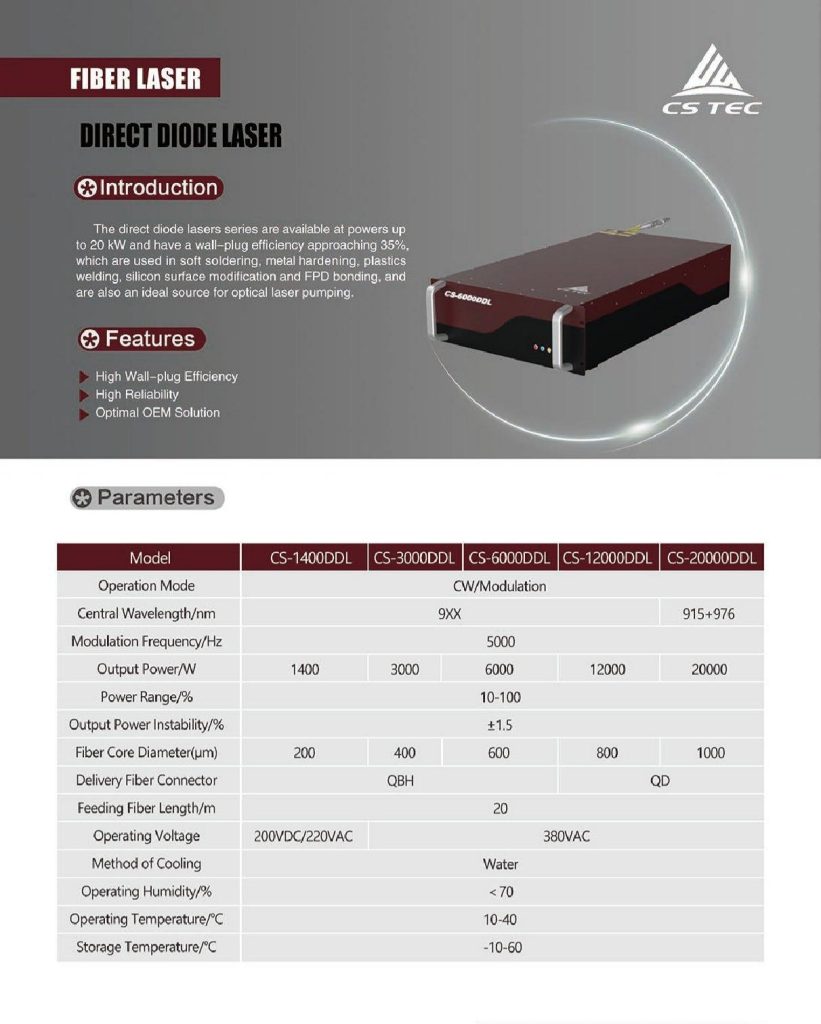
A Direct Diode Laser (DDL), also known as a high-power semiconductor laser or direct semiconductor laser, has become an important solution for industrial applications requiring high-power laser energy delivery.
Unlike fiber lasers or solid-state lasers that use semiconductor lasers as pump sources, direct diode lasers use semiconductor laser chips as the primary laser source, directly converting electrical energy into laser output.
Thanks to their high electro-optical efficiency, compact design, long lifetime, and excellent thermal performance, kilowatt-class direct diode lasers are widely used in:
- Laser cladding
- Surface treatment
- Laser hardening
- Brazing
- Welding
- Polymer processing
- Fiber laser pumping
Wuhan CS Tec provides customized high-power diode laser solutions from semiconductor laser modules to industrial laser systems for global applications.
1. What Is a Direct Diode Laser?
A direct diode laser is a laser system based on semiconductor laser technology.
The basic working process is:
Electrical Energy → Semiconductor Laser Diodes → Optical Combining → Fiber Coupling → Laser Output
A typical high-power diode laser system consists of:
1. Laser Diode Source
Multiple semiconductor laser emitters or diode bars generate laser light, commonly in the wavelength range of:
- 808 nm
- 915 nm
- 940 nm
- 976 nm
For industrial processing, 9xx nm wavelengths are widely used due to their excellent efficiency and material absorption characteristics.
2. Beam Combining and Optical Management
Individual diode emitters usually have limited output power.
To achieve kilowatt-level power, multiple emitters are combined through:
- Spatial beam combining
- Wavelength beam combining
- Polarization combining
Advanced optical design improves:
- Output power
- Beam uniformity
- Energy distribution
3. Fiber Coupling System
After optical combining, the laser beam can be coupled into an optical fiber for flexible delivery.
Common fiber options:
- 200 μm
- 400 μm
- 600 μm
- 800 μm
- Custom fiber sizes
Fiber delivery enables easy integration with:
- Robotic systems
- CNC machines
- Automated production lines
2. Direct Diode Laser vs Fiber Laser
Many customers ask:
“Why choose a direct diode laser instead of a fiber laser?”
The answer depends on the application.
| Parameter | Direct Diode Laser | Fiber Laser |
|---|---|---|
| Laser Source | Semiconductor diode | Fiber gain medium |
| Electro-optical efficiency | Very high | High |
| Beam quality | Moderate to high | Excellent |
| Processing area | Large-area heating | Precision processing |
| Energy cost | Lower | Higher |
| System complexity | Simple | More complex |
| Typical applications | Cladding, heat treatment, brazing | Cutting, fine welding |
Direct diode lasers are especially suitable for applications where:
- Large spot size is required
- High energy efficiency is important
- Surface heating is needed
- Processing speed is critical
3. Why Use 9xx nm Wavelength Diode Lasers?
The 9xx nm wavelength range is one of the most important bands for industrial diode lasers.
Common wavelengths include:
- 915 nm
- 940 nm
- 976 nm
3.1 High Electrical-to-Optical Efficiency
Compared with many traditional laser sources, semiconductor lasers provide excellent conversion efficiency.
Advantages:
- Lower electricity consumption
- Reduced cooling requirements
- Lower operating cost
3.2 Excellent Metal Processing Capability
For many metals, including:
- Steel
- Stainless steel
- Nickel alloys
- Copper-based materials
9xx nm diode lasers provide effective energy absorption for thermal processing.
This makes them suitable for:
- Surface modification
- Cladding
- Brazing
- Heat treatment
3.3 Stable Continuous Wave Operation
Most industrial diode lasers operate in CW mode.
Benefits:
- Stable output power
- Consistent processing quality
- Long production cycle capability
4. Advantages of High Power Direct Diode Lasers
4.1 High Energy Efficiency
One of the biggest advantages of direct diode lasers is efficiency.
Higher efficiency means:
- Less wasted electrical energy
- Reduced cooling demand
- Lower manufacturing costs
For high-power industrial systems operating thousands of hours per year, energy savings become significant.
4.2 Compact and Modular Design
Compared with traditional laser systems, diode lasers feature:
- Smaller footprint
- Easier installation
- Flexible integration
They can be installed on:
- Robotic arms
- Automated production equipment
- Industrial processing platforms
4.3 Long Lifetime and Reliability
Modern semiconductor laser modules provide:
- Long operating lifetime
- Stable output power
- High reliability
Advanced thermal management ensures reliable operation under industrial conditions.
5. Industrial Applications of Direct Diode Lasers
5.1 Laser Cladding
Laser cladding is one of the most important applications for high-power diode lasers.
The laser creates a controlled molten pool, allowing coating materials to bond with the substrate.
Applications:
- Hydraulic cylinder repair
- Mining equipment refurbishment
- Gear surface reinforcement
- Aerospace component repair
Advantages:
- Large processing area
- High deposition efficiency
- Low thermal deformation
5.2 Laser Surface Hardening
Direct diode lasers provide precise localized heating for surface strengthening.
Applications:
- Automotive gears
- Mechanical components
- Mold surfaces
Benefits:
- Reduced material deformation
- Improved wear resistance
- High processing speed
5.3 Laser Brazing
Diode lasers are widely used in brazing applications.
Typical industries:
- Automotive manufacturing
- Heat exchangers
- Battery systems
Advantages:
- Precise heat control
- High repeatability
- Automation-friendly
5.4 Laser Welding
For some welding applications requiring controlled heat input, direct diode lasers provide an efficient solution.
Applications:
- Metal components
- Copper joining
- Aluminum processing
5.5 Fiber Laser Pumping
Besides direct material processing, 9xx nm semiconductor lasers are also widely used as pump sources for fiber lasers.
Advantages:
- High optical power
- High reliability
- Efficient energy conversion
6. Key Parameters When Selecting a Direct Diode Laser
When choosing a high-power diode laser system, engineers should consider:
Output Power
Typical industrial ranges:
- 500W
- 1kW
- 2kW
- 3kW
- 5kW+
Wavelength
Common choices:
- 915nm
- 940nm
- 976nm
Different wavelengths provide different absorption characteristics.
Fiber Core Diameter
Fiber size affects:
- Power density
- Processing area
- Beam delivery flexibility
Beam Quality
Important parameters:
- M² value
- Brightness
- Spot profile
Better beam quality enables more precise processing.
Cooling System
High-power diode lasers require efficient thermal management:
- Water cooling
- Air cooling
- Customized cooling solutions
7. Future Development Trends of Direct Diode Lasers
The development trend of direct diode lasers includes:
Higher Output Power
From hundreds of watts to multi-kilowatt systems.
Improved Beam Quality
Advanced optical combining technologies continue improving brightness.
More Compact Systems
Integrated diode laser modules simplify industrial deployment.
Intelligent Laser Processing
Combination with:
- AI monitoring
- Process sensors
- Automated control systems
will further improve manufacturing efficiency.
Conclusion
Direct diode lasers have become an important technology for modern industrial laser processing.
With advantages including:
- High electro-optical efficiency
- Compact design
- Reliable operation
- Flexible fiber delivery
- Lower operating cost
kW-class 9xx nm direct diode lasers provide an efficient solution for applications such as laser cladding, surface treatment, brazing, welding, and industrial heating.
As a laser technology company specializing in semiconductor lasers and high-power laser solutions, Wuhan CS Tec provides customized direct diode laser systems to meet the evolving requirements of global industrial customers.