
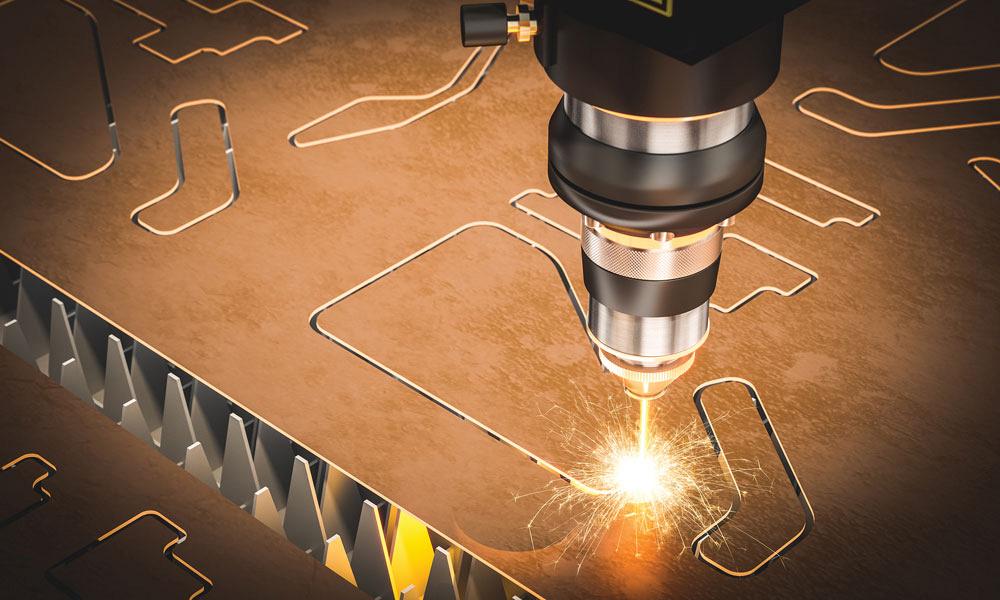
A fiber laser source is the single component that determines your cutting machine’s speed ceiling, edge quality, and long-term reliability. This guide explains every specification that matters, compares the major decisions you’ll face, and gives both machine builders and end users a practical framework for making the right call.
What does a fiber laser source actually do inside a cutting machine?
The fiber laser source generates the beam. Everything else in your cutting machine — the motion system, the cutting head, the CNC controller — exists to deliver that beam to the right place at the right time. The source converts electrical power into a coherent, high-intensity light beam, which is then transmitted through a delivery fiber to the cutting head.
What the source determines directly: maximum output power, beam quality, pulse characteristics, and the efficiency with which electricity becomes usable light. According to RP Photonics, one of the most authoritative references in laser physics, the beam’s spatial quality — how well it can be focused — is set entirely by the source and cannot be improved by any downstream optic. A poor-quality beam entering a cutting head will produce a poor-quality cut, regardless of how expensive the head is.
For machine builders integrating a source into their own equipment, the source also determines your machine’s market positioning. End users comparing laser cutting machines will often ask specifically which laser source brand is installed. The source is not a hidden component — it is a selling point.
What specs on a fiber laser source datasheet actually matter?
Most datasheets list a dozen or more parameters. Four of them determine real-world cutting performance. The rest are either secondary or redundant.
What does output power (wattage) really control — and what doesn’t it tell you?
Output power sets the upper limit on cutting speed and material thickness. A 3 kW source can cut thicker steel than a 1 kW source, and faster. That relationship is real and well-documented.
What power does not tell you is edge quality, kerf width, or how well the source handles thin, reflective, or precision-tolerance materials. Two sources with identical wattage ratings but different beam quality parameters will produce measurably different cut results on the same material. Buying on wattage alone is the most common mistake in fiber laser source selection, and it is the gap that most existing buyer guides fail to address.
What is BPP, and why does it affect cut edge quality more than wattage?
Beam Parameter Product (BPP) is the product of the beam’s waist radius and its half-angle divergence, measured in mm·mrad. It describes how tightly the beam can be focused and how quickly it spreads after the focal point. Edmund Optics defines it clearly: a smaller BPP means a higher-quality beam that can be focused to a smaller, more intense spot.
In practical cutting terms, BPP has a direct and measurable impact on edge quality, cutting speed, and process stability. A source with lower BPP achieves a smaller focal spot, which increases energy density at the cut zone. The result: cleaner edges on thin stainless steel and aluminum, narrower kerf width, and reduced heat-affected zone — all of which reduce or eliminate the need for secondary finishing. For high-volume production of precision sheet metal parts, this difference is quantifiable in downstream labor cost.
The minimum achievable BPP is λ/π, corresponding to a theoretically perfect Gaussian beam. For high-power commercial fiber lasers, typical BPP values range from 3 to 10 mm·mrad, with single-mode sources approaching the lower end and high-power multi-mode sources occupying the upper end.
What is M² factor, and when should you care about it?
M² (M-squared) is BPP normalized by wavelength, making it a dimensionless beam quality ratio that allows comparison across different laser types. A diffraction-limited Gaussian beam has M² = 1. Real-world high-quality beams have M² just above 1. Physically, M² cannot be lower than 1.
For practical selection purposes: M² matters most in thin-sheet, high-precision applications where the cutting head’s focusing optic needs to create the smallest possible spot. Single-mode fiber laser sources typically achieve M² ≤ 1.1, enabling spot sizes below 100 µm. Multi-mode sources at high power levels will have M² in the range of 3–10 or higher — acceptable for thick-plate cutting where depth of cut matters more than kerf precision.
As laser power increases, maintaining good beam quality becomes physically harder due to thermal lensing in the gain medium. This is why you will see M² degrade as you move up the power range within any product family. Ask suppliers for M² values at rated power, not at reduced test conditions.
What does electro-optical efficiency mean for your operating cost?
Electro-optical (EO) efficiency is the ratio of laser output power to electrical input power, expressed as a percentage. Fiber lasers are significantly more efficient than CO₂ lasers — typically 25–35% EO efficiency vs. 10–15% for CO₂ — but there is meaningful variation between fiber laser source models and manufacturers.
At 3 kW output power, the difference between a 30% and a 25% EO efficient source is 2 kW of additional electrical consumption in the less efficient unit. At 16 hours/day industrial operation, that difference compounds into thousands of dollars per year in electricity cost alone, before accounting for the additional cooling capacity required to handle the extra waste heat. For machine builders, EO efficiency also affects the chiller specification and the electrical supply infrastructure required for your machine — both of which affect your system cost and your customers’ installation requirements.
What is back reflection tolerance, and why does it matter for copper and brass cutting?
Back reflection occurs when the laser beam reflects off a highly reflective material surface and travels back into the fiber delivery system toward the source. Copper, brass, aluminum (particularly at certain angles), and polished stainless steel are the main materials that generate significant back reflection.
Insufficient back reflection tolerance is a failure mode that most buyer guides omit entirely. The consequence ranges from temporary output instability to permanent damage to the source’s pump diodes or delivery fiber. If your application involves cutting copper or brass — or if you are a machine builder whose customers may cut these materials — back reflection tolerance must appear explicitly on the spec sheet you evaluate. Higher-grade sources include internal optical isolators or back-reflection protection circuits. Confirm this before purchasing, not after a failure event.
Single-mode vs. multi-mode fiber laser source: which is right for your application?
This is not a question of which technology is better. It is a question of matching beam characteristics to your material and thickness range.
| Single-Mode | Multi-Mode | |
|---|---|---|
| Typical M² | ≤ 1.1 | 1.5 – 10+ |
| Typical BPP | < 0.4 mm·mrad | 1 – 10+ mm·mrad |
| Common power range | 100 W – 3 kW | 1 kW – 40 kW+ |
| Focal spot size | Very small (< 100 µm typical) | Larger |
| Ideal material thickness | Thin sheet (< 3 mm) | Medium to thick plate |
| Cutting edge quality | Excellent — minimal burr, narrow kerf | Good — adequate for structural parts |
| Cutting speed on thin material | Very high | Moderate |
| Depth of cut on thick material | Limited | Strong |
| Typical applications | Precision sheet metal, electronics enclosures, medical devices, decorative cutting | Structural steel, heavy plate fabrication, automotive, shipbuilding |
| Back reflection sensitivity | Higher — requires protection for reflective metals | More tolerant at high power |
| Representative use case | 1 kW single-mode cutting 0.5–2 mm stainless steel | 6–12 kW multi-mode cutting 10–25 mm carbon steel |
The practical rule: if your primary application is thin-gauge sheet metal with tight tolerances, single-mode delivers better results at lower power. If your primary application is medium-to-heavy plate where throughput and thickness penetration matter, multi-mode at higher power is the correct choice. Applications that genuinely span both ranges may require a dual-focus or zoom cutting head — a system-level decision that begins with the source specification.
Air-cooled vs. water-cooled fiber laser source: what changes beyond just temperature?
Cooling method determines more than thermal management. It affects installation complexity, spatial requirements, operating environment constraints, and the power range that is realistically achievable.
Air-cooled sources are available up to approximately 1.5–2 kW in most product lines. They require no chiller unit, no water supply, and no plumbing — a meaningful advantage in mobile, space-constrained, or lower-infrastructure environments. The tradeoff is that their power ceiling is fixed by the physics of convective heat dissipation, and their performance can degrade in high-ambient-temperature environments (above 35–40°C). For machine builders selling into markets where water supply and chiller installation are inconvenient or expensive, air-cooled sources simplify the machine’s installation story significantly.
Water-cooled sources are required above approximately 2 kW and are standard for all high-power industrial applications. They deliver more stable thermal control, which correlates with more stable beam quality during long production runs. The chiller must be sized correctly — undersized cooling is one of the most common causes of premature source degradation in field installations. Confirm the required coolant flow rate and temperature range from the source datasheet, then spec the chiller with margin, not at the minimum rated value.
For machine builders: water-cooled systems add a subsystem (the chiller) that requires its own maintenance schedule and can become a failure point independent of the laser source itself. This affects your after-sales support model and your customers’ total operating cost.
IPG, Raycus, MAX, nLIGHT: how do you actually compare laser source brands?
Brand reputation is a starting point, not a decision framework. The practically useful comparison runs across four dimensions.
1. Warranty terms and what they actually cover A longer warranty period is not automatically better if the exclusions undermine it. Read what constitutes a “warranty event” versus normal degradation. Power output gradually declines with use — the 100,000-hour MTBF figure corresponds to the point where pump diode output has dropped by approximately 20%, at which point the source is still functional but measurably less efficient. Confirm whether your warranty covers a replacement threshold or only catastrophic failure.
2. EO efficiency and its documentation Independent comparison data shows meaningful efficiency differences between leading brands. Request the EO efficiency curve across the power operating range — not just peak efficiency at a single test point — and compare it against your expected duty cycle.
3. Back reflection specification This should appear explicitly in the datasheet. Absence of a stated back reflection tolerance is itself information about the product.
4. Local support and parts availability A source that costs 30% less but requires 8-week lead time for a replacement pump module will cost more in real terms during a production shutdown than a premium-priced source with local inventory. For machine builders: evaluate the supplier’s support network in your target sales markets, not just in your manufacturing location. IPG is widely regarded as the global standard for high-reliability, high-production applications; Raycus and MAX have closed the performance gap significantly for mid-range cutting applications while offering competitive pricing for cost-sensitive markets.
For machine builders (OEM): what else matters beyond the spec sheet?
If you are integrating a fiber laser source into a machine you manufacture and sell, the selection criteria extend well beyond optical performance.
Communication protocol compatibility. Fiber laser sources communicate with CNC controllers via analog (0–10V), RS-232, RS-485, or fieldbus protocols (EtherCAT, Profinet, Modbus). Your choice of source must match the interface your controller expects, or require an additional adaptation layer that adds latency and complexity. Confirm the exact control interface before committing to a source in your bill of materials.
Batch-to-batch consistency. Production machines ship in volume. A source that performs well in your prototype but varies in beam quality or power calibration across batches creates downstream warranty exposure. Request production-level sample specifications, not cherry-picked engineering samples.
Supply chain continuity. The fiber laser source market is concentrated among a small number of manufacturers, and geopolitical factors have introduced meaningful supply risk for certain brands in certain markets. Assess whether your target sales regions have any import restrictions, tariff exposure, or certification requirements (CE, FDA, RoHS) that affect which source brands you can realistically use. Building your machine around a single-source supplier without a qualified backup creates business risk independent of the source’s technical quality.
Labeling and brand visibility. Some OEM customers will specify which source brand they want. Others will not. Understanding your customer’s expectations about source brand visibility — whether it appears on the machine nameplate, in the documentation, or is transparent to end users — should be part of your procurement conversation with the source supplier.
For end users replacing or upgrading a laser source: what do you need to verify first?
Replacing a fiber laser source in an existing machine is not plug-and-play. Four compatibility factors must be confirmed before purchasing a replacement.
1. Fiber output connector type and core diameter The delivery fiber connects the source to the cutting head via a standardized connector (QBH, QD, LLK-D, and others depending on manufacturer). The connector type and fiber core diameter must match exactly. A mismatch requires replacing the delivery fiber — an additional cost and lead time that is often not anticipated.
2. Control interface The new source must speak the same control protocol as your machine’s CNC. If the original source used a specific analog or digital interface, a replacement from a different brand may require a control interface adapter or a CNC parameter change.
3. Power supply voltage and phase Higher-power sources typically require 3-phase supply. Confirm that your facility’s electrical infrastructure matches the replacement source’s input requirements before purchasing.
4. Chiller capacity If you are upgrading to a higher-power source, your existing chiller may be undersized. For every 10°C increase in operating temperature above the design point, pump diode lifespan can be cut in half. Verify the required coolant flow rate and temperature specifications for the new source against your chiller’s rated capacity.
What should a fiber laser source warranty actually cover — and what red flags should you watch for?
The “100,000 operating hours” figure appears in nearly every fiber laser source product page. It is widely misunderstood.
This number is the MTBF (Mean Time Between Failures) for the pump diode ensemble — the statistical average time before a measurable failure occurs under controlled laboratory conditions. It is not a warranty period. It is not a guarantee of lifespan. It is not the point at which the source stops working. As SPI Lasers’ technical documentation makes clear, this MTBF is for the ensemble of all pump diodes — individual diode MTBF is considerably longer, but the ensemble figure is what determines practical machine life.
In real production environments, actual lifespan depends heavily on three variables: operating temperature (lifespan halves for every 10°C above design range), operating current (running at full rated power continuously accelerates degradation faster than operating at 80–85% power), and maintenance quality.
What a strong warranty should include:
- Coverage period stated in calendar time, not operating hours (hours are unverifiable)
- Defined power output threshold below which a warranty replacement is triggered
- Coverage for early-life failures attributable to manufacturing defects, separate from normal degradation
- Clear statement on what voids the warranty (back reflection events, coolant quality failures, unauthorized modifications)
Red flags in warranty language:
- No stated power degradation threshold — means the source is “working” even at 60% of rated output
- Warranty that excludes “normal wear” without defining it
- No local or regional service coverage — replacement requires shipping the source internationally
What questions should you ask a fiber laser source supplier before you order?
Use this list as a pre-purchase checklist. A credible supplier should be able to answer every item without hesitation.
For all buyers:
- What is the M² value at rated output power (not at a reduced test power)?
- What is the BPP at rated output power?
- What is the electro-optical efficiency at 50%, 75%, and 100% of rated power?
- What back reflection protection is built into the source, and what is the rated tolerance?
- What is the warranty period, what does it cover, and what triggers a replacement versus a repair?
- What coolant flow rate, temperature range, and water quality specification is required?
Additional questions for machine builders (OEM): 7. What control interfaces are available (analog, RS-232, EtherCAT, Modbus)? 8. What is the typical lead time for production-volume orders, and what is your supply continuity plan? 9. Are there any export restrictions, certification requirements, or tariff classifications that affect shipment to [your target markets]? 10. What batch-to-batch performance specification do you hold, and how is it documented?
FAQ
What’s the difference between a fiber laser source and a fiber laser cutting machine? The fiber laser source is one component inside a complete cutting machine — it generates the beam. The cutting machine also includes a motion system, cutting head, CNC controller, and enclosure. When someone says “we use a Raycus laser,” they mean the source brand inside their machine, not the machine brand itself.
Is a higher-wattage fiber laser source always better for cutting? No. Higher power enables cutting thicker material and cutting faster, but beam quality (BPP, M²) determines edge quality and precision — and higher-power sources typically have higher BPP values. For thin-sheet precision cutting, a lower-power single-mode source often outperforms a higher-power multi-mode source on the metrics that matter most: kerf width, edge roughness, and heat-affected zone.
How long does a fiber laser source actually last in production? The 100,000-hour MTBF figure cited by most manufacturers is a statistical projection for pump diodes under controlled conditions, not a production guarantee. In real industrial environments, 50,000–80,000 hours of effective life is a realistic expectation under good maintenance and thermal management. Running the source at 80–85% of rated power rather than continuous 100% output meaningfully extends operational life.
Can I replace a Raycus source with an IPG source in my existing machine? Possibly, but not without verification. You must confirm that the fiber output connector type, delivery fiber core diameter, control interface protocol, power supply requirements, and chiller capacity all match or can be adapted. Different brands use different connector standards and communication protocols. Treat it as an integration project, not a direct swap, and confirm compatibility with both the new source supplier and your machine’s CNC manufacturer before purchasing.