

Single mode fiber laser lets you work with great accuracy. You get quick results and better efficiency using this tool. New features like AI and beam shaping help you watch and control the process. Smaller and stronger systems help many industries do more, like cars, planes, and electronics.
- The world market for single mode fiber lasers was $2.5 billion in 2023. It could grow to $8.5 billion by 2032. Experts think it will grow by 14.5% each year.
- AI makes semiconductor metrology work better. It helps measure many things and watch the process.
- Physics-informed neural networks need less data. Multi-level networks give very good accuracy for making things.
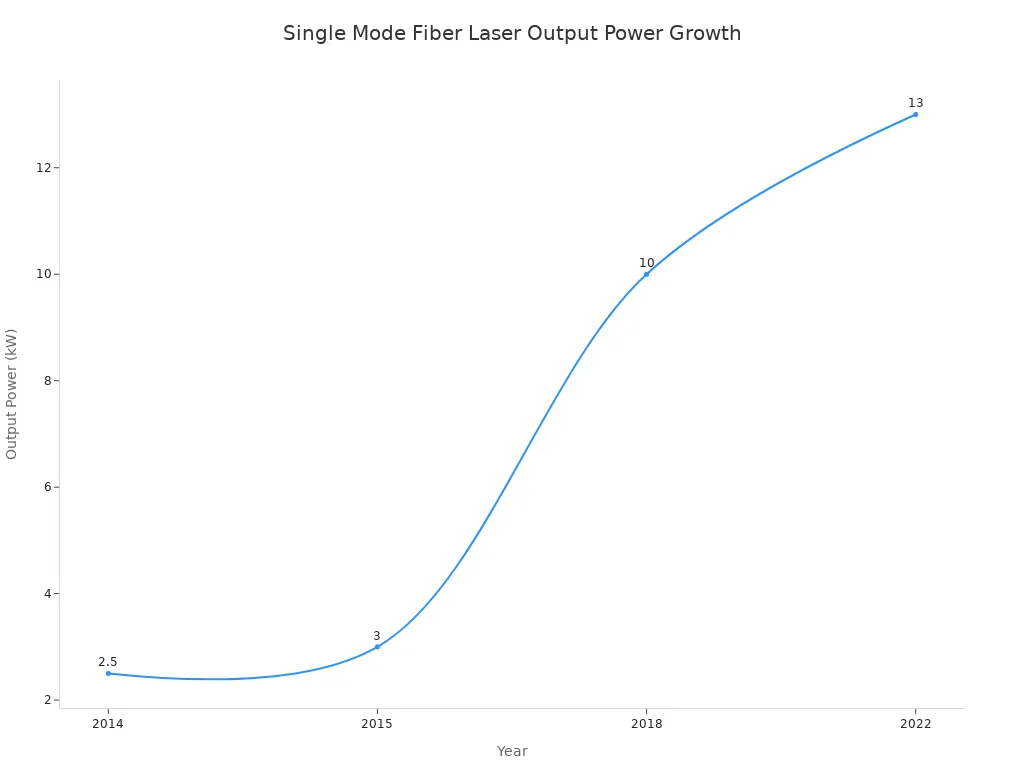
| Year | Study/Research Team | Output Power | Beam Quality | Notes |
|---|---|---|---|---|
| 2014 | Shandong Haifu Photon Company & Fang Q | 2.5 kW | M² < 1.3 | Teams worked together to make more power |
| 2015 | Wang XJ et al. | 3 kW | N/A | Used local optical fibers to reach this power |
| 2018 | Lin AX et al. | 10 kW | N/A | First time a semiconductor-pumped fiber laser reached this power |
| 2022 | Wang P et al. | 13 kW | High beam quality | Important for more uses and better efficiency |
| 2023 | Xi XM et al. | >20 kW | N/A | Big step for LD-pumped all-fiber laser system |
Key Takeaways
- Single mode fiber lasers help make things more exact and quick. They help car and airplane companies make better things faster.
- Using AI and automation with fiber lasers can make twice as many products. It also lowers worker costs by 30%. This makes work easier and saves money.
- High-power fiber lasers can go up to 25 kW. They help weld and cut things faster. This helps people get more done and use less energy and materials.
Advances in Single Mode Fiber Laser Technology

New laser technology is changing how factories work. These changes help you get better results. You save time and use less energy. Let’s see what’s new with fiber lasers and how they help the future.
AI and Automation Integration
AI controls make fiber lasers smarter and more dependable. Predictive maintenance helps you find problems early. This keeps machines working longer and stops delays. Adaptive power modulation lets you change laser power fast. You get good results for different materials and speeds. Beam shaping makes sure your work looks great every time.
Automation helps you do more work. You can make twice as many products. Labor hours go down by 30%. Robots move parts quickly and stop slowdowns. Scheduling gets easier, and you can change plans fast.
Tip: Using automation with fiber lasers means you fix fewer problems and make better products.
| Benefit | Impact |
|---|---|
| Increased productivity | Doubling throughput |
| Reduced labor costs | Cutting labor hours by 30% |
| Improved part quality | Enhanced precision and consistency |
- A metal shop used robots and made twice as many products.
- Workers spent 30% less time on jobs.
- Automation stopped slowdowns and made scheduling easier.
Ultra-High-Power Systems
High-power fiber lasers help with tough jobs. You can use lasers up to 25kW for welding and cutting thick things. These lasers work at 980 nm, 1020 nm, 1040 nm, and 1060 nm. They can be 60% efficient and last up to 30,000 hours.
| Metric | Value |
|---|---|
| Output Power | Up to 25 kW |
| Wavelength | 980 nm, 1020 nm, 1040 nm, 1060 nm |
| Beam Parameter Product | 200 mm mrad x 40 mm mrad |
| Wall-plug Efficiency | Up to 60% |
| Proven Lifetime | < 30,000 hours |
IPG Photonics’ 25kW platform welds faster and deeper. Adjustable Mode Beam lets you change the beam for better welding. Power split between core and ring makes welds stronger and faster. You can weld car steels and aluminum at over 6 meters per minute. The ring energy helps heat before and after welding, making welds better.
| Feature | Description |
|---|---|
| Adjustable Mode Beam (AMB) | Lets you change the beam for better welding. |
| Power Distribution | Splits power between core and ring for stronger welds. |
| Weld Speed | Welds car steels and aluminum faster than 6 m/min. |
| Pre-heating/Post-heating | Ring energy heats before and after welding for better results. |
- The fiber laser system can make 25 kW of power.
- It has a core size of 2.0 mm and NA of 0.22.
- The system uses a new way to change the beam for better work.
New laser breakthroughs include the 520nm 40W fiber coupled laser, the first 3 kW single-mode dual-beam fiber laser for battery welding, and 2 kW laser delivery over hollow-core fiber. These new ideas help you work faster and more accurately.
| Breakthrough | Description |
|---|---|
| 520nm 40W Fiber Coupled Laser | Big step forward with many uses. |
| 3 kW single-mode dual-beam fiber laser | First one for better battery welding and e-mobility. |
| 2 kW laser delivery over hollow-core fiber | Delivers laser far away, helping more jobs. |
Miniaturization and Portability
Now you can use small fiber lasers in tight spaces. Air-cooled systems save energy and cost less. Portable lasers weigh 20–30 kg and can mark products anywhere. You do not need special power, so you can work in many places. Eco-friendly features like low idle power and no chemicals make it safer.
- The RX-1064-300 is much smaller than old fiber lasers.
- It can burst at MHz and control energy well.
- This small design helps makers who need good work in small spaces.
The RX-1064-300 pulsed fiber laser shows how small size helps you work better. Its tiny size and smart features are great for places with little room. You get more choices and work faster in your factory.
Dynamic Beam Shaping
Dynamic beam shaping lets you change the laser’s strength fast. You can match the beam to different jobs and materials. This helps you get better results with many things. You can switch between beam shapes for each job.
- Dynamic beam engineering lets you change laser strength quickly, making work faster.
- You can change beam shapes for different materials, so it works with more things.
- Beam shape sequencing lets you pick the best shape for each job, making work easier.
- The WD-DNN helps with multi-wavelength beam shaping, which is good for jobs needing different beams.
Laser technology keeps getting better. New fiber lasers, high-power lasers, and strong fiber sources help you work faster and smarter. Small size, automation, and beam shaping give you more control. You will see even more speed and better results as technology grows.
Manufacturing Applications of Laser Technology

Laser technology helps you do many things in factories. You see it used in cars, planes, and electronics. Lasers can cut, weld, and engrave. These jobs are easier with lasers. Let’s see how lasers help in different industries.
Industrial Cutting and Welding
Lasers cut and weld in car and plane making. They cut metals and alloys very well. You get smooth edges and less waste. Lasers weld fast and join parts quickly. There is less heat and less bending. You can use lasers on many metals, even ones that are hard to mix.
| Application Type | Industries Involved | Description |
|---|---|---|
| Cutting | Automotive, Aerospace | Cuts metals and alloys with high accuracy. |
| Welding | Automotive, Aerospace | Joins parts with great precision. |
| Engraving | Automotive, Aerospace, Electronics | Makes detailed designs and serial numbers. |
Lasers make work faster and simpler. You do not need much training to use them. Lasers save money because they use less energy.
Tip: Lasers can make your work twice as fast and better.
Electronics and Semiconductor Processing
Lasers help make better electronics. You use lasers to cut semiconductors like silicon carbide. This makes smoother and stronger parts. You lose less material and get better quality. Lasers can also engrave tiny designs and numbers on parts.
Lasers cause fewer cracks and keep parts strong. You get better phones, computers, and other devices.
Additive and Green Manufacturing
Lasers help build things in new ways. You use lasers to make parts layer by layer. Lasers work with metals and plastics. You get exact shapes and use less material. Lasers also help you be greener. You see less pollution and use less energy.
| Benefit | Description |
|---|---|
| Minimal emissions | Lasers make less pollution and keep work safer. |
| Precision | Lasers waste less material because they are accurate. |
| Energy efficiency | Lasers use less energy, saving money and helping the planet. |
Lasers give you more options and better results. You work faster, save materials, and make stronger products. Lasers help you do well in modern manufacturing.
Market Trends in Fiber Laser Adoption
Industry Growth and Projections
Laser technology is changing how things are made. The single mode fiber laser market is getting bigger every year. Experts think it will be worth over $7 billion in 2024. By 2030, it could go past $15 billion. The market grows about 12-15% each year. By 2036, it may reach $15.1 billion, growing 11.5% each year. Most lasers are used in factories for cutting and welding. More electric cars are being made, which helps this growth. Lasers help weld battery parts and cut light materials for EVs. This means batteries work better and are made faster.
- Low power fiber lasers are the most popular.
- Factories, hospitals, and planes use lasers the most.
- Electric car sales could reach 17.36 million by 2029.
Regional Adoption Patterns
Laser technology is used all over the world. Different places use lasers in their own ways.
| Region | Key Characteristics | Growth Drivers |
|---|---|---|
| North America | Has a strong market and good systems | Spends a lot, uses new ideas, adopts fast |
| Europe | Cares about quality and rules | Likes new things, has strong rules, can grow easily |
| Asia-Pacific | Grows fastest, has many people, gets help from leaders | Cities grow, more factories, lots of need |
North America grows by 14% each year from 2023 to 2030. Asia-Pacific grows the fastest, with more factories using lasers to make lots of things.
Integration with Smart Factories
Smart factories use lasers to get better results. Robots and computers help cut down on machine stops by over 70%. Lasers help waste less material by up to 20%. Smart factory lasers are worth $7.44 billion. You get more steady work and less waste. Lasers help your factory work better and smarter.
Note: Lasers help you solve new problems in making things and get better results.
Impact on Manufacturing Performance
Productivity and Throughput Gains
Single mode fiber lasers help factories make more products. These lasers finish jobs faster and keep machines working longer. Automation and smart controls help you work quickly. Many shops now reach OEE rates over 90%. The average is only 65%. Cycle times often drop below 10 minutes for each fiber batch. Labor costs go down because you need fewer workers. Most companies get their money back in 18 to 24 months. Some do it in less than a year by cutting waste. Profit margins can grow by 300–500% during the machine’s life.
| Performance Metric | Impact on Manufacturing Performance |
|---|---|
| Throughput Rates | Automation and smart controls help you make more products. |
| Equipment Uptime | Predictive maintenance keeps machines working longer. |
| Cycle Times | New systems finish fiber batches in under 10 minutes. |
| Labor Costs | Fewer workers are needed because processes are better. |
- AFX fiber lasers can make build rates almost 8 times higher for laser powder bed fusion.
- You keep material density above 99.8%, showing strong precision.
Quality and Consistency Improvements
Single mode fiber lasers give you cleaner cuts and better results. You can make tiny cuts in microelectronic parts. This means fewer mistakes and higher quality. Many factories see a 20–30% jump in how much they make and fewer defects. Using the right scanning speed means fewer mistakes and less heat damage, especially for battery electrodes. This technology helps you keep product quality high and results steady.
- You get cleaner cuts in microelectronics, so you make more good parts.
- Production goes up by 30%, and defects go down.
- Fast scanning speeds help lower mistakes and heat damage.
Sustainability Benefits
Fiber lasers help the environment. They turn electrical energy into optical energy with up to 50% efficiency. You use less power than older CO₂ lasers, so bills are lower. Power conversion rates range from 30% to 57%, which is much better than other systems. Fiber lasers cut materials very accurately, so you waste less. This saves resources and helps manage waste better. By making less scrap, you need fewer raw materials and help nature.
- Fiber lasers use less energy and work better.
- Accurate cuts mean less scrap and better use of materials.
- Less waste helps you protect the environment and save money.
Single mode fiber lasers help factories work faster and more accurately.
Fiber laser welding makes welds cleaner. It also cuts down on waste. Production gets quicker with this technology.
New ideas in 2026 will help factories grow and be greener:
| Innovation Type | Description |
|---|---|
| Energy-Efficient Laser Systems | These lasers use less energy than older ones. |
Experts think technology will keep improving. This will help you do your job better.
FAQ
What makes single mode fiber lasers different from other lasers?
You get a focused beam with single mode fiber lasers. This helps you cut and weld with more accuracy and less waste.
Can you use fiber lasers for marking products?
Yes, you can mark products with fiber lasers. You get clear marks on metals, plastics, and electronics.
How do fiber lasers help the environment?
Fiber lasers use less energy. You waste fewer materials and make less pollution in your factory.