
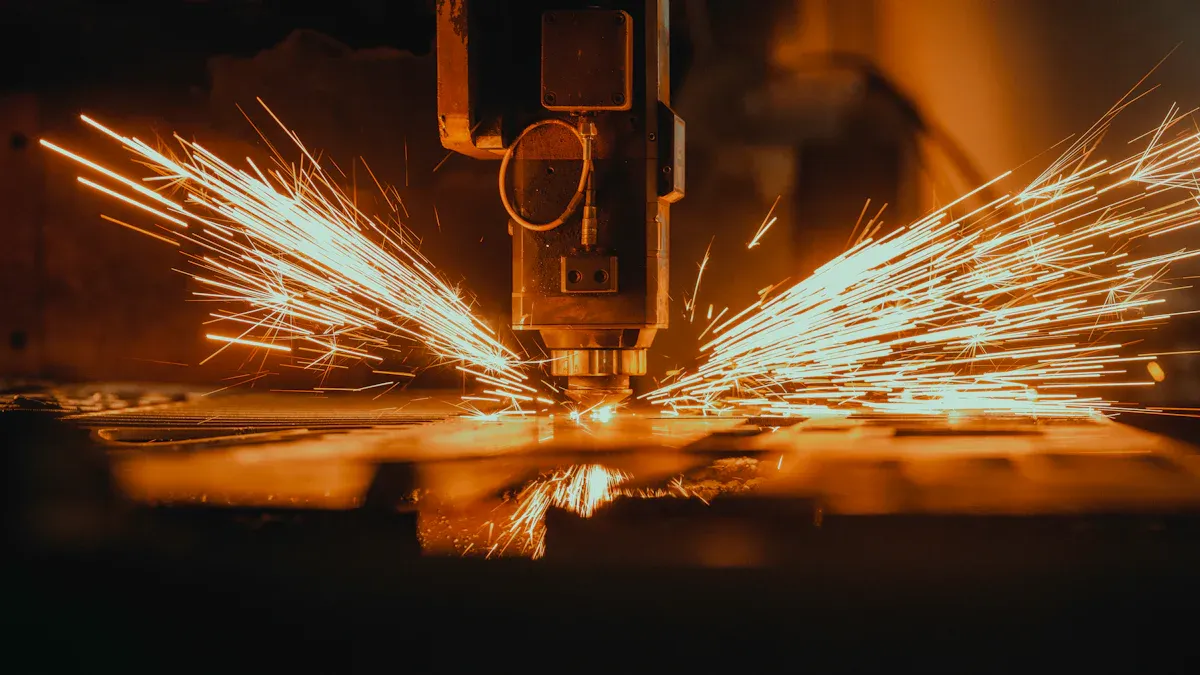
A Fiber Laser Source works much like a high-speed train channeling energy down a single track. Laser diodes convert electricity into light, which enters a special fiber made of silica glass. This fiber contains rare earth elements that boost the light’s strength as it travels. The cladding around the core keeps the light focused, allowing it to exit as a powerful, precise beam.
- Fiber lasers now account for over 60% of industrial laser sales, showing their strong presence in the market.
Key Takeaways
- Fiber laser sources use a special glass fiber to create powerful and precise laser beams, making them efficient for cutting and welding.
- The main components include doped optical fiber, pump laser diodes, and fiber Bragg gratings, all working together to amplify light.
- Fiber lasers are highly efficient, converting 50-60% of electrical energy into laser light, which reduces operating costs significantly.
- These lasers have a long lifespan of over 100,000 hours and require minimal maintenance, making them cost-effective for industries.
- Fiber lasers are versatile and can cut various materials, including metals and plastics, making them ideal for many applications.
What Is a Fiber Laser Source

Basic Definition
A Fiber Laser Source is a device that creates a powerful and focused beam of light using a special type of glass fiber. This fiber acts as both the pathway and the amplifier for the light. The process starts when electrical energy powers small laser diodes. These diodes produce light, which then enters the core of the optical fiber. The fiber contains rare earth elements, such as ytterbium or erbium, that help boost the light’s energy. The result is a strong, precise laser beam that can cut, weld, or mark materials with high accuracy.
Fiber laser sources stand out because they use the fiber itself as the main part of the laser. This design makes them more efficient and reliable than many other types of lasers. The fiber keeps the light tightly contained, so very little energy is lost. This means the device can produce a high-quality beam while staying compact and cool.
Note: Fiber laser sources are popular in industries like manufacturing, medicine, and communications because they offer both power and precision.
Main Components
A fiber laser source relies on several key parts to function properly. Each component plays a specific role in creating and shaping the laser beam. The main components include:
- Doped Optical Fiber – This is the heart of the system. The fiber is infused with rare earth elements that amplify the light.
- Double-Clad Fiber – This structure allows more pump light to enter the fiber, increasing efficiency.
- Pump Laser Diodes – These small devices generate the initial light that powers the laser.
- Pump Laser Combiners – These parts combine light from several diodes and direct it into the fiber.
- Fiber Bragg Gratings – These act like tiny mirrors inside the fiber, helping to control and shape the laser beam.
Each of these components works together to ensure the fiber laser source delivers a stable and powerful output. The careful design of these parts allows the device to operate with high efficiency and low maintenance.
Fiber Laser Source Working Principle
Pump Light from Laser Diodes
The process begins with pump light. Laser diodes act like tiny flashlights, shining their energy into the fiber. These diodes convert electrical power into light at very specific wavelengths. Most fiber lasers use pump light in the range of 915nm to 980nm. Ytterbium-doped fiber lasers often use 976nm as a common pump wavelength.
| Wavelength Range | Description |
|---|---|
| 915nm – 980nm | Typical range for pump light in fiber lasers |
| 976nm | Common pump wavelength for ytterbium-doped fiber lasers |
The pump light enters the fiber and travels along its length. This light does not become the laser beam itself. Instead, it provides the energy needed to start the lasing process. The pump light fills the fiber core with energy, preparing the next step.
Think of the pump light as the fuel that powers a car. It does not move the car directly, but it gives the engine what it needs to run.
Doped Fiber as Gain Medium
Inside the fiber, the core contains special atoms called dopants. These dopants are rare earth elements, such as ytterbium, erbium, or thulium. The fiber acts as the gain medium, which means it is the place where light gets stronger.
| Doped Fiber Type | Description |
|---|---|
| Erbium-doped | Used for amplifying light in lasers. |
| Ytterbium-doped | Commonly used for high-power lasers. |
| Thulium-doped | Utilized in specific wavelength ranges. |
The structure of the fiber includes several layers:
- The outer coating protects the fiber.
- The inner cladding guides the pump light.
- The doped core is where the action happens.
When pump light enters the doped core, it excites the dopant atoms. These atoms absorb the pump light and move to a higher energy state. This process is called population inversion. More atoms are now in an excited state than in their normal state. This condition is necessary for the fiber to amplify light.
- The gain medium in a fiber laser is a length of optical fiber doped with rare earth ions.
- The active doped core absorbs pump light and amplifies the laser signal.
- Doping with rare-earth elements like ytterbium or erbium excites electrons to higher energy levels.
- This excitation leads to light amplification through the process of stimulated emission.
| Dopant | Characteristics | Applications |
|---|---|---|
| Ytterbium | Efficient light absorption in the 900nm to 1100nm range; causes laser oscillation in the 1000nm to 1100nm range. | Primarily used in metal processing. |
| Erbium | Commonly used for telecommunications and fiber amplifiers. | Fiber amplifiers and medical lasers. |
| Thulium | Offers unique wavelength suitable for specific medical applications. | Medical applications and imaging. |
Silica glass, used in the fiber, has excellent properties for high gain efficiency. This allows the Fiber Laser Source to generate strong laser beams and flexible system designs.
Stimulated Emission Process
The heart of the laser process is stimulated emission. This is where the magic happens. When an excited atom in the doped core meets a photon (a particle of light), it can be triggered to release its energy as another photon. The new photon matches the original in color, direction, and phase. This process is called stimulated emission.
- Spontaneous emission happens when atoms release photons on their own, without outside help.
- Stimulated emission occurs when an incoming photon causes an excited atom to release a second, identical photon.
The laser cavity, formed by special mirrors or fiber Bragg gratings, acts as a resonator. Light bounces back and forth inside this cavity. Only light of a specific wavelength survives and grows stronger with each pass. The result is a powerful, focused beam of laser light.
- Pump light travels through the fiber-optic cable.
- The light enters the laser cavity, a region where specific wavelengths are produced.
- Doped fibers interact with light, causing electrons to rise to higher energy levels.
- When electrons return to their ground state, they release energy in the form of photons, contributing to laser light.
The process is like a row of dominoes. One falling domino triggers the next, creating a chain reaction. In the fiber, one photon triggers another, building a strong, organized beam.
Fiber lasers stand out for their high efficiency. They convert a large portion of electrical energy into laser light, often reaching wall-plug efficiencies of 50-60%. This is much higher than traditional CO2 lasers, which usually achieve only 10-15%.
| Laser Type | Power Conversion Rate | Wall-Plug Efficiency |
|---|---|---|
| Fiber Laser | 30–50% | 50-60% |
| CO2 Laser | 10–15% | N/A |
This efficiency makes fiber lasers popular in industries like automotive, home appliances, and metal processing.
Amplification and Beam Output
Light Amplification in Fiber
Light amplification is the core function of a Fiber Laser Source. The process starts when pump light from several semiconductor laser diodes enters the doped fiber. The fiber contains rare-earth elements, such as ytterbium, which allow electrons to become excited. When these electrons return to their ground state, they release energy as photons. This energy release creates more photons, leading to a chain reaction called stimulated emission.
The laser cavity, formed by fiber Bragg gratings at both ends of the fiber, acts as a resonator. It reflects light back and forth, causing the light to build up in strength. As photons travel through the cavity, they hit other excited electrons, causing even more photons to be released. This process amplifies the light to very high power levels.
- Pump light travels through the fiber-optic cable into the laser cavity.
- The fiber is doped with a rare-earth element, which allows for electron excitation.
- Electrons release energy in the form of photons when they return to their ground state.
- The laser cavity acts as a resonator with fiber Bragg gratings that reflect light back into the cavity.
- Photons hitting excited particles cause further photon release, leading to stimulated emission and light amplification.
Fiber laser sources can produce a wide range of output powers, depending on the application:
| Application | Average Power |
|---|---|
| Marking applications | 10–20 W |
| High-speed ablation and cleaning | More than 500 W |
| QCW fiber lasers | Up to 100 W |
Some industrial systems can reach even higher powers:
| Application | Maximum Power |
|---|---|
| Fiber laser welding systems | Exceeds 100 kW |
| Ultra-high power fiber lasers | 10 to 40 kW |
Beam Shaping and Delivery
After amplification, the laser beam must be shaped and delivered to its target. The quality of the beam is very important for precise work. Fiber lasers have high beam quality, often measured by an M² value close to 1.1. This means the beam is nearly perfect and can be focused to a tiny spot.
Several methods help shape and deliver the beam:
| Method | Description |
|---|---|
| Lenses | Used to shape the laser beam for different application needs. |
| Beam Expanders | Adjust the beam diameter for better delivery and focus. |
- Different delivery fibers and focusing lenses can be used.
- Adjusting the distance between the beam delivery and the target changes the focus.
- Using longer or shorter wavelengths can suit different materials.
The cutting head uses a specialized lens to concentrate the laser beam onto a tiny focal point, creating extremely high power density.
The waveguide structure of the fiber helps keep the beam stable and cool, even at high powers. This makes the Fiber Laser Source ideal for tasks that require both power and precision, such as cutting, welding, and marking.
Unique Features of Fiber Laser Sources
Comparison with Other Lasers
Fiber laser sources stand out when compared to CO2 and solid-state lasers. They offer higher efficiency, longer lifespans, and lower maintenance needs. The table below highlights these differences:
| Laser Type | Efficiency | Reliability |
|---|---|---|
| CO2 Lasers | Higher power consumption, slower speeds, and more maintenance needs. | Shorter lifespan (10,000 to 20,000 hours) and higher operational costs. |
| Fiber Lasers | Superior energy efficiency, faster speeds, and lower maintenance needs. | Longer lifespan (exceeding 100,000 hours) and robust design. |
| Solid-State | Lower efficiency and complex cooling systems. | Varies, but generally less reliable than fiber lasers. |
Fiber laser sources also last much longer than other types. For example:
| Laser Type | Average Lifespan (MTBF) |
|---|---|
| Fiber Laser | 100,000 hours |
| CO2 Laser | 30,000 hours |
Maintenance is easier with fiber lasers. They do not need lamp or gas replacements, and there is no need for mirror alignments. Most maintenance involves simple cleaning and inspection. This reduces costs by up to 70% compared to other systems.
Fiber laser systems can run for years before needing major service, while CO2 lasers often require attention after just a few thousand hours.
Key Advantages
Fiber laser sources offer several important benefits in industrial and research settings:
- High Precision: They can cut and mark with extreme accuracy, making them ideal for detailed work.
- High Speed: These lasers process materials quickly, which boosts productivity.
- Low Operating Costs: Their high efficiency and minimal maintenance keep expenses down.
- Versatility: Fiber lasers work with many materials and suit a wide range of applications.
Other advantages include:
- No need for lamp or gas replacements.
- Lower energy use compared to older laser types.
- Payback periods are often short, thanks to reduced running costs.
- Fiber laser sources are used in automotive, aerospace, and electronics manufacturing for tasks like welding, cutting, and marking.
Their high efficiency also means less energy is wasted, which helps the environment. Improvements in beam quality and reliability continue to drive their adoption in new industries.
A fiber laser source works through a series of clear steps:
- Laser diodes create light from electricity.
- The fiber guides this light using its core and cladding.
- Rare-earth elements in the fiber amplify the light.
- The fiber’s doping sets the laser’s wavelength.
- Lenses and expanders shape the final beam.
Fiber laser sources stand out for their versatility and efficiency:
| Characteristic | Description |
|---|---|
| Wavelength Range | Broad range, suitable for many applications |
| Efficiency | High output with less energy wasted |
| Ultrafast Pulse Generation | Stable, fast pulses for advanced uses |
These features make fiber lasers reliable and effective for many industries.
FAQ
What materials can fiber lasers cut?
Fiber lasers cut metals like steel, aluminum, copper, and brass. They also mark plastics and ceramics. The high power and precision make them suitable for many industrial materials.
How long does a fiber laser source last?
Most fiber laser sources last over 100,000 hours. This long lifespan comes from their solid-state design and efficient cooling. Maintenance needs are minimal compared to other laser types.
Are fiber lasers safe to use?
Fiber lasers are safe when used with proper protective equipment. Operators should wear safety glasses and follow guidelines to prevent exposure to the laser beam.
Can fiber lasers be used for medical applications?
Fiber lasers are used in surgery, imaging, and dental treatments. Their precision and ability to target specific tissues make them valuable in medical fields.