
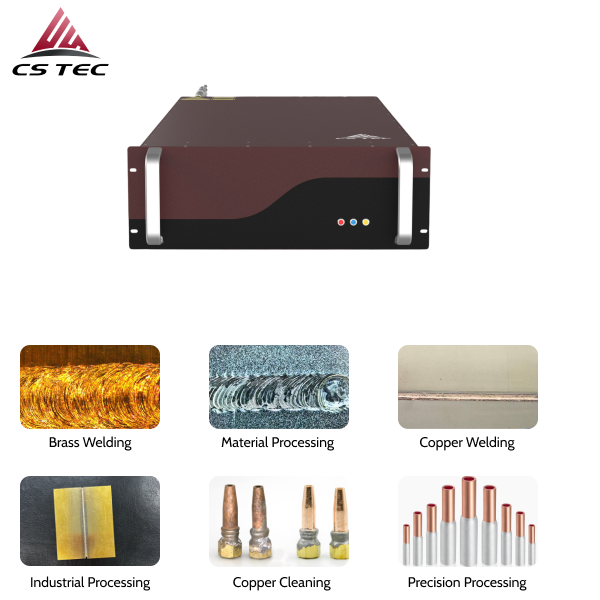
The rapid development of high-power blue semiconductor laser diodes (LDs) has significantly transformed industrial processing of highly reflective materials such as copper, gold, and aluminum alloys. Compared with traditional near-infrared (1 μm) fiber lasers, blue lasers exhibit a much higher absorption rate in non-ferrous metals, enabling more efficient energy coupling, reduced thermal distortion, and improved process stability.
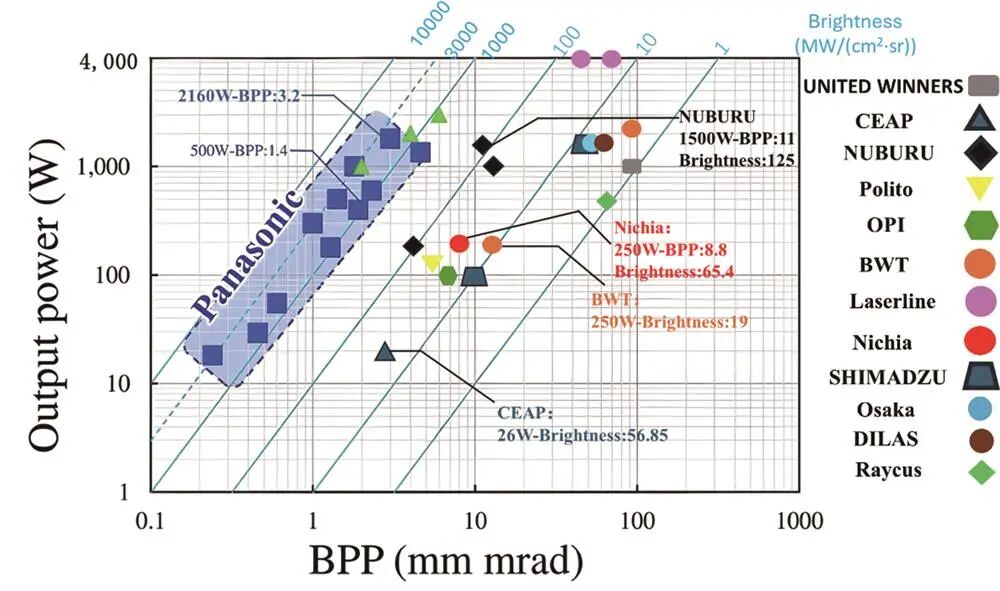
As industrial requirements continue to evolve toward higher precision and higher efficiency, the focus of blue laser technology has shifted from simple power scaling to brightness enhancement. This transition is fundamentally enabled by advanced laser beam combining technologies, which allow multiple laser emitters or modules to be integrated into a single high-brightness output beam.
1. From Power Scaling to Brightness-Driven Design
In semiconductor lasers, increasing output power alone is no longer sufficient to meet industrial demands. Simply enlarging the emitter stripe width can increase power, but it typically leads to degraded beam quality and reduced brightness.
Brightness is a key system-level parameter that combines:
- Output power
- Beam quality (BPP / M²)
- Operating wavelength
Therefore, the true challenge in modern blue laser development is achieving high power while maintaining excellent beam quality simultaneously.
This has led to the widespread adoption of multi-emitter architectures and optical beam combining strategies.
2. Beam Combining Technologies for High-Brightness Blue Lasers
Beam combining technologies can be broadly classified into two categories:
2.1 Coherent Beam Combining (CBC)
Coherent beam combining relies on strict control of phase, frequency, and polarization among multiple laser channels. When properly synchronized, multiple beams interfere constructively, producing a single high-quality output beam with significantly enhanced brightness.
However, CBC requires:
- Precise phase locking between channels
- Highly stable environmental control
- Complex feedback and control systems
While CBC has achieved maturity in near-infrared laser systems, its application in blue semiconductor lasers remains limited due to the higher cost and technical difficulty of GaN-based devices.
2.2 Incoherent Beam Combining (IBC)
Incoherent beam combining is currently the dominant approach in high-power blue laser systems. It does not require phase alignment, making it more practical and scalable for industrial applications.
IBC technologies include:
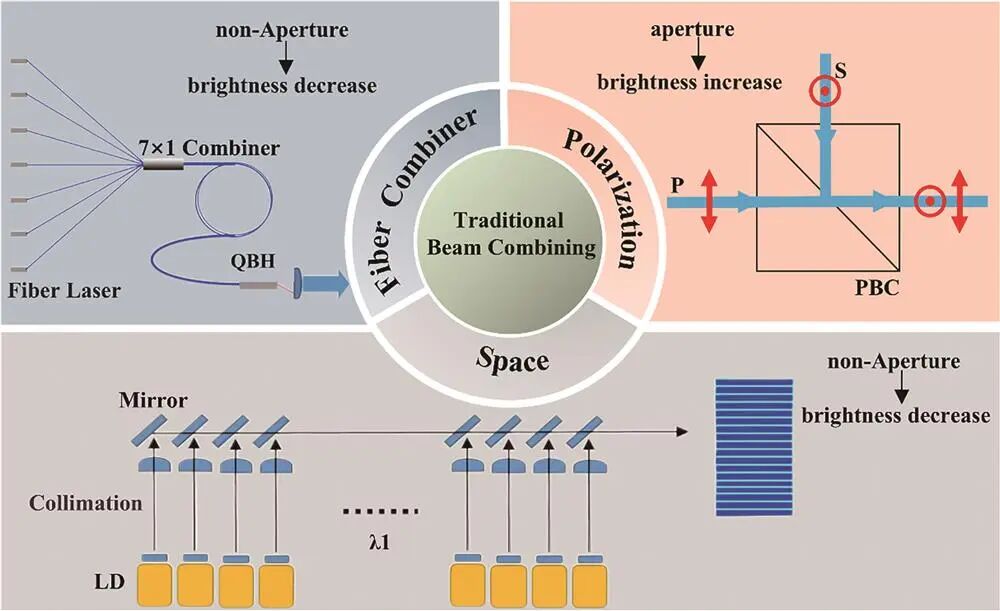
(1) Traditional Beam Combining (TBC)
Includes spatial combining, polarization combining, and fiber-based combining.
- Spatial combining increases power by stacking beams in space
- Polarization combining merges orthogonal polarization states
- Fiber combining integrates multiple LDs into a single large-core fiber output
However, these approaches often involve a trade-off between power scaling and beam quality preservation.
(2) Wavelength Beam Combining (WBC)
WBC uses wavelength-selective optical components such as dichroic mirrors or volume gratings to combine multiple laser sources operating at different wavelengths into a single beam.
Compared with TBC:
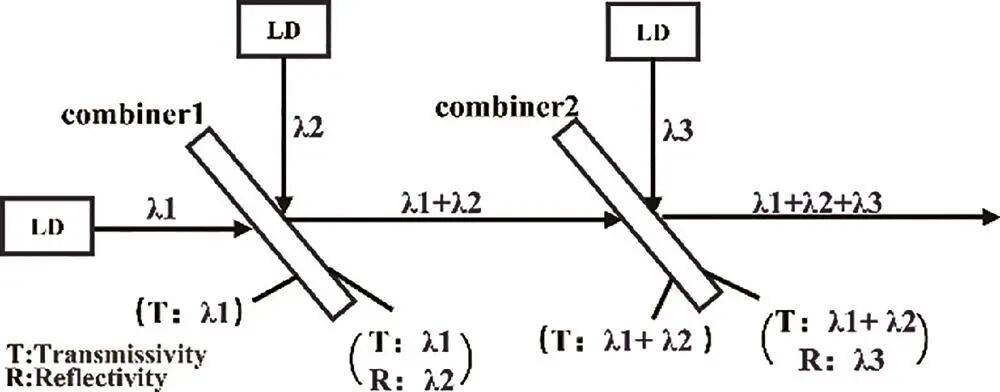
- Better preservation of beam quality
- Higher brightness improvement (typically 1–2 orders of magnitude)
- Limited by wavelength spacing and coating complexity
WBC is widely considered a transitional solution toward higher-density beam integration.
(3) Spectral Beam Combining (SBC) — The Leading Approach
Spectral beam combining based on diffraction gratings is currently the most advanced and promising technique for high-brightness blue lasers.
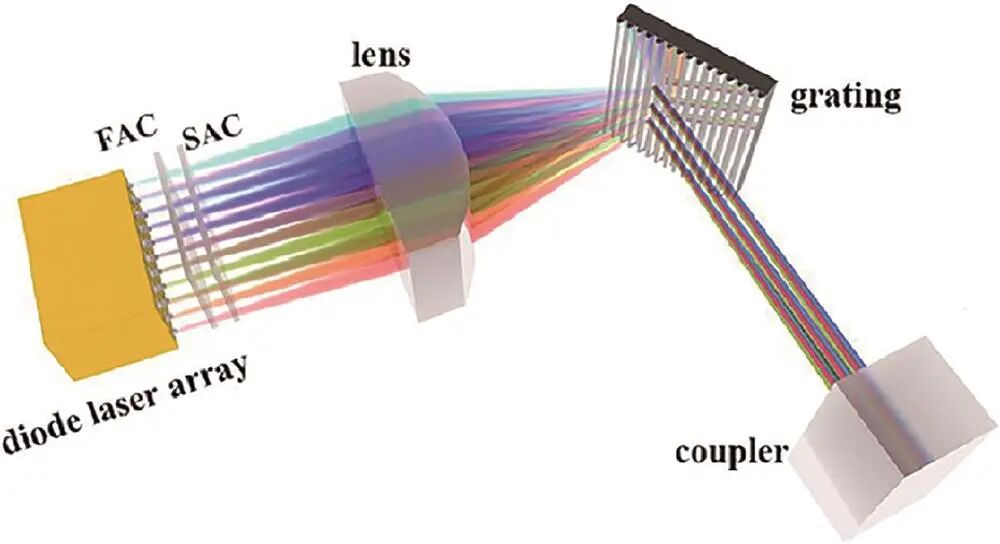
In an external-cavity configuration:
- Each laser emitter is wavelength-locked
- A diffraction grating spatially separates and recombines beams
- All channels are combined into a single high-quality output beam
Key advantages of SBC include:
- Excellent beam quality preservation (similar to single emitter)
- High scalability with multiple emitters
- Brightness improvement by 2–3 orders of magnitude
- Strong compatibility with industrial system integration
SBC effectively merges semiconductor laser array technology with wavelength-division multiplexing principles, making it the most efficient route toward ultra-high-brightness blue laser systems.
3. Technical Challenges in Blue Laser Beam Combining
Despite rapid progress, blue laser systems still face several engineering challenges:
3.1 Optical Material Limitations
Blue wavelength operation (~450 nm) introduces higher photon energy, leading to stronger material absorption compared with near-infrared lasers.
- Common optical glass (e.g., S-TIH53) shows only 75%–90% transmission in blue wavelengths
- Absorption-induced heating leads to thermal lensing and optical distortion
- Fused silica offers ~99.5% transmission but limits optical design flexibility
3.2 Coating and Damage Threshold Challenges
Optical coatings for blue lasers require extremely high laser-induced damage thresholds (LIDT).
- Shorter wavelength → higher energy density
- Lower damage threshold compared to infrared optics
- Requires advanced multilayer coating engineering
3.3 System-Level Integration Complexity
As beam combining density increases:
- Thermal management becomes critical
- Wavelength stability must be tightly controlled
- Optical alignment precision directly affects system efficiency
4. Industrial Demand and Market Direction
With the rapid expansion of electric vehicles, power electronics, and precision manufacturing, copper processing has become one of the most important industrial laser applications.
Blue lasers are uniquely positioned to meet this demand due to:
- High absorption in copper and reflective metals
- Reduced spatter and improved weld quality
- Higher process efficiency compared with IR lasers
The industry is now clearly moving toward:
high-brightness, high-power, and system-integrated blue laser architectures
5. CS Tec High-Power Blue Laser Solutions
Based on advanced semiconductor laser technology and beam combining architectures, CS Tec provides a complete portfolio of blue laser solutions for industrial integration:
● High-Power Blue Laser Diodes (LD)
Spec:
- Wavelength:445 ± 20nm
- Output Power:60/90/200/320W
- Fiber Core Diameter:50/105um;
- BPP:3/6/7.5/9mm·mrad
- Pilot Laser:638nm or Customized;
- Cooling Method:water cooling
- Delivery Fiber connectors:SMA905 or QBH
- Feeding Fiber Length:5m or Customized;
Key features:
- Extreme Brightness
- Performance
- Mininum < 3 mm·mrad
- Industrial-Leading NA
- Average < 0.15 (minimum 0.12)
- Themal&Mechanical Excellence
- Modular Design
- Scalable power range up to 6kW
● Blue Laser Modules (High Brightness Systems)
- Industry-Leading Brightness
- Advanced thermal management system
- Unrivaled Stability
- Compatibility for External Optics
● “CP” Hybrid Laser Systems
- Industry-Leading Brightness
- 10x higher absorption in cooper/relective metals
- Reduced significantly Heat Input
- Industry-Leading Brightness
- Minimized Spatter
- Hybrid for multi-material processing