
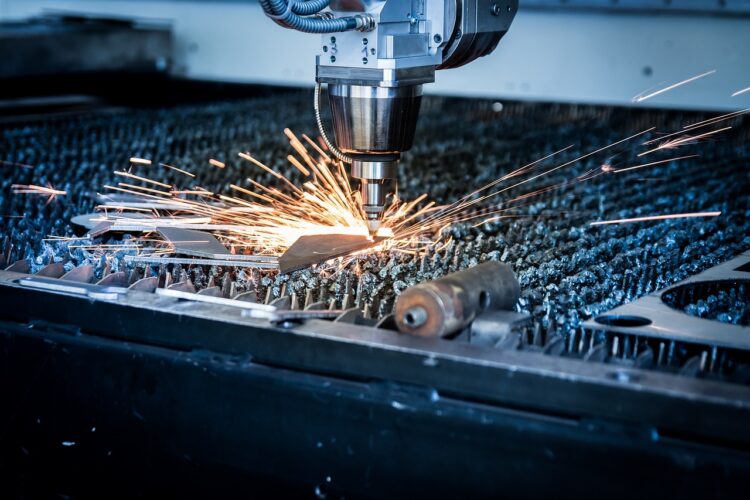
Fiber Laser Source for Stainless Steel Cutting: Nitrogen, Speed, and Edge Quality
Stainless steel is the most widely cut material on fiber laser machines after carbon steel, and it is the material most likely to produce edge quality problems when operators transfer parameters from carbon steel without adjustment. The physics of stainless steel under a fiber laser beam are different enough from carbon steel to warrant a dedicated approach — different assist gas, different speed strategy, different focus logic, and different expectations by grade. This guide covers all of these, with quantified data where available.
Why stainless steel behaves differently from carbon steel under a fiber laser
Two physical properties distinguish stainless steel from carbon steel in laser cutting, and both flow from the same alloying chemistry.
First, thermal conductivity. Carbon steel conducts heat at approximately 50 W/m·K. Austenitic stainless steel (304, 316) conducts at approximately 15 W/m·K — roughly one-third the rate. Stainless has lower thermal conductivity than carbon steel, meaning heat stays concentrated in the cut zone. This is simultaneously an advantage and a challenge. The advantage: heat concentration in the kerf means the laser energy is not being wasted to lateral conduction, making stainless steel highly responsive to focused laser energy. The challenge: the same concentration means the heat-affected zone is sensitive to parameter variation in ways that carbon steel is not. A parameter set that produces acceptable results on carbon steel will not transfer to stainless steel without adjustment, and the consequences of over-heating the kerf — edge discoloration, HAZ expansion, dross formation — appear faster and more severely than they would on carbon steel.
Second, surface oxidation chemistry. The chromium content of stainless steel (minimum 10.5% for stainless classification) is what gives it corrosion resistance: chromium reacts with oxygen to form a thin, stable passive layer (Cr₂O₃) on the surface. When laser cutting introduces elevated temperatures and oxygen, this passive layer is disrupted and replaced with thicker chromium oxide that discolors the cut edge and, more importantly, compromises the corrosion resistance that the material was specified for. This is the physical reason why the assist gas choice for stainless steel is not simply a matter of preference — it determines whether the finished part retains its material properties.
Why nitrogen is not optional for most stainless steel applications
What happens chemically when oxygen meets stainless steel at laser cutting temperatures
Oxygen causes an exothermic reaction that speeds up the cut but leaves a dark oxide scale that demands expensive mechanical removal before welding or coating. For carbon steel, this oxide layer is a manageable trade-off — it can be ground off, and the steel beneath it retains its properties. For stainless steel, the situation is structurally different.
The oxide scale formed on stainless steel during oxygen-assisted cutting is not a surface deposit that can be removed to restore the underlying metal to its original condition. The formation of thick chromium oxide at elevated temperatures depletes the chromium content in the immediate sub-surface zone, creating a chromium-depleted layer that has meaningfully lower corrosion resistance than the bulk material. In food processing equipment, pharmaceutical manufacturing fixtures, marine architectural components, and medical devices, this degraded zone is not acceptable — the corrosion resistance that justified the choice of stainless steel in the first place is precisely what oxygen cutting removes.
What nitrogen actually does — and why pressure matters as much as purity
Nitrogen performs two functions simultaneously in stainless steel cutting: it provides an inert atmosphere that prevents oxidation of the cut surface throughout the cutting process, and it provides the mechanical ejection force that removes molten metal from the kerf before it can re-solidify as dross.
These two functions impose different requirements on the gas supply. The protective function requires sufficient flow volume to maintain a positive-pressure inert atmosphere at the cut zone throughout the cut — allowing any air to reach the hot kerf produces visible oxidation. The ejection function requires sufficient pressure to provide the momentum necessary to overcome the surface tension and gravity holding the melt in the kerf.
For austenitic stainless steel grades 304 and 316, nitrogen cutting at 10–18 bar produces oxide-free edges critical for food processing, medical, and architectural applications. The lower end of this range (10–12 bar) is typically sufficient for thin sheet (below 3 mm). As thickness increases, the kerf depth increases and the gas jet must maintain ejection pressure at greater depth — requiring higher nozzle pressure.
Gas purity matters as much as pressure. Nitrogen for stainless steel cutting should be 99.99% or higher. Oxygen contamination in the nitrogen supply at any concentration introduces the oxidation chemistry that nitrogen was chosen to prevent. A nitrogen system with a compromised fitting, an incorrect regulator, or a cylinder that was not fully purged before use will produce an oxidized edge despite nominally “using nitrogen.”
When oxygen or air cutting is acceptable — and the trade-offs
Three scenarios make oxygen or compressed air a defensible choice for stainless steel:
Parts that will receive subsequent surface treatment — powder coating, painting, plating, or mechanical grinding — where the cut edge is not a functional surface and the oxide layer will be removed or covered in downstream processing. Structural or heavy fabrication applications where cutting speed and cost dominate the requirements and the cut edge will not be visible, will not be welded without prior grinding, and is not in a corrosion-sensitive environment. High-volume production of low-specification stainless parts where gas cost is a significant operational variable. Air cutting offers approximately 80% cost savings versus nitrogen — a significant number at scale — with the trade-off of a slightly yellow edge and compromised corrosion resistance at the cut surface.
The rule is straightforward: choose nitrogen when edge appearance matters — food-contact, decorative, visible weld-prep, or corrosion-sensitive parts. Choose oxygen when speed and cost matter more than edge appearance — structural plate or parts that will be coated, ground, or machined later. Do not use oxygen on any application where the cut edge will be welded without grinding, exposed to corrosive environments, or visible in the finished product.
The counterintuitive truth about cutting speed and edge quality
Operator instinct in laser cutting generally points toward slower speed as the path to better cut quality — more time at each point means more complete melting and cleaner cuts. For stainless steel, this instinct produces the wrong result.
The physical mechanism is straightforward once the thermal properties are understood. Stainless steel’s low thermal conductivity means that heat input at the kerf does not diffuse laterally into the surrounding material at the same rate as in carbon steel. At slow cutting speeds, the laser dwells at each point long enough for heat to accumulate in the kerf zone beyond what is needed for clean melting — the excess heat expands the melt pool, produces irregular melt flow dynamics, and results in wider kerf and higher surface roughness as the nitrogen jet cannot cleanly eject the oversized melt pool.
At higher speeds, the laser delivers energy to each point for a shorter duration. The melt zone remains tighter, the kerf is narrower, and the nitrogen jet can eject the more contained melt pool cleanly. The result is a more regular striation pattern, lower Ra, and less HAZ width. Increased cutting speed results in smaller heat-affected zone and lower thermal softening, preserving the material’s original hardness due to rapid cooling.
The practical implication: when stainless steel cut quality is poor — rough striations, excessive dross, edge discoloration — the first adjustment to try is increasing cutting speed, not decreasing it. Reduce speed only after confirming that the source power is sufficient for the current thickness at the target speed.
Power requirements by thickness — and why stainless steel needs more than equivalent carbon steel
The 30–40% power premium and where it comes from
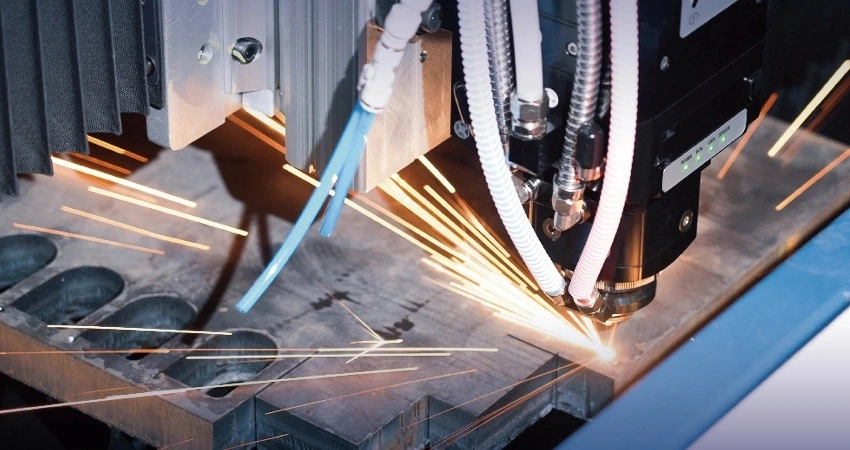
Stainless steel cutting with nitrogen requires approximately 30–40% more laser power than oxygen-assisted carbon steel cutting at the same thickness. The reason is the absence of exothermic reaction assistance. Oxygen-assisted carbon steel cutting benefits from the heat released by the iron-oxygen oxidation reaction — this supplemental energy contributes meaningfully to the cutting process, effectively adding energy on top of what the laser delivers. Nitrogen-assisted stainless steel cutting provides no such supplement: all cutting energy comes from the laser source alone, and the laser must supply sufficient power density to melt and eject the material without any chemical energy contribution.
This is why a source rated at 3 kW for carbon steel applications should not be assumed to be adequate for equivalent stainless steel thicknesses — the power requirement is higher because the cutting mechanism is fundamentally different.
Power and thickness reference for stainless steel
| Stainless thickness | Recommended power | N₂ cutting speed | O₂ cutting speed | N₂ pressure | Notes |
|---|---|---|---|---|---|
| 0.5–1 mm | 1,000–1,500 W | 15–30 m/min | 20–40 m/min | 10–12 bar | Thin sheet; beam quality critical for tight features |
| 1–2 mm | 1,500–2,000 W | 10–20 m/min | 15–25 m/min | 10–14 bar | Standard precision sheet; N₂ preferred |
| 2–3 mm | 2,000–3,000 W | 6–12 m/min | 10–16 m/min | 12–16 bar | Separate pierce parameters recommended |
| 3–5 mm | 3,000–4,000 W | 3–7 m/min | 6–10 m/min | 14–18 bar | N₂ standard for most applications |
| 5–8 mm | 4,000–6,000 W | 1.5–4 m/min | 3–6 m/min | 16–20 bar | 6 kW practical mainstream for this range |
| 8–12 mm | 6,000–8,000 W | 0.8–2 m/min | 1.5–3 m/min | 18–22 bar | 12 kW enables 20 mm+ with stable quality |
| 12–20 mm | 8,000–12,000 W | 0.4–1.2 m/min | 0.8–2 m/min | 20–25 bar | Edge taper increases; high-power reduces taper |
| Above 20 mm | 12,000 W+ | 0.2–0.6 m/min | N/A or O₂ only | 22–30 bar | Thick plate; taper control requires careful focus management |
These figures are production reference values for standard austenitic grades (304, 316). Apply the grade-specific adjustments described in the next section.
Grade matters: how 304, 316L, and 430 cut differently
Austenitic grades (304, 316L) — the standard and its hidden variable
304 and 316L are both austenitic stainless steels with similar macroscopic cutting behavior. Treating them as interchangeable in laser cutting parameter development is a common error in precision applications.
The molybdenum content of 316L (2–3%) has a significant impact on its thermal conductivity and melt behavior compared to 304. Using 304 parameters directly for 316L produces edge overheating and corrosion resistance loss in the heat-affected zone. The molybdenum in 316L changes the melt pool viscosity and the rate at which heat distributes through the material, requiring a parameter adjustment — typically a modest reduction in cutting speed and a corresponding reduction in power — compared to 304 at the same thickness.
For applications where 316L is specified precisely because of its superior corrosion resistance — marine environments, chemical processing, pharmaceutical manufacturing — this grade-level parameter difference is not academic. The whole point of 316L is its performance in corrosive environments; cutting it with parameters that generate a wider HAZ and reduce its chromium-passive-layer integrity defeats the purpose of specifying 316L in the first place.
Develop independent parameter sets for 304 and 316L rather than assuming one set of stainless steel parameters covers both. The parameter adjustment between them is modest — 5–15% speed and power change — but the functional consequence of ignoring it is significant in precision applications.
Ferritic grade 430 — why it actually cuts easier than austenitic grades
430 stainless steel is often grouped with 304 and 316 in general “stainless steel cutting” discussions, but its cutting behavior is meaningfully different — and more favorable.
Ferritic grades such as 430 possess a body-centered cubic (BCC) structure. They are magnetic, non-hardenable by heat treatment, and have better thermal conductivity than austenitic grades. The higher thermal conductivity of 430 (approximately 26 W/m·K compared to 15 W/m·K for 304) means heat dissipates more readily from the kerf into the surrounding material. This reduces the tendency for heat accumulation that makes austenitic stainless cutting parameter-sensitive.
Research on fiber laser cutting of AISI 430 confirms that its higher thermal conductivity relative to austenitic grades results in lower dross formation and more stable cutting quality across a wider range of process parameters. In practical production terms: 430 can be cut at higher speeds than 304 at equivalent thickness, with less dross and more consistent edge quality across the parameter range. If your production includes both 430 and 304, develop separate parameter sets — the 430 parameters will run faster and are more forgiving of minor variations.
Duplex grades — when standard parameters fail
Duplex stainless steels (2205, 2507, and similar) combine austenitic and ferritic microstructure phases, producing mechanical strength significantly higher than standard 304 or 316. This higher strength has direct consequences for laser cutting.
Cutting duplex grades requires significantly higher laser power and slower travel speeds compared to standard 304 stainless steel sheets. The higher strength means more energy is required per unit volume of material removed, and the mixed microstructure produces different melt flow behavior than either pure austenitic or ferritic grades. Using 304 parameters on a duplex grade typically produces incomplete penetration, severe dross on the lower edge, or both.
If your application specifies duplex stainless — structural components requiring high strength with corrosion resistance, subsea equipment, chemical processing vessels — develop dedicated parameters from scratch rather than scaling from 304 reference values. Plan for 20–40% more power and 20–30% slower speed compared to 304 at the same thickness, and increase nitrogen pressure by approximately 15% above your 304 reference.
Focus position and its effect on edge taper
Stainless steel cutting uses a negative focus position — the focal point is set below the material surface — in contrast to carbon steel, which typically uses a positive or near-zero focus. Normally use a positive focus point for cutting carbon steel, and a negative focus point for cutting stainless steel. This focus strategy distributes the beam’s energy more uniformly through the material depth, reducing the power density differential between the top and bottom of the kerf.
Research confirms that focus position is one of the most significant variables in stainless steel laser cutting: changing the focal position from 30% to 50% depth setting (moving toward the material surface) in combination with optimized cutting speed reduces kerf width from 185 µm to 138 µm — a change in the same magnitude as the cutting speed effect. Both variables matter, and neither alone produces optimal results.
For thick stainless steel (above 10 mm), edge taper — the difference in kerf width between the entry and exit surfaces — becomes a meaningful quality concern. High-power systems at 12 kW and above provide better control over heat input and reduced taper, which is critical for precision components. At thicknesses above 15 mm, taper control typically requires deeply negative focus positions and may require secondary machining to achieve tight tolerances on the cut edge. Edge taper becomes much more pronounced on plates thicker than 10 mm, which usually requires secondary CNC machining if tight tolerances are required.
Surface finish considerations — polished, brushed, and bare stainless
The surface finish of the stainless steel sheet significantly affects laser cutting parameters, and stainless steel has the widest range of surface finishes of any common cutting material — from matte mill finish to mirror-polished #8 finish.
Mirror-polished stainless (BA, #8) reflects more near-infrared laser energy than standard mill finish, requiring higher power density to establish stable cutting. The difference in initial absorptance between a matte mill finish and a mirror finish is significant enough to require parameter adjustment — not the same adjustment as switching between material grades, but measurable in cutting speed terms.
Before cutting polished stainless steel, the protective film on the surface should remain intact until cutting is complete. This practice serves two purposes: it protects the polished surface from spatter and fume deposition during cutting, and the film itself slightly reduces the surface reflectance, making initial beam coupling more reliable. Remove the film only after the cut parts have been removed from the cutting table.
For brushed stainless (#4 finish), which is common in architectural and food processing applications, the directional surface texture can produce slightly different cut quality depending on whether the cut path runs parallel or perpendicular to the brush direction. Parts with long straight cuts parallel to the brush direction are typically not affected. Parts with complex feature geometries that cross the brush direction at multiple angles may show minor variation in edge quality at the direction transitions. This is a design and nesting consideration rather than a source specification issue, but it is worth noting when developing parameters for brushed stainless applications.
Application-specific requirements — food processing, medical, and architectural
The industries that specify stainless steel most consistently are also the industries with the strictest cut quality requirements. Understanding these requirements at the application level clarifies why source specifications for stainless steel cutting are more demanding than for carbon steel.
Food processing equipment requires cut edges that are free of oxidation, free of crevices that could harbor bacteria, and sufficiently smooth to be cleanable by standard sanitization procedures. Nitrogen cutting of 304 and 316 austenitic stainless at 10–18 bar produces oxide-free edges critical for food processing applications. The HAZ at the cut edge must be minimized — wide heat-affected zones create subtle surface chemistry changes that affect cleanability. High cutting speed, which reduces HAZ width as demonstrated in the research cited earlier in this guide, is the process-level response to food processing edge quality requirements.
Medical device components require dimensional accuracy that places additional demands on beam quality. Tolerances of ±0.1 to ±0.25 mm conforming to ISO 9013:2017 quality ranges are achievable on stainless steel with appropriate source and process parameters. Heat-affected zones measure 0.2–0.4 mm, smaller when using nitrogen assist gas. Achieving these tolerances consistently requires a source with tightly specified beam quality (M² and BPP measured at rated power), stable power output, and a cutting head with reliable focus position repeatability. Source beam quality that is adequate for general fabrication may not produce the dimensional consistency required for medical device components at production volume.
Architectural stainless steel panels — exterior cladding, interior feature walls, decorative screens — require a bright silver cut edge without any yellowing, blueing, or oxide discoloration. This edge will be visible in the finished installation. Any deviation from the bright, mirror-like edge that nitrogen cutting produces is a quality rejection. The nitrogen supply purity requirement (99.99%+) is non-negotiable for architectural applications, and the gas delivery system — regulators, hoses, fittings — must be verified to be free of contamination that could introduce trace oxygen into the cutting zone.
For all three of these application categories, the fiber laser source specification requirements converge on the same set of attributes: adequate power with 30–40% margin above equivalent carbon steel, beam quality specified at rated power (not at reduced test conditions), and a cutting system with the focus position control accuracy to produce consistent HAZ widths across production runs.
Source selection checklist for stainless steel cutting
Before specifying a fiber laser source for stainless steel cutting applications, verify the following:
Power specification:
- Source power covers the required thickness range with the 30–40% nitrogen-cutting premium over oxygen-assisted carbon steel accounted for
- For applications above 10 mm: 8 kW minimum; above 15 mm: 12 kW minimum for production-viable speeds
- For precision applications: confirm power is stated at rated output, not at a reduced test condition
Beam quality:
- M² and BPP specified at rated output power per ISO 11146 standard
- For thin-sheet precision work (below 3 mm) or medical device applications: M² ≤ 1.5 at rated power
- For thick-plate applications (above 10 mm): confirm beam quality is maintained at the high power levels required for the thickness range
Nitrogen infrastructure:
- Nitrogen supply rated to 25+ bar for applications above 10 mm stainless steel
- Nitrogen purity specification: 99.99% minimum — no exceptions for food processing, medical, or architectural applications
- Gas delivery system verified clean — no oxygen contamination from fittings, hoses, or inadequately purged cylinders
Process capability:
- Negative focus position capability: confirm the cutting head supports the required negative focus range for target thickness
- Separate piercing parameter capability: confirmed for thicknesses above 3 mm where pierce parameters must differ from cutting parameters
- Grade-specific parameter development: separate parameter sets confirmed for 304, 316L, and any other grades in the production mix