
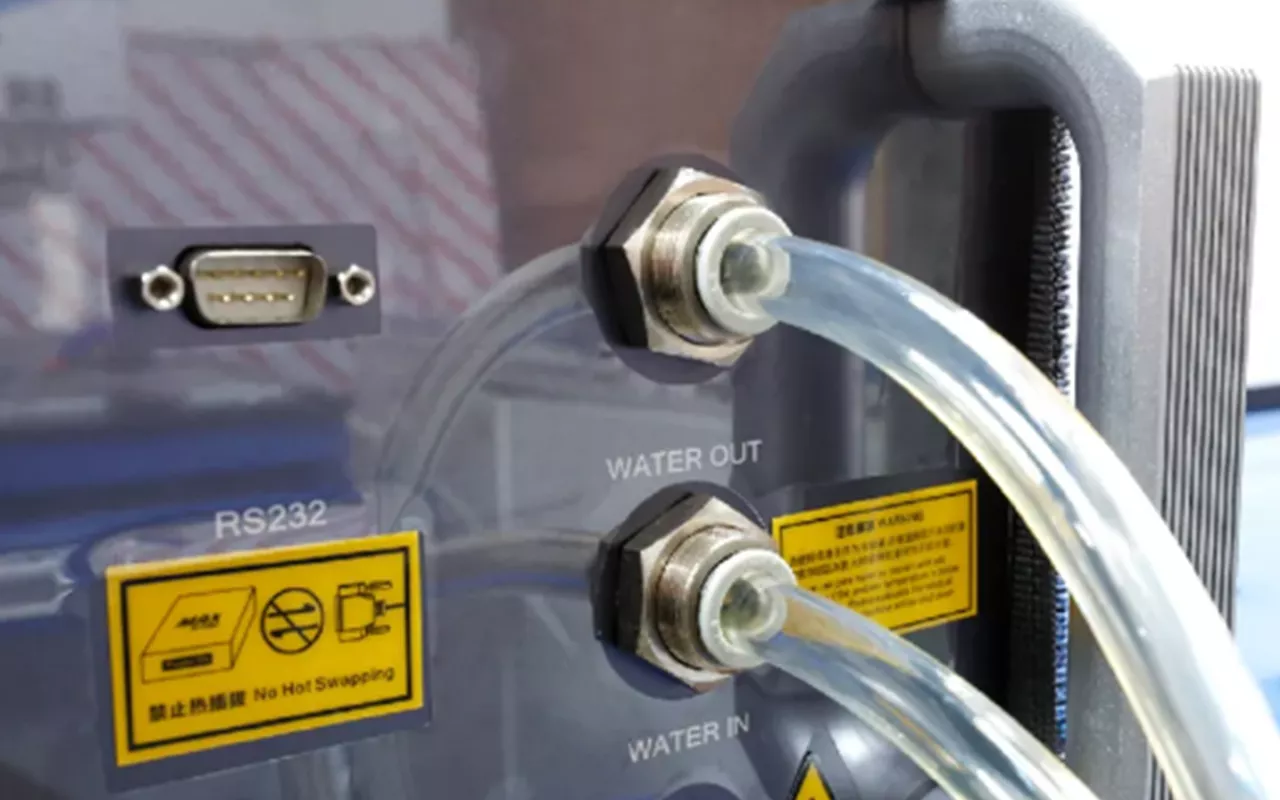
Cooling water is an active part of a fiber laser source’s thermal system, not simply a fluid that carries heat away. Its conductivity, pH, hardness, particle content, additives, temperature, and biological condition must remain within the limits defined for the exact laser source and cooling circuit.
There is no universal water-quality specification that applies to every fiber laser. Different source models may use different wetted materials, channel dimensions, electrical-isolation designs, output connectors, and cooling architectures, so a value accepted by one manufacturer may be unsuitable for another.
The governing rule is therefore simple: follow the technical manual for the exact laser source, processing head, and chiller configuration. Generic online recommendations should never override model-specific requirements.
What Cooling Water Should a Fiber Laser Source Use?
Use only the water or premixed coolant approved by the laser source manufacturer. Deionized, distilled, purified, reverse-osmosis, softened, and tap water are not interchangeable because they can differ in ionic content, hardness, chloride concentration, particles, microorganisms, and storage contamination.
Current laser manuals illustrate why the exact product documentation matters. The Raycus RFL-C40000 user guide, for example, provides cooling requirements for a specific high-power source rather than presenting them as universal limits for all fiber lasers.
Before filling the chiller, confirm:
- The approved water or coolant type
- The required conductivity range or maximum value
- The permitted pH range
- Hardness, chloride, and particle limits
- Whether additives or biocides are permitted
- Whether the laser source and processing head use the same coolant specification
- The required replacement and flushing procedure
Operators of water-cooled CW fiber laser sources should obtain these values before selecting the chiller, preparing the installation site, or purchasing water in bulk.
Is Deionized Water the Same as Distilled Water?
No. Deionization primarily removes electrically charged ions, while distillation separates water from many dissolved and suspended contaminants through evaporation and condensation.
Neither production method guarantees that the water remains suitable after packaging and storage. Water can absorb carbon dioxide from the air, dissolve ions from a container, or collect particles during transport and filling.
The label on the container should therefore be treated as a starting point, not a complete acceptance test. Where the source manual specifies measurable limits, verify the delivered water before it enters the laser cooling circuit.
Can Purified or Reverse-Osmosis Water Be Used?
Purified or reverse-osmosis water may be acceptable when the laser manufacturer permits it and the measured properties meet the required limits. The term “purified” does not establish a specific conductivity, hardness, chloride level, or biological condition.
Reverse osmosis reduces many dissolved salts, but performance varies with membrane condition, incoming water, pressure, and treatment stages. Two containers carrying similar labels can therefore have different water chemistry.
When purchasing treated water, record the supplier, batch, date, and available certificate of analysis. Conductivity should still be checked at the point of use because transport containers and filling equipment can reintroduce contamination.
Can Tap Water or Softened Water Be Used Temporarily?
Tap water should not be introduced unless the laser manufacturer explicitly allows it. It can contain calcium, magnesium, chloride, treatment chemicals, suspended material, and biological contaminants that promote scaling, corrosion, or channel blockage.
Softened water is also not equivalent to deionized water. A conventional softener replaces much of the calcium and magnesium with sodium ions, so the water may have lower hardness while retaining substantial electrical conductivity.
If an incorrect water type is added accidentally, do not assume that diluting it with approved water resolves the problem. Obtain a manufacturer-approved draining and flushing procedure before normal operation continues.
Why Is There No Universal Fiber Laser Cooling-Water Specification?
Acceptable water chemistry depends on the internal design of the laser and cooling circuit. Different systems may contain copper, stainless steel, aluminum, polymers, seals, brazed joints, optical components, and electrically sensitive assemblies.
The cooling channels may also differ substantially in diameter and function. A laser module, process-fiber connector, collimator, beam switch, and processing head may not share the same flow, filtration, pressure, or water-quality requirements.
The IPG High Power Laser Pre-Installation Guide illustrates this distinction by documenting separate cooling conditions for laser and beam-delivery components. Although equipment designs evolve, the underlying integration lesson remains relevant: the complete cooling system must be specified component by component.
Differences between manuals do not mean that one specification is incorrect. They mean the approved chemistry depends on the materials, sensors, electrical design, and hydraulic conditions of the specific product.
What Does Cooling-Water Conductivity Measure?
Conductivity measures how readily water carries electrical current through dissolved ions. It is useful for detecting changes in ionic contamination, but it does not provide a complete analysis of water quality.
ASTM D1125-23 covers conductivity and resistivity measurements in water and identifies conductivity as a method used to detect and, in some cases, quantify dissolved ionic constituents. The standard includes methods for static samples and continuous inline measurement.
In a laser cooling loop, increased conductivity may result from:
- Incorrect incoming water
- Corrosion products dissolving into the coolant
- Residues inside new hoses, fittings, or reservoirs
- Unapproved additives or antifreeze
- Repeated topping up with unsuitable water
- Contamination introduced during maintenance
- Ions released from deteriorating system materials
Conductivity is commonly expressed in microsiemens per centimetre, written as μS/cm. Resistivity expresses the inverse relationship, so high conductivity corresponds to low resistivity.
Is Conductivity the Same as TDS?
No. Conductivity is measured from the electrical response of the water, while many handheld total dissolved solids meters estimate TDS by applying a conversion factor to the conductivity reading.
Because the relationship depends on which ions are present, two meters using different factors can display different TDS values for the same sample. If the laser manual specifies conductivity in μS/cm, use a conductivity result rather than converting it into ppm.
Confirm that the meter covers the required range and provides suitable resolution. A general-purpose meter designed for drinking water may not be accurate enough for a low-conductivity laser cooling circuit.
Why Does Conductivity Rise After the Chiller Is Filled?
Fresh water begins interacting with the reservoir, hoses, pumps, fittings, filters, heat exchangers, and internal laser passages as soon as circulation starts. Residues or ions released from these surfaces can cause conductivity to rise from its initial value.
A small initial change does not automatically indicate failure, but the value should stabilize within the operating limits defined by the manufacturer. A continued rise requires investigation.
Possible causes include corrosion, incompatible materials, an unclean reservoir, contamination from a top-up container, an exhausted filter, an incorrect additive, or residual cleaning chemicals.
This is why a trend is often more useful than a single measurement. Record the conductivity immediately after filling, after circulation has stabilized, and at consistent maintenance intervals.
Does Low Conductivity Prove That the Water Is Clean?
No. Water can have low ionic conductivity while still containing suspended particles, oil, nonionic organic contamination, microorganisms, or biofilm fragments.
Conductivity also does not identify which ions are present. A sample can meet a general conductivity limit while containing an individual contaminant that is restricted by the laser manufacturer.
A complete inspection may therefore include:
- Conductivity
- pH
- Hardness where specified
- Chloride or other ion analysis where specified
- Visual particle inspection
- Filter condition
- Color, cloudiness, sediment, slime, or odor
- Flow and pressure behavior
How Should Cooling-Water Conductivity Be Measured?
Conductivity should be measured with a suitable, calibrated instrument using a repeatable sampling method. Measurements should be taken from the same location and under comparable conditions whenever possible.
A practical procedure is:
- Use a meter with the required range and resolution.
- Calibrate it according to the meter manufacturer’s instructions.
- Use a clean sample container reserved for cooling-water testing.
- Allow the sample and probe reading to stabilize.
- Record the sample location and water temperature.
- Apply or confirm temperature compensation where required.
- Rinse the probe using the approved procedure before storage.
Do not place a contaminated probe directly into the chiller reservoir. Residues from calibration solution, tap water, cleaning chemicals, or previous samples can alter a low-conductivity circuit.
How Often Should Conductivity Be Tested?
Testing frequency should follow the laser source and chiller manuals. It should be increased after commissioning, a refill, a component replacement, repeated top-ups, an alarm, or any contamination event.
A practical monitoring plan can include:
- A baseline before filling
- A reading after initial circulation
- Shorter intervals during early commissioning
- Regular readings during preventive maintenance
- Additional testing after filter, hose, pump, or heat-exchanger work
- Testing before and after seasonal antifreeze use
The maintenance trigger should be based on the manufacturer’s limit and the trend from the system’s established baseline—not on a generic number copied from another laser model.
When Should Cooling Water Be Replaced Based on Conductivity?
Replace the coolant when it reaches the limit defined by the manufacturer or when an unexplained trend indicates progressive contamination. Confirm an unexpected reading before taking action by checking the instrument, probe, sample container, and temperature.
If the conductivity returns to an unacceptable level shortly after replacement, repeated water changes are unlikely to solve the problem. Inspect the circuit for corrosion, residues, unapproved materials, additives, contamination, or incomplete flushing.
What pH Should Fiber Laser Cooling Water Have?
The water should remain within the pH range specified for the exact source and chiller. Water that is too acidic or alkaline can accelerate corrosion, affect seals, alter mineral solubility, and contribute to deposits.
Do not apply one universal “neutral” value to every system. The acceptable range depends on the metals, polymers, coatings, inhibitors, and other materials in contact with the coolant.
Why Can Low or High pH Damage the Cooling Circuit?
Acidic water can increase attack on susceptible metals, joints, and protective surfaces. Strongly alkaline conditions can also damage certain metals, coatings, elastomers, or adhesives and may encourage some dissolved minerals to precipitate.
A pH result should be evaluated together with conductivity and visible evidence. A change in pH may indicate contamination, carbon dioxide absorption, additive degradation, corrosion, or unsuitable replacement water.
Why Is pH Difficult to Measure in Low-Conductivity Water?
High-purity water contains few ions and has little buffering capacity, making conventional pH measurements slow and sensitive to contamination. Exposure to air can also change the result because high-purity water rapidly absorbs carbon dioxide.
ASTM D1293 notes that its conventional methods are not adequate below approximately 5 μS/cm. For low-conductivity samples, ASTM D5464-25 addresses pH measurement in water from 2 to 100 μS/cm and highlights the effects of atmospheric exposure, contamination, and temperature.
This means an unstable pH reading does not automatically prove that the coolant chemistry is changing. The test method, electrode, sample handling, exposure time, and temperature must also be reviewed.
For low-conductivity water:
- Use an instrument and electrode intended for the measurement range.
- Minimize exposure to air.
- Use a clean container with minimal sample handling.
- Allow for the required stabilization time.
- Keep the sample near the operating temperature where practical.
- Do not rely only on inexpensive pH strips.
How Do Hardness and Dissolved Minerals Create Scale?
Calcium, magnesium, and other dissolved minerals can precipitate on warm heat-transfer surfaces and form scale. The deposit creates thermal resistance, narrows passages, and can reduce coolant flow.
ASTM D1126 identifies calcium and magnesium hardness salts as primary causes of tube and pipe scaling, which can result in clogging, reduced heat transfer, and loss of process efficiency.
Inside a laser cooling circuit, scale can contribute to:
- Higher internal component temperatures
- Increased pressure drop
- Reduced flow through narrow channels
- More frequent chiller operation
- Flow or temperature alarms
- Local hot spots
- Progressive component damage
Is Softened Water Safe for a Fiber Laser Source?
Not automatically. Softening commonly exchanges calcium and magnesium for sodium, reducing hardness without necessarily reducing conductivity, chloride, or total ionic content.
Softened water should only be used when the laser manufacturer permits it and all required parameters have been verified. A water-softener certificate alone does not demonstrate compatibility with a laser cooling circuit.
What Does Scale Do to Cooling Performance?
Scale acts as an insulating layer between the cooled component and the circulating water. The component can become hotter even when the chiller outlet temperature appears normal.
At the same time, deposits reduce the effective channel area. This can decrease flow, increase pressure drop, and make the system more sensitive to filter loading or pump deterioration.
A low-flow or high-temperature alarm should not be treated only as a pump problem. Filters, hoses, internal passages, coolant chemistry, and evidence of mineral deposition should also be checked.
How Do Chloride and Other Ions Cause Corrosion?
Total conductivity does not show which ions are present. Specific ions can be damaging even when the overall conductivity remains within a broad range.
Chloride is particularly important in systems containing susceptible metals because it can contribute to localized corrosion. ASTM D512 provides methods for measuring chloride ion in water and notes its potential to damage stainless-steel and other industrial water systems.
Possible chloride sources include:
- Tap water
- Incorrect purified water
- Cleaning residues
- Handling contamination
- Unapproved additives
- Salt-containing antifreeze products
If the source manual includes a chloride limit, conductivity cannot be used as a substitute for chloride analysis.
Can Deionized Water Cause Corrosion?
Deionized water is not permanently ion-free. It can absorb carbon dioxide from air and dissolve ions from metals, hoses, fittings, seals, residues, and containers until it reaches a new chemical equilibrium.
Whether it becomes corrosive depends on its pH, dissolved gases, temperature, flow, wetted materials, inhibitors, and the source manufacturer’s intended operating range.
This is another reason not to assume that the lowest possible conductivity is always best. Some systems require water below a maximum value, while others may be designed around a controlled operating range.
What Do Different Deposit Colors Mean?
Deposit color can provide an initial clue, but it cannot reliably identify the cause without analysis.
- White deposits: May indicate mineral scale or dried coolant residue.
- Green or blue material: May involve copper-containing corrosion products.
- Brown or red particles: May include iron corrosion products, environmental contamination, or biological material.
- Black particles: May come from degraded hoses, seals, coatings, or other system materials.
- Slime or films: May indicate microbial growth or mixed contamination.
Do not select a cleaning chemical based only on color. Retain a sample, photograph the location, inspect the filter and hoses, and ask the equipment supplier whether laboratory analysis is required.
Can Bacteria or Algae Grow in a Closed Laser Chiller?
Yes. A closed circuit can still support microbial growth when contamination is introduced during filling, nutrients are present, water remains stagnant, transparent hoses admit light, or the coolant operates within a favorable temperature range.
Microbial growth may produce:
- Slime or biofilm
- Cloudiness or discoloration
- Unusual odor
- Filter blockage
- Restricted cooling channels
- Reduced heat transfer
- Corrosion beneath deposits
Can Biocide Be Added to Fiber Laser Cooling Water?
Only use a biocide approved by the laser and chiller manufacturers at the specified concentration. An unapproved product can change conductivity, damage seals, react with metals, form deposits, or interfere with another coolant additive.
Do not mix products unless the manufacturer has confirmed their compatibility. More biocide is not necessarily more effective and may increase chemical attack or residue formation.
Is Filtration Enough to Control Biological Contamination?
No. A filter can capture particles above its rated size, but it does not automatically remove dissolved nutrients or biofilm attached to the reservoir, hoses, fittings, and internal passages.
A contaminated system may require an approved combination of:
- Draining
- Reservoir inspection
- Filter replacement
- Hose replacement
- Chiller cleaning
- Controlled flushing
- Approved chemical treatment
- Correction of light exposure or stagnation
Which Cooling-Water Problems Cause Which Fiber Laser Symptoms?
Cooling problems rarely identify their own root cause. The same temperature or flow alarm may result from incorrect water, a blocked filter, scale, glycol concentration, pump deterioration, trapped air, or a restricted hose.
| Water-quality problem | Likely mechanism | Possible operating symptom | What should be checked |
|---|---|---|---|
| Conductivity above the approved limit | Excess dissolved ions or contamination | Conductivity alarm or increased corrosion risk | Water source, additives, corrosion, residues, and top-up history |
| Conductivity outside a required target range | Coolant chemistry does not match the system design | Sensor alarm or accelerated interaction with system materials | Exact manual requirement and meter accuracy |
| pH outside the approved range | Acidic or alkaline attack | Corrosion, leakage, seal damage, or deposits | Measurement method, water age, additives, and contamination |
| High hardness | Mineral precipitation | White scale, low flow, or rising temperature | Incoming-water hardness, filters, and internal deposits |
| Chloride contamination | Localized corrosion | Pitting, leakage, or colored corrosion products | Water source, cleaning residues, additives, and chemical analysis |
| Suspended particles | Filter or channel blockage | Low-flow alarm, pressure increase, or local overheating | Reservoir, filters, hoses, and flushing history |
| Biological growth | Biofilm and sludge formation | Slime, odor, discoloration, and restricted flow | Stagnation, light exposure, reservoir condition, and approved treatment |
| Unapproved glycol or additive | Increased viscosity and altered chemistry | Low flow, reduced cooling, or abnormal conductivity | Product type, concentration, and supplier approval |
| Coolant below the ambient dew point | Condensation | Moisture, corrosion, electrical faults, or false alarms | Ambient temperature, humidity, and coolant setpoint |
| Frozen coolant | Expansion inside confined passages | Cracked pipes, fittings, channels, or optical components | Minimum temperature, storage history, and shutdown procedure |
How Does Poor Cooling Water Damage a Fiber Laser Source?
Poor water quality can reduce heat transfer, restrict circulation, accelerate corrosion, damage seals, and contaminate narrow cooling passages. These mechanisms often reinforce one another.
A typical deterioration cycle can develop as follows:
- Unsuitable water introduces minerals, ions, particles, or microorganisms.
- Deposits begin forming on warm surfaces or inside filters.
- Flow decreases and heat transfer becomes less effective.
- Internal temperatures rise and corrosion or material degradation accelerates.
- Additional ions and particles enter the coolant.
- Conductivity, pressure drop, and alarm frequency increase.
- The system reaches a point where replacing only the water no longer removes the cause.
Possible external symptoms include flow alarms, overtemperature alarms, unstable operation, unexplained top-up requirements, leakage, filter discoloration, rising conductivity, or visible sediment.
What Water Temperature Should a Fiber Laser Source Use?
The coolant must remain within the manufacturer’s specified operating range and safely above the ambient dew point. Colder water is not automatically better.
Cooling water that is too warm may not remove enough heat. Cooling water that is too cold can cause moisture from the surrounding air to condense on hoses, connectors, optical components, electronics, or internal surfaces.
What Is Dew Point and Why Does It Matter?
Dew point is the temperature at which the surrounding air becomes saturated and moisture begins condensing on a cooler surface. It depends on both ambient temperature and relative humidity.
A coolant temperature that is safe in a dry, air-conditioned room may cause condensation in a hot and humid workshop. The risk can also change during the day as doors open, weather changes, or production equipment adds heat and moisture.
Laser manuals warn against condensation because moisture can contribute to:
- Electrical short circuits
- Connector contamination
- Corrosion
- False alarms
- Damage to circuit boards or optical assemblies
How Far Above Dew Point Should the Coolant Be Set?
Use the margin specified by the equipment manufacturer. Do not invent one fixed offset for every facility or laser source.
Where humidity varies substantially, monitor ambient temperature and relative humidity near the laser rather than relying on a reading from another part of the building. The chiller setpoint should be reviewed whenever seasonal or production conditions change.
A laser moved from a cold storage area into a warm, humid room should be allowed to reach safe environmental conditions before startup. Starting immediately can create condensation even when the normal chiller setpoint is correct.
Can Antifreeze Be Used in a Fiber Laser Cooling Circuit?
Antifreeze should only be used when freezing cannot be prevented and the exact product and concentration have been approved. Glycol changes viscosity, heat capacity, conductivity, and hydraulic performance, so it is not a neutral substitute for water.
The official Raycus laser antifreeze guidance warns that antifreeze can reduce cooling performance and affect coolant flow. It also states that antifreeze should not automatically replace deionized or purified water for permanent year-round use.
How Does Glycol Affect Cooling Performance?
Adding glycol generally increases viscosity and reduces the mixture’s specific heat compared with water. At the same pump condition, this can lower flow or reduce the amount of heat carried away by each unit of coolant.
Possible consequences include:
- Higher pump load
- Lower coolant flow
- Reduced thermal margin
- Flow or temperature alarms
- A need to derate the cooling system
The required concentration should be based on the lowest expected temperature and the approved product data. Excess antifreeze should not be added “for extra protection.”
Can Automotive Antifreeze Be Used?
Not without written approval. Automotive products may contain dyes, silicates, organic-acid inhibitors, anti-foam agents, or other additives selected for vehicle engines rather than laser cooling circuits.
These chemicals may affect conductivity, form deposits, attack seals, or react with wetted metals. An antifreeze that protects against freezing can still be unsuitable for the laser.
Should Antifreeze Remain in the System Year-Round?
Only when the manufacturer approves permanent use. Some guidance recommends draining or flushing antifreeze after the freezing season and returning to the normal approved water.
After seasonal use, record:
- The antifreeze product
- The original concentration
- The duration of use
- The draining and flushing procedure
- The conductivity of the final refill
- Any flow or temperature alarms observed
How Often Should Fiber Laser Cooling Water Be Replaced?
There is no universal replacement interval for every source. Follow the laser and chiller manuals, then adjust the maintenance plan according to operating hours, water tests, environment, contamination history, and filter condition.
A calendar interval should not be the only decision factor. Water may require earlier replacement when:
- Conductivity reaches the model limit
- pH moves outside the approved range
- Particles, cloudiness, slime, or discoloration appear
- An unapproved product has been added
- The system has experienced freezing or prolonged stagnation
- Filters load unusually quickly
- Flow or temperature performance changes
What Should Be Checked Before Replacing the Water?
Inspect and record the old coolant before draining it. Discarding the water immediately can remove useful evidence about the cause of a developing problem.
Record:
- Conductivity
- pH where required
- Water temperature
- Color and clarity
- Visible particles or sediment
- Odor
- Filter condition
- Hose and reservoir appearance
- Recent alarms
- Top-up volume and frequency
Retain a labeled sample when contamination, corrosion, or deposit analysis may be necessary.
Is Topping Up the Reservoir the Same as Replacing the Water?
No. Topping up restores the volume but leaves accumulated ions, corrosion products, microorganisms, degraded additives, and deposits inside the system.
If water loss is caused by evaporation, repeated top-ups can concentrate contaminants already present. If it is caused by leakage, the leak must be identified instead of treating additional coolant as routine consumption.
When Does the Cooling Circuit Need a Full Flush?
A full flush may be required when the system contains visible deposits, biological growth, corrosion products, unapproved coolant, persistent conductivity problems, or contamination that returns soon after a water change.
Do not create a flushing procedure without supplier approval. The laser source may contain narrow passages and materials that are incompatible with common descaling or disinfecting chemicals.
What Is the Difference Between a Water Change and a Full Flush?
A water change drains the accessible coolant and refills the system. A flush uses an approved fluid and controlled procedure to remove residual contamination from the reservoir, hoses, filters, heat exchangers, and passages.
Depending on the problem, the approved process may require:
- Isolating the laser source while the chiller is cleaned
- Replacing filters before or after flushing
- Removing contaminated hoses
- Multiple rinse cycles
- Draining trapped low points
- Testing the final rinse
- Verifying flow and pressure before reconnecting the source
Can Acid, Bleach, Detergent, or Alcohol Be Used?
Do not use any cleaning chemical unless the laser or chiller manufacturer has approved the product, concentration, exposure time, temperature, and rinse procedure.
Residual acid, bleach, alcohol, peroxide, or detergent can attack metals, seals, adhesives, coatings, pumps, or internal components. Combining chemicals can also create hazardous reactions or deposits.
If contamination is severe, provide the supplier with photographs, water-test results, filter samples, coolant history, and a list of all chemicals previously used.
How Should a New Chiller Be Prepared Before Connecting the Laser?
A new or repaired chiller should be inspected and prepared before coolant circulates through the laser source. Manufacturing residues, shipping contamination, incorrect hoses, or unapproved fittings can contaminate the source during its first startup.
A commissioning procedure should include:
- Inspect the reservoir, hoses, filters, and fittings.
- Confirm that all wetted materials are compatible with the approved coolant.
- Perform any manufacturer-required initial rinse.
- Install the correct filter elements.
- Fill using clean equipment reserved for approved coolant.
- Remove trapped air according to the chiller instructions.
- Check for leaks.
- Verify flow, pressure, and water temperature.
- Measure and record baseline conductivity.
- Confirm the coolant remains within specification after circulation.
Do not circulate cleaning residues from the chiller through the laser as a way of “flushing the whole system.” Clean the chiller separately where the manufacturer’s procedure requires isolation.
Which Cooling-Water Records Should Be Maintained?
A maintenance log reveals trends that may not be visible in a single inspection. It is also useful when diagnosing recurring alarms or supporting a service and warranty investigation.
| Record item | Why it matters | Possible warning sign |
|---|---|---|
| Conductivity | Tracks dissolved ionic contamination | Rising trend or value outside the model limit |
| pH | Shows acidic or alkaline change | Movement outside the approved range |
| Coolant temperature | Confirms thermal operating conditions | Value outside the source specification |
| Ambient temperature and humidity | Supports dew-point assessment | Coolant approaching the dew point |
| Water appearance | Reveals visible contamination | Cloudiness, color, sediment, slime, or foam |
| Filter condition | Shows particle loading and deposits | Frequent blockage or unusual material |
| Top-up volume | Helps identify leakage or concentration change | Repeated unexplained additions |
| Flow and pressure | Tracks hydraulic condition | Declining flow or rising pressure drop |
| Coolant product and batch | Confirms approved chemistry | Unknown or mixed products |
| Maintenance action | Preserves system history | The same problem returning after service |
For consistent trend analysis, measurements should be taken using the same instruments, sample location, and procedure whenever practical.
What Should You Ask the Fiber Laser Source Supplier About Cooling Water?
The supplier should provide exact chemical, hydraulic, thermal, filtration, additive, maintenance, and winter-protection requirements for the ordered source configuration. “Use pure water” is not a complete technical specification.
Request written confirmation of:
- Approved water or coolant type
- Conductivity maximum, minimum, or target range
- Permitted pH range
- Hardness limit
- Chloride and other ion restrictions
- Particle-size and filtration requirements
- Approved biocide and dosage
- Approved antifreeze and concentration limits
- Required cooling capacity
- Minimum flow and pressure limits
- Coolant-temperature range
- Dew-point or non-condensing requirement
- Separate source and processing-head requirements
- Water replacement interval
- Approved flushing and cleaning procedure
- Long-shutdown and winter-storage procedure
- Coolant-related warranty exclusions
These requirements should be matched to the exact model, power, process-fiber connector, and beam-delivery configuration. Buyers comparing fiber laser source cooling requirements should request the applicable manual before finalizing the chiller and installation design.
Should You Top Up, Replace, Flush, or Stop the Laser?
The correct response depends on the measured condition and likely failure mechanism. Continuing to operate after unexplained contamination, condensation, freezing, or loss of flow can turn a maintenance problem into permanent source damage.
| Observed condition | Recommended decision |
|---|---|
| Water level is slightly low, with no evidence of leakage or contamination | Top up only with the approved coolant and record the amount added |
| Scheduled replacement interval has been reached and the water appears normal | Replace it according to the manufacturer’s procedure |
| Conductivity or pH is outside the approved range | Confirm the measurement, stop operation if required, replace the water, and investigate the cause |
| Visible particles, slime, deposits, or persistent discoloration are present | Stop normal operation and obtain an approved cleaning and flushing procedure |
| Low-flow or overtemperature alarms recur | Inspect filters, pump performance, hoses, trapped air, scale, and contamination before restarting |
| Condensation is visible | Stop operation, correct the coolant and ambient conditions, then dry and inspect affected areas |
| The coolant has frozen or may have frozen | Do not restart; inspect the complete cooling circuit for cracks, leaks, and internal damage |
| An unapproved antifreeze or cleaning chemical was added | Stop operation and request a supplier-approved recovery procedure |
Frequently Asked Questions About Fiber Laser Cooling Water
Can I Use Distilled Water in a Fiber Laser Chiller?
Only when the source and chiller manufacturers approve it and its measured properties meet their limits. The word “distilled” does not prove that the water remained uncontaminated during storage, transport, or filling.
What Conductivity Should Fiber Laser Cooling Water Have?
There is no universal conductivity value for every fiber laser source. Use the minimum, maximum, or target range stated for the exact laser model and cooling circuit.
How Often Should Fiber Laser Cooling Water Be Changed?
Follow the manufacturer’s interval and adjust it according to conductivity, pH, appearance, filter loading, operating hours, and contamination history. Repeated topping up does not replace a complete water change.
Can I Add Antifreeze to a Fiber Laser Chiller?
Only use a product and concentration approved by the laser manufacturer. Antifreeze changes viscosity, heat capacity, conductivity, and flow behavior, and an unsuitable product can damage the cooling system.