
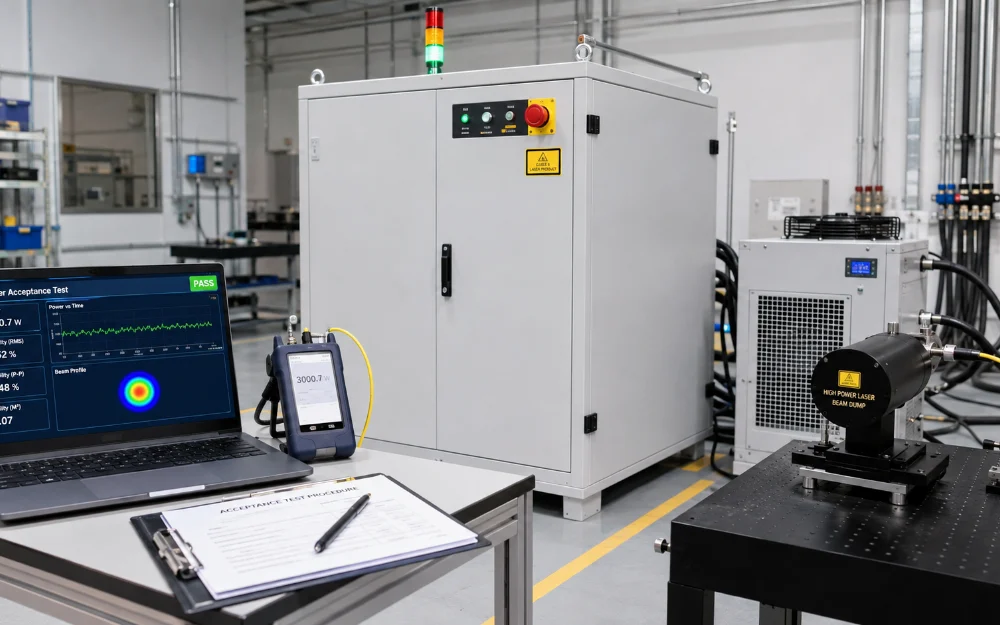
Fiber laser source acceptance testing should prove that the delivered unit meets the optical, electrical, thermal, control, and configuration requirements agreed before purchase. A valid FAT therefore needs predefined acceptance limits, documented test conditions, calibrated measurement equipment, and results tied to the exact source serial number.
The key distinction is simple: a product datasheet describes what a model is designed to achieve, while acceptance testing verifies what the individual unit being shipped actually achieves under defined conditions.
For buyers comparing industrial CW fiber laser sources, the FAT should therefore be agreed before shipment rather than created after the measurements have already been taken.
What Is Fiber Laser Source Acceptance Testing?
Fiber laser source acceptance testing is a structured verification process used to determine whether a specific source complies with the technical requirements agreed between the buyer and supplier. It is different from routine factory quality control because the acceptance criteria should reflect the purchase specification, quotation, technical agreement, or approved FAT protocol.
A source FAT may verify:
- Model and serial number
- Rated optical output
- Power-control range
- Power stability
- Wavelength
- BPP or M² where contractually required
- Process-fiber core diameter
- Connector and fiber length
- Modulation behavior
- Cooling requirements
- Electrical configuration
- Control signals and communication
- Critical alarms and interlocks
- Burn-in completion
- Documentation and shipping condition
Source-level FAT should also be separated from complete-machine site acceptance. A cutting sample can show that a machine processes material, but it does not independently verify every optical and integration specification of the laser source.
What Should Be Defined Before the FAT Begins?
The acceptance method and pass/fail rule should be agreed before testing starts. Otherwise, a borderline result can lead to disagreement because the buyer and supplier may apply different interpretations after seeing the measurement.
The FAT protocol should define:
- The exact source model and configuration
- The acceptance limit for each measured parameter
- Whether a value is minimum, maximum, range, or typical
- The measurement point
- Required warm-up or thermal stabilization
- Ambient temperature and other environmental conditions
- Cooling-water temperature and flow
- Test duration
- Measurement equipment
- Calibration requirements
- How measurement uncertainty will be handled
- Retest rules
- How deviations will be approved
ISO 11554:2025 defines test methods for laser radiant power, radiant energy, temporal characteristics, and stability. It provides an important technical basis for building repeatable source-level measurements rather than relying on an undocumented factory procedure.
Which Datasheet Values Should Become Acceptance Criteria?
Not every catalogue value needs to become a contractual FAT requirement. Prioritize values that affect process performance, machine integration, safety, or the commercial obligation of the supplier.
Typical acceptance criteria may include:
- Minimum optical output power
- Maximum permitted power variation
- Maximum BPP or M²
- Specified process-fiber core
- Exact output connector
- Required fiber length
- Power-control range
- Required modulation performance
- Electrical input configuration
- Required control interfaces
By contrast, a typical efficiency figure or general application recommendation may remain descriptive unless it is specifically important to the machine design.
Should the Laser Source Serial Number Be Verified First?
Yes. Every acceptance record should identify the exact source being tested before any performance measurement is accepted.
Record:
- Manufacturer and model
- Source serial number
- Nameplate rated power
- Nominal wavelength
- Hardware revision
- Firmware or source-software version
- Process-fiber core diameter
- Connector type
- Delivery-fiber length
- Any ordered optional configuration
The FAT report should use the same serial number throughout. Photographs of the nameplate, output connector, and delivery fiber can provide additional configuration evidence.
How Should Fiber Laser Output Power Be Tested?
Output power should be measured with suitable calibrated equipment under defined thermal and operating conditions. The measurement location, source setpoint, warm-up condition, and measurement uncertainty must be known before the result can be compared with the acceptance limit.
Where Should Laser Power Be Measured?
The measurement point should match the contractual definition of output power. For a fiber-delivered industrial source, this may mean measurement at the output of the specified process fiber rather than at an internal optical point.
This matters because the delivered configuration includes the process fiber and connector. A result taken before those components should not automatically be treated as equivalent to power available at the external output.
The FAT should state clearly:
- Where the measurement was taken
- Whether any downstream optics were included
- Which process-fiber configuration was installed
- Which connector was used
How Long Should the Laser Warm Up Before Power Testing?
The source should reach the thermal condition required by the agreed test procedure before final measurements are taken. A cold-start reading should not be compared with a specification intended for thermally stabilized operation.
The required stabilization period should come from the manufacturer or purchase specification rather than an arbitrary universal value.
During stabilization, record:
- Source output setpoint
- Cooling-water temperature
- Coolant flow
- Ambient temperature
- Any alarms or interruptions
Should Power Be Tested Only at 100%?
Full rated power is normally a critical acceptance point, but testing several command levels can also verify power-control range and scaling. The required test points should be defined before FAT.
For example, an OEM may choose to verify:
- Minimum stable operating level
- 25% command
- 50% command
- 75% command
- 100% command
This is an example test plan rather than a universal standard requirement. The actual points should reflect the machine’s control strategy and production process.
How Does Measurement Uncertainty Affect Pass or Fail?
A laser power meter does not produce an uncertainty-free result. Calibration, detector behavior, environmental conditions, test setup, and repeatability all contribute to measurement uncertainty.
This is especially important when the result lies close to the contractual limit.
Does a Reading Below the Limit Automatically Mean Failure?
Not necessarily. Whether a borderline result passes or fails depends on the acceptance rule agreed before testing and the known measurement uncertainty.
Consider this example:
- Contractual minimum: 6,000 W
- Displayed measurement: 5,990 W
The displayed number alone does not provide enough information to make a rigorous engineering decision. The FAT team also needs to know:
- The power-meter calibration status
- The applicable calibration factor
- The stated measurement uncertainty
- Measurement repeatability
- Measurement location
- Coolant and ambient conditions
- The contractual acceptance rule
The NIST laser power and energy calibration guidance treats calibration factors and uncertainty as essential parts of a valid power measurement. This is why a FAT result should not be reduced to a single number on a display.
What Calibration Information Should the FAT Record?
The report should identify the measurement instrument and enough calibration information to establish traceability.
Record:
- Power-meter manufacturer and model
- Instrument serial number
- Detector or measurement-head serial number
- Calibration date
- Calibration certificate number
- Applicable calibration factor
- Measurement uncertainty
- The range for which calibration is valid
NIST has also demonstrated multikilowatt laser-power calibration comparisons extending into industrial power levels, reinforcing why measurement equipment itself must be suitable for the source power being accepted.
How Should Power Stability Be Tested?
Power stability should be defined by test duration, output level, warm-up condition, sampling method, cooling condition, and calculation method. A statement such as “±1% power stability” is incomplete without these details.
How Long Should a Power Stability Test Run?
There is no universal duration for every fiber laser source. Use the manufacturer-defined test condition or the duration agreed contractually.
For example, some manufacturer specifications associate power instability with nominal output and a defined multi-hour test period under controlled temperature conditions. This illustrates why the percentage alone cannot be separated from the test setup.
The FAT should therefore define:
- Source output level
- Warm-up condition
- Test duration
- Sampling interval
- Cooling-water temperature
- Ambient temperature
How Should Power Stability Be Calculated?
The calculation method must also be stated. Peak-to-peak variation, RMS variation, standard deviation, and other statistical treatments are not interchangeable.
The report should identify:
- Mean power
- Maximum measured power
- Minimum measured power
- Calculation method
- Sampling interval
- Whether abnormal events were excluded
Should the Buyer Receive the Complete Power Curve?
For critical applications, yes. A time-series power curve provides a much stronger baseline than a single final percentage.
The curve can later support:
- Warranty investigations
- Power-degradation analysis
- Comparison after service
- Identification of thermal drift
- Review of intermittent alarms
Should BPP or M² Be Included in Acceptance Testing?
Beam-quality testing should be included when BPP or M² is a guaranteed contractual value or is important to the optical design of the machine. A typical catalogue value should not automatically become a FAT criterion unless it was included in the purchase requirement.
How Should M² Be Measured?
M² cannot be determined from one spot-size measurement. It requires beam-width measurements through the propagation region so that beam waist, divergence, and propagation behavior can be characterized.
ISO 11146-1:2021 specifies test methods for laser beam widths, divergence angles, and beam propagation ratios. When M² is contractual, the FAT report should identify the measurement method used.
How Should BPP Be Verified?
BPP should correspond to the actual process-fiber configuration being delivered. A report generated using another fiber core, another connector configuration, or another source unit does not prove the purchased unit meets the requirement.
Record:
- BPP result
- Units
- Output-power condition
- Process-fiber core diameter
- Measurement location
- Whether the value is serial-specific
Commercial industrial sources may specify BPP specifically at the process-fiber output. The current Coherent EDGE fiber laser datasheet, for example, lists beam quality together with process-fiber core, wavelength, modulation, cooling, electrical requirements, and control interfaces.
Can Fiber Core Diameter Replace a BPP Test?
No. Core diameter describes the physical delivery fiber, while BPP describes beam propagation and also depends on divergence.
Both can therefore be relevant acceptance parameters:
- Fiber core: physical configuration check
- BPP: optical beam-quality check
Should Wavelength Be Verified?
Wavelength testing is appropriate when the value is contractually specified or important to downstream optics and the intended application. The FAT should distinguish nominal wavelength from measured center wavelength and permitted range.
Record:
- Specified wavelength or range
- Measured center wavelength
- Measurement instrument
- Source output condition
- Spectral width where relevant
For conventional industrial cutting and welding sources, wavelength may be less critical than power and beam quality. For narrow-linewidth or wavelength-sensitive systems, it can become a primary acceptance parameter.
How Should Modulation and Power Control Be Tested?
Acceptance testing should confirm that the source responds correctly to the machine’s intended power and modulation commands. A listed maximum frequency does not prove correct command scaling or temporal response.
How Should Analog Power Control Be Tested?
Apply known command levels and compare them with measured optical output. This can identify offset, incorrect scaling, or an unusable lower control range.
For a 0–10 V control system, the FAT may record:
| Command | Expected output | Measured output | Result |
|---|---|---|---|
| 2.5 V | Agreed response | Measured value | Pass / Fail |
| 5.0 V | Agreed response | Measured value | Pass / Fail |
| 7.5 V | Agreed response | Measured value | Pass / Fail |
| 10.0 V | Agreed response | Measured value | Pass / Fail |
The values above illustrate a test format only; the actual command relationship should come from the source specification.
How Should Modulation Frequency Be Tested?
Test the frequencies and duty cycles that matter to the intended machine. If temporal performance is critical, the test may also need to verify rise time, fall time, waveform, and modulation depth.
ISO 11554:2025 also covers temporal characteristics, making it relevant when modulation or pulsed behavior is part of the acceptance specification.
How Is Acceptance Testing Different for QCW or Pulsed Fiber Lasers?
QCW and pulsed sources require more than average-power testing. Pulse energy, peak power, pulse duration, repetition rate, duty cycle, and temporal stability may all affect the process.
Depending on the purchase specification, acceptance may include:
- Average power
- Peak power
- Pulse energy
- Pulse duration
- Repetition rate
- Pulse shape
- Pulse-energy stability
The buyer should not compare a QCW peak-power rating directly with the CW output specification of another source.
What Should a Fiber Laser Source FAT Include?
The FAT should link every contractual requirement to a defined method and serial-specific result.
| Test item | Acceptance requirement | Test method / evidence | Result |
|---|---|---|---|
| Model and serial | Matches PO | Nameplate and document inspection | Pass / Fail |
| Rated output power | Meets agreed minimum | Calibrated power meter | Value + Pass / Fail |
| Power-control range | Meets agreed range | Multi-point command test | Recorded values |
| Power stability | Within agreed limit | Timed power measurement | Curve + calculation |
| Wavelength | Within agreed range | Wavelength/spectrum measurement | Value |
| BPP or M² | Below agreed maximum if required | Defined beam-quality method | Report |
| Fiber core | Correct ordered configuration | Document and physical verification | Value |
| Output connector | Exact ordered type | Inspection | Pass / Fail |
| Fiber length | Within ordered tolerance | Inspection / measurement | Value |
| Modulation | Meets required range | Functional / temporal test | Pass / Fail |
| Cooling | Within approved conditions | Chiller/source monitoring | Values |
| Electrical input | Matches ordered configuration | Inspection / measurement | Values |
| Analog control | Correct scaling | Command versus measured power | Table / curve |
| Digital I/O | Correct logic | Functional test | Pass / Fail |
| Communication | Required protocol operates | Functional test | Pass / Fail |
| Alarm/interlock | Agreed response | Approved fault simulation | Pass / Fail |
| Burn-in | Agreed duration completed | Logged operation | Record |
| Documentation | Complete package | Document review | Pass / Fail |
Should Cooling Conditions Be Recorded During the FAT?
Yes. Laser performance should be interpreted together with coolant flow, temperature, and thermal conditions because these variables can affect output and stability.
Record:
- Coolant inlet temperature
- Outlet temperature where available
- Coolant flow
- Pressure where relevant
- Ambient temperature
- Relative humidity where relevant
- Condensation-free operation
Should Cooling-Water Quality Be Part of the FAT Record?
Where water chemistry is specified by the source manufacturer, recording the coolant condition helps demonstrate that the optical test was performed under an approved cooling environment.
This may include:
- Water or coolant type
- Conductivity
- pH where specified
- Approved additive or antifreeze
- Coolant temperature
What Electrical Parameters Should Be Verified?
The delivered source should match the ordered electrical configuration and operate correctly at rated output. Where useful, actual electrical consumption can also become baseline data.
Verify:
- Input voltage
- Phase
- Supply frequency
- Current at relevant load
- Power consumption where required
- Protective earth
- Electrical connector configuration
Which Control Signals Should Be Tested?
Every machine-critical input, output, and communication interface should be functionally tested. A source that generates optical power correctly but does not communicate alarms or respond to the machine’s control logic has not completed integration acceptance.
Which Hardwired I/O Should Be Checked?
Depending on the source architecture, test:
- Laser ready
- Laser enable
- Emission command
- Warning output
- Alarm output
- Reset input
- External interlock
- Power command
Also confirm voltage level, polarity, active-high or active-low logic, and reset behavior.
Should Communication Loss Be Simulated?
Yes, when communication-loss behavior is part of the approved machine integration. The FAT should verify the expected safe state, alarm behavior, and restart sequence.
Possible tests include:
- Fieldbus interruption
- Ethernet disconnection
- Controller timeout
- Restoration of communication
- Manual reset where required
Which Alarms and Interlocks Should Be Tested?
Test critical externally accessible protective functions rather than deliberately forcing unsafe internal faults.
Appropriate FAT checks may include:
- External interlock opening
- Approved chiller or flow-fault input
- Fiber-head or connector interlock
- Communication loss
- Alarm output
- Reset sequence
- Prevention of unintended automatic restart where required
Do not intentionally overheat the source, interrupt required cooling, short circuits, or create uncontrolled optical conditions simply to generate an alarm.
What Is a Fiber Laser Burn-In Test?
Burn-in is extended operation intended to expose early-life faults and confirm stable operation before shipment. It is not necessarily the same as a formal power-stability test, even if optical power is logged during both.
How Long Should a Burn-In Test Last?
There is no universal burn-in duration for every fiber laser source. If burn-in duration is important to the buyer, it should be specified in the purchase requirement together with the operating profile.
The agreement may define:
- Continuous versus cyclic operation
- Output-power level
- Startup/shutdown cycles
- Maximum permitted alarms
- Required retest after an interruption
What Should Be Logged During Burn-In?
At minimum, the record should identify:
- Start and end time
- Total operating duration
- Output setpoint
- Cooling conditions
- Any alarms or shutdowns
- Reset or corrective actions
For high-value OEM programs, continuous power data can provide an additional baseline for future service-life comparison.
Should the Process Fiber and Connector Be Inspected?
Yes. Optical performance can pass while the delivered physical configuration is incorrect or damaged.
Inspect:
- Connector type
- Protective cap
- Connector cleanliness
- Fiber-core configuration
- Fiber length
- Visible bends, kinks, or damage
- Shipping protection
- Configuration labels
The output connector should remain protected until the approved installation or inspection procedure is ready.
What Should Be Included in the Fiber Laser FAT Report?
The FAT report should contain enough information for another engineer to identify the source, understand how it was tested, interpret the results, and review any deviation. A generic QC certificate does not provide the same level of traceability.
A complete report can include:
- Buyer and project information
- Purchase-order or contract number
- Source model
- Serial number
- Hardware revision
- Firmware/software version
- Process-fiber core
- Connector type
- Fiber length
- Test date and location
- Ambient and cooling conditions
- Measurement-equipment model and serial
- Calibration date and certificate reference
- Measurement uncertainty
- Test method
- Acceptance criterion
- Measured result
- Pass/fail decision
- Power-stability curve
- BPP/M² report where required
- Documented deviations
- Corrective action and retest result
- Supplier approval
- Buyer or witness approval where required
What Should Happen If a Test Result Fails?
A failed result should trigger a documented disposition rather than an informal change to the acceptance limit.
A practical sequence is:
- Confirm the test setup.
- Verify measurement equipment and calibration.
- Confirm source and cooling conditions.
- Repeat the measurement according to the approved retest rule.
- Identify whether the cause is the source or test system.
- Perform approved corrective action if applicable.
- Retest the affected requirement.
- Record the final disposition.
The final outcome may be:
- Pass after a valid retest
- Repair and retest
- Replacement of the source
- Rejection of shipment
- Buyer-approved written deviation
The original acceptance criterion should not be rewritten after the result is known unless both parties formally approve the change.
Is Factory Acceptance Testing Enough Before Production?
No. Source FAT verifies the fiber laser source itself, while machine commissioning and site acceptance verify the complete installed system and production process.
| Source FAT | Machine SAT / Process Validation |
|---|---|
| Optical power | Cutting or welding result |
| Power stability | Production repeatability |
| BPP/M² | Focus and process optimization |
| Fiber configuration | Processing-head integration |
| Cooling requirements | Complete machine cooling performance |
| I/O and communication | CNC/PLC integration |
| Source alarms | Complete machine safety functions |
A successful cutting sample is useful process evidence, but it should not replace source-level acceptance data.
What Is the Quickest Fiber Laser Source Acceptance Checklist?
A fast FAT review should confirm that the correct unit was tested, contractual performance was measured under defined conditions, calibrated equipment was used, critical interfaces worked correctly, and serial-specific records were supplied.
- Does the model match the purchase order?
- Is the serial number shown on the report?
- Is the ordered fiber configuration correct?
- Was output power measured with calibrated equipment?
- Is the measurement location defined?
- Was the warm-up condition recorded?
- Does full-power output meet the agreed requirement?
- Was power-control range verified?
- Was power stability tested for the agreed duration?
- Is the stability calculation method defined?
- Is measurement uncertainty available?
- Was BPP/M² verified if contractual?
- Was wavelength verified if required?
- Were modulation requirements tested?
- Were coolant conditions recorded?
- Does the electrical configuration match?
- Were machine-critical I/O signals tested?
- Was required communication verified?
- Were critical interlocks tested safely?
- Was burn-in completed if required?
- Was the connector visually inspected?
- Were raw curves and reports supplied?
- Are deviations documented?
- Is the report signed and tied to the serial number?
When sourcing CW fiber laser source configurations, defining this checklist before the purchase order helps turn the final FAT into a measurable acceptance process rather than a general factory demonstration.
Frequently Asked Questions About Fiber Laser Source Acceptance Testing
Is Output Power the Most Important Fiber Laser FAT Test?
It is one of the most important optical tests, but it is not sufficient by itself. Beam quality, stability, fiber configuration, cooling, controls, alarms, and documentation may also be contractual requirements.
Does a Fiber Laser Power Meter Need Calibration for FAT?
Yes, when its reading is used to accept or reject the source. Calibration status and measurement uncertainty should be appropriate for the power range and required acceptance tolerance.
How Long Should Fiber Laser Power Stability Be Tested?
There is no universal duration for every source. Use the manufacturer-defined or contractually agreed duration together with specified output, warm-up, cooling, ambient, and calculation conditions.
Is a Generic Factory QC Certificate Enough?
Not for a rigorous source acceptance program. The strongest evidence is a serial-specific FAT report showing the exact configuration, test conditions, measurement equipment, measured results, and pass/fail criteria.