

Fiber Core Diameter plays a critical role in laser cutting. A smaller core diameter produces a focused beam with high quality, which is ideal for precision tasks. Larger core diameters allow more power but result in lower beam quality. The choice affects how efficiently the laser transmits energy and the quality of the spot on the material. The table below shows how core size impacts beam quality and application suitability:
| Fiber Type | Core Diameter | Beam Quality | Applications |
|---|---|---|---|
| Single-mode | Small | High | Precision tasks, long-distance uses |
| Multimode | Large | Low | Industrial cutting, welding |
Selecting the right core size ensures the laser matches the demands of each application.
Key Takeaways
- Smaller core diameters, like 50μm, provide high precision and clean cuts, making them ideal for delicate tasks in electronics and medical devices.
- Medium core diameters, such as 100μm, balance speed and quality, suitable for general cutting across various materials and thicknesses.
- Larger core diameters, like 200μm, support higher power and faster cutting speeds, best for heavy-duty applications in industries like manufacturing and automotive.
- Choosing the right core diameter is crucial; it affects cutting quality, speed, and the type of materials that can be processed effectively.
- Understanding the trade-offs between core size and cutting performance helps ensure optimal results for specific applications.
Fiber Core Diameter Comparison

Cutting Quality and Spot Size
The size of the fiber core directly affects the quality of the cut and the spot size produced by the laser. Smaller cores, such as 50μm, create a tightly focused beam. This results in a spot diameter as small as 20-30 μm when using standard optics. The beam stays sharp and precise, which is important for tasks that require clean edges and fine detail. Larger cores, like 200μm, produce a wider spot, often reaching 200-300 μm. The beam becomes less focused, which can cause rougher edges and less detail.
| Core Diameter | Spot Size (μm) | Cutting Quality |
|---|---|---|
| 50μm | 20-30 | High precision |
| 100μm | 60-120 | Balanced |
| 200μm | 200-300 | Lower precision |
- A single-mode fiber with a small core diameter achieves the smallest spot size and highest beam quality.
- A multimode fiber with a larger core diameter produces a bigger spot and lower beam quality.
Speed and Transmission Efficiency
Fiber Core Diameter also influences how fast the laser can cut and how efficiently it transmits energy. Larger cores allow more power to pass through, which increases cutting speed. However, the numerical aperture (NA) plays a role in this process. NA measures how much light the fiber can collect and transmit. A higher NA boosts light collection but can cause more modal dispersion, which spreads out the laser pulse and reduces efficiency.
Tip: Doubling the numerical aperture from 0.20 to 0.40 quadruples modal dispersion. This reduces the bandwidth-distance product by 75%. A fiber with NA = 0.50 supports about six times more modes than one with NA = 0.20, which leads to increased pulse broadening.
- Small-core, high NA fibers are limited in output power because they are more likely to experience nonlinear optical effects.
- Larger cores with lower NA can handle higher power and reduce unwanted effects, making them better for fast, high-power cutting.
Material and Application Suitability
Choosing the right Fiber Core Diameter depends on the material and the application. Small-core fibers are best for thin materials and jobs that need high precision, such as electronics or medical devices. Larger-core fibers suit thicker materials and tasks where speed matters more than edge quality, like industrial cutting and welding.
- Small-core, high NA fibers are ideal for precision cutting but have lower power limits.
- Larger-core fibers increase energy storage and allow shorter fiber lengths, which raises the threshold for nonlinear effects.
- The energy storage capacity grows with the square of the core diameter, making larger cores more suitable for heavy-duty applications.
| Core Diameter | Best Applications | Material Compatibility |
|---|---|---|
| 50μm | Micro-machining, fine cutting | Thin metals, delicate parts |
| 100μm | General cutting, balanced tasks | Medium-thickness materials |
| 200μm | High-speed, high-power cutting | Thick metals, industrial use |
Selecting the right core diameter ensures the laser matches the needs of the job. Smaller cores deliver precision, while larger cores provide speed and power.
50μm Core Diameter Impact
Precision and Edge Quality
A 50μm fiber core diameter creates a very small and focused laser spot. This allows for extremely precise cuts and smooth edges. The laser beam stays sharp, which helps reduce heat-affected zones on the material. As a result, the finished product has clean lines and little to no roughness along the cut. Many industries choose this core size when they need high accuracy. For example, electronics and medical device makers often require fine detail and tight tolerances.
Note: A smaller spot size means the laser can cut tiny shapes and patterns without damaging nearby areas.
Limitations in Speed and Power
While a 50μm core offers excellent precision, it does have some limits. The small core cannot handle high laser power. If too much energy passes through, the fiber may overheat or become damaged. This restricts the cutting speed and the thickness of materials that can be processed. For high-power laser applications, larger core diameters are usually preferred because they can transmit more energy safely. A continuous-wave laser above 50W often needs at least a 100μm core to work efficiently.
- Small cores are best for low to moderate power levels.
- They are not suitable for cutting thick or very hard materials quickly.
Best Use Cases
The 50μm fiber core diameter is ideal for tasks that demand accuracy over speed. It works well with thin metals, delicate parts, and materials that require minimal thermal damage. Common applications include:
- High-speed communications networks
- Manufacturing of micro-components
- Healthcare devices
- Scientific research
These fields value the ability to make fine, controlled cuts. The 50μm core is also used in industries such as agriculture, entertainment, and defense, especially when detail is more important than speed.
100μm and 200μm Core Diameter Effects

Balance of Speed and Quality (100μm)
A 100μm fiber core diameter offers a strong balance between cutting speed and edge quality. This size improves the laser beam’s properties, such as absorptivity and kerf geometry. When the beam diameter increases, the kerf area becomes larger, which can reduce the maximum cutting speed. However, a larger beam diameter also decreases the angle of incidence on the cutting front. This change increases absorptivity and allows for higher cutting speeds. Many manufacturers choose 100μm for general-purpose cutting because it works well with a wide range of materials and thicknesses.
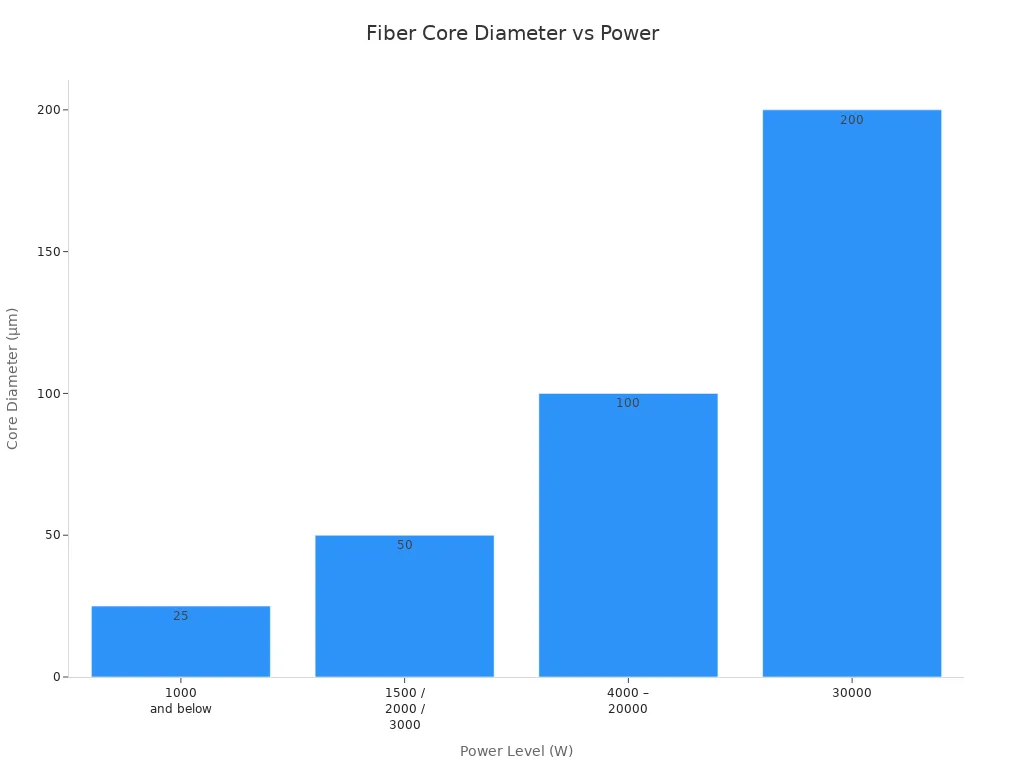
The following table shows how different core diameters match with laser power levels:
| Power Level (W) | Core Diameter (μm) |
|---|---|
| 1000 and below | 25 |
| 1500 / 2000 / 3000 | 50 |
| 4000 – 20000 | 100 |
| 30000 | 200 |
High Power and Speed (200μm)
A 200μm fiber core diameter supports much higher power and faster cutting speeds. This size is ideal for heavy-duty industrial applications. The larger core allows the laser to deliver more energy without damaging the fiber. However, the trade-off is reduced precision and rougher edges compared to smaller cores. For many jobs, speed and power are more important than fine detail.
Here are some typical specifications for a 200μm core:
| Specification | Value |
|---|---|
| Maximum Output Power | 300 W |
| Peak Power | up to 6 kW |
| Pulse Energy | up to 30 J |
| Pulse Repetition Rate | up to 2.5 kHz |
Note: The 200μm core is often used in high-power lasers for cutting thick metals and other tough materials.
Application Scenarios
Different industries benefit from each core size. The 100μm core is popular in metal cutting, especially for thin sheet materials. It provides a good mix of speed and edge quality. Cutting tests with a 4 kW Corona laser show that 100μm fibers can maximize cutting speed in real-world settings.
The 200μm core is best for applications that need high power and speed. It is common in heavy manufacturing, shipbuilding, and automotive industries. These fields often cut thick metals where precision is less important than speed.
- 100μm: Used for thin sheet metal, general-purpose cutting, and jobs needing both speed and quality.
- 200μm: Chosen for thick metals, high-speed production, and heavy industry tasks.
Selecting the right Fiber Core Diameter helps match the laser’s performance to the needs of each job.
Choosing the right core diameter affects cutting results. Small cores, like 50μm, give high precision and smooth edges. Medium cores, such as 100μm, balance speed and quality for most tasks. Large cores, like 200μm, handle thick materials and high power but reduce detail. Recent fiber laser technology allows longer transmission distances and higher power, especially with smaller cores. The table below shows how core size relates to power and distance:
| Core Diameter (µm) | Transmission Distance (km) | Output Power (kW) |
|---|---|---|
| 32 | >20 | 20 |
| 38 | >20 | 20 |
| Larger | Needed for bigger offsets | 20 |
Select a core size based on your material thickness, desired speed, and required edge quality.
FAQ
What is fiber core diameter?
Fiber core diameter is the width of the central part of an optical fiber. This part carries the laser light. Common sizes include 50μm, 100μm, and 200μm.
How does core diameter affect cutting quality?
A smaller core diameter creates a finer, more focused laser spot. This improves edge quality and detail. Larger cores produce wider spots, which can make edges rougher.
Which core diameter is best for thick materials?
A 200μm core works best for thick materials. It allows higher power and faster cutting. This size is common in heavy industry.
Can I use a 50μm core for all cutting jobs?
No. A 50μm core is best for thin materials and precision work. It cannot handle high power or cut thick metals efficiently.
Does core diameter affect laser speed?
Yes. Larger core diameters support higher cutting speeds. They transmit more power, which helps cut faster, especially in industrial settings.