
Introduction
In the world of optics, collimated beams play a vital role. It refers to a beam of light or other electromagnetic radiation that propagates in high parallel to each other and has minimal divergence. This beam has uniform energy distribution and highly concentrated propagation direction, making it the core technology foundation for scientific research, precision engineering, medical equipment, and many industrial fields. This article will take you to a deep understanding of the nature and working principle of collimated beams.
1. What is a collimated beam?
The core characteristics of a collimated beam are its high degree of parallelism and extremely low beam divergence. Imagine a beam of light in which all the rays move in almost the same direction like well-trained soldiers, and its cross-sectional size and shape can remain relatively stable during long-distance propagation, minimizing energy loss. The original meaning of the word “collimate” is “to make parallel”.
Key characteristics:
Parallel propagation: The direction of the light rays in the beam is highly consistent.
Minimal diffusion: The divergence angle of the beam during propagation is extremely small.
Energy concentration: The energy is evenly distributed and concentrated along the propagation path, and it is not easy to dissipate.
2. How is a collimated beam achieved?
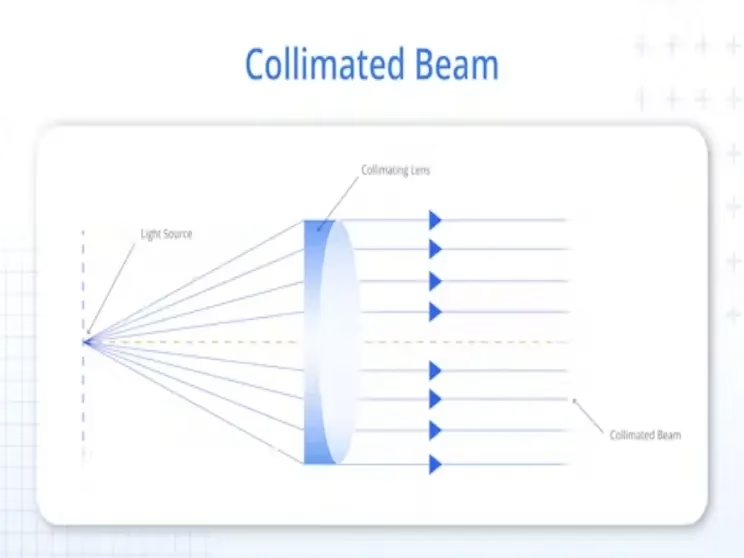
The ideal perfectly collimated beam (zero divergence) cannot be achieved in reality, mainly due to the diffraction effect of light. However, through precision optical elements (such as lens groups, concave reflectors, or specialized collimators), we can adjust the divergent light from a point light source (such as a laser) into a highly parallel beam, so that its divergence angle is controlled within a very small range, achieving a “collimated” state.
3. Related terms
Terms similar to “collimated beam” include “parallel beam” or “collimated light”, which all emphasize the parallelism of the propagation direction of the beam.
4. Working Principle
The working principle of collimation is to guide light or other radiation through one or a group of lenses so that the light from the light source is parallel to each other. When the light is collimated, the beam will remain focused over a long distance. The collimation process starts with a light source, which emits light in all directions. These rays are guided through a collimating lens or a series of lenses, which refract and guide the light so that the light becomes parallel.
In the next chapter we will explore the application of collimated beams in depth.