
As electronic devices continue to become smaller, denser, and more highly integrated, traditional contact-based soldering processes such as soldering irons and hot-air soldering are facing increasing limitations.
Heat-affected areas, limited accessibility, mechanical contact, and inconsistent process control can become major challenges in applications involving 3C electronics, new energy systems, medical electronics, and automotive electronics.
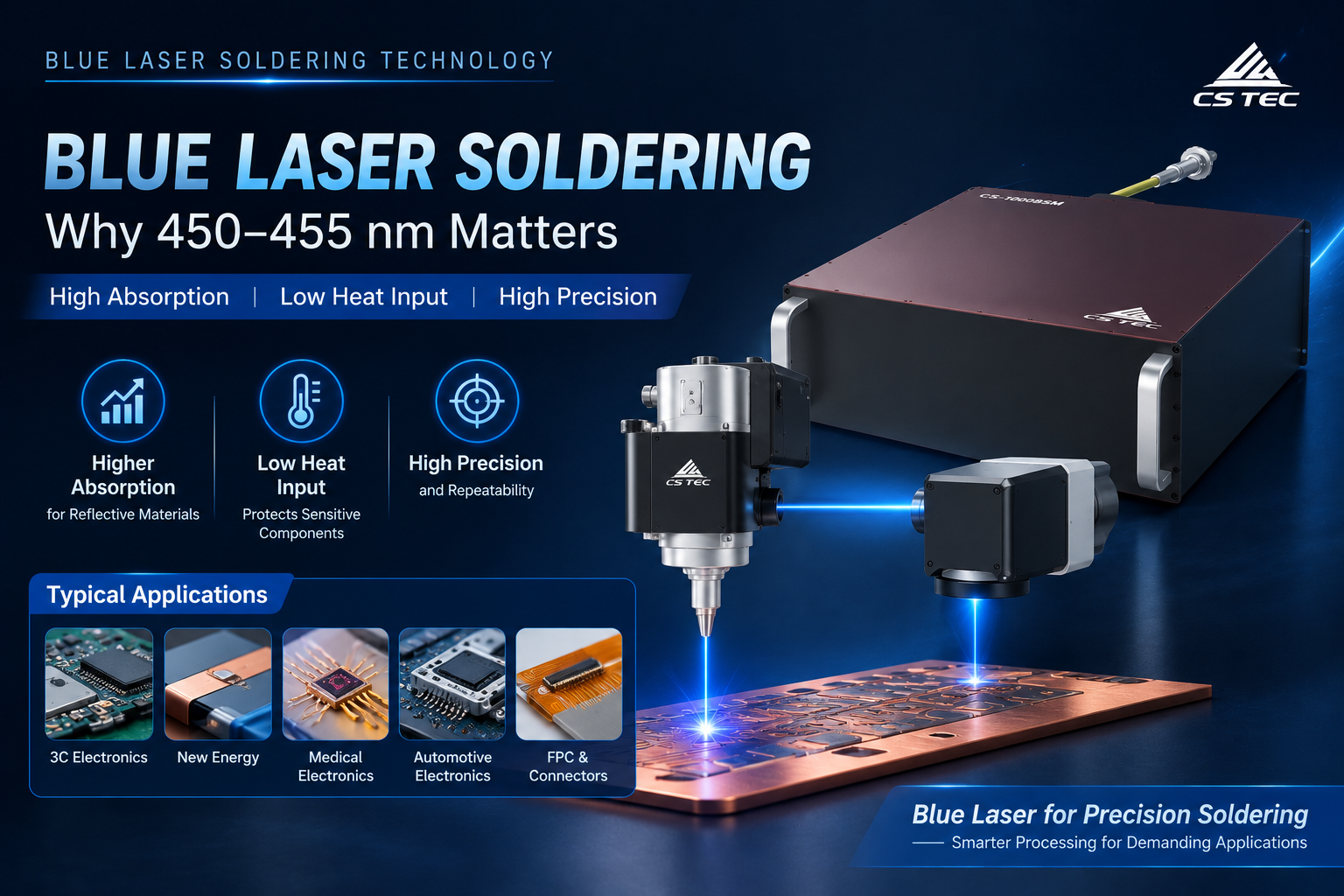
Blue laser soldering technology, typically based on 450–455 nm semiconductor blue lasers, offers a non-contact approach for precise soldering and thermal processing.
Its advantages are particularly noticeable when working with highly reflective materials such as copper.
What Makes Blue Laser Soldering Different?
Blue laser soldering systems generally consist of a blue laser source and an optical execution system.
It is important to distinguish between three different products:
- Blue laser source – provides the laser energy.
- Blue laser welding/soldering head – provides beam delivery, collimation, focusing, and localized processing.
- Blue laser galvanometer scanner – enables high-speed beam scanning and pattern-based processing.
The welding head and galvanometer scanner are independent optical products. Both require a compatible blue laser source to operate.
Depending on the application, customers can select the appropriate optical configuration or integrate the components into a complete blue laser soldering system.
1. Key Advantages of Blue Laser Soldering
Higher Absorption for Highly Reflective Materials
Copper, aluminum, and other reflective metals are widely used in electronic manufacturing.
One of the major advantages of blue laser technology is its higher absorption by copper compared with conventional near-infrared laser wavelengths.
At approximately 450–455 nm, blue laser energy can be absorbed more effectively by copper, allowing more efficient energy coupling into the material.
This can provide advantages such as:
- More efficient energy utilization
- Lower required laser power for certain processes
- More stable heating
- Reduced risk associated with excessive reflected laser energy
This characteristic makes blue lasers particularly attractive for precision processing of copper components.
Low Heat Input and Reduced Thermal Impact
Blue laser soldering is a non-contact process.
The laser delivers energy directly to the target area without mechanical contact, helping avoid mechanical deformation or pressure on sensitive components.
Because the laser can be focused precisely, heat can be concentrated around the soldering area.
This is especially useful for:
- Fine wires
- Small terminals
- Dense pin arrays
- Flexible circuits
- Miniature electronic components
For localized soldering, a blue laser welding head provides precise beam positioning and focusing.
For larger areas or complex patterns, a galvanometer scanner can rapidly move the beam across the processing field.
High Precision and Process Consistency
Laser soldering allows the energy input, beam position, scanning speed, and processing parameters to be precisely controlled.
Compared with manual soldering processes, automated laser soldering can improve repeatability and process consistency.
A fixed optical head is particularly suitable for:
Small-area and point-based soldering
while a galvanometer scanner is better suited to:
High-speed scanning and pattern-based soldering.
This distinction allows manufacturers to select the optical configuration according to production requirements.
Improved Efficiency and Reduced Consumable Requirements
Blue laser soldering can reduce reliance on traditional contact-based tools and associated consumables.
Depending on the process and soldering material, laser soldering may also reduce the need for additional process steps and simplify automation.
For high-volume production, the ability to precisely control laser energy and rapidly process multiple points can contribute to higher production efficiency.
2. Blue Laser Soldering Applications
3C Electronics
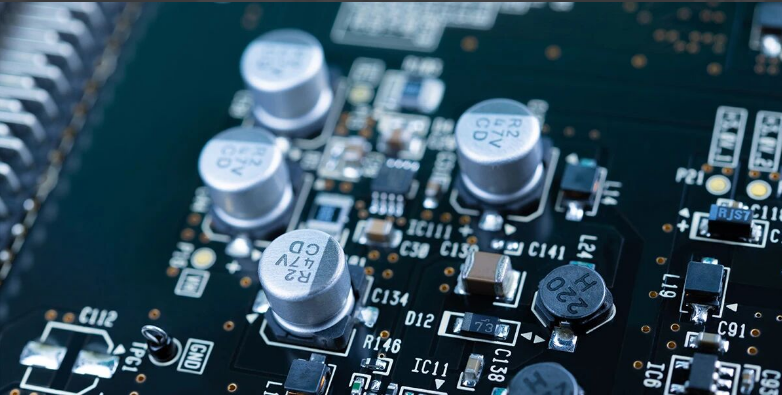
Miniaturized consumer electronics often contain densely packed components and extremely small soldering points.
Typical applications include:
Blue Laser Welding Head
- Fine coaxial wires
- Camera module components
- Small sensor terminals
- Miniature electronic pins
Blue Laser Galvanometer Scanner
- FPC circuits
- BTB connectors
- Dense PCB soldering areas
- Large-area or multi-point soldering
The combination of high precision and localized heat input is particularly valuable where conventional soldering tools have limited accessibility.
3. New Energy Applications
New energy systems increasingly use copper and aluminum components for electrical connections.
Potential applications include:
- Battery tabs
- Copper busbars
- BMS connections
- Charging terminals
- Energy storage components
A blue laser welding head can be used for localized, precision soldering or welding processes.
A galvanometer scanner can provide faster processing across larger areas or multiple connection points.
4. Medical Electronics
Medical electronic components require high precision, process stability, and strict contamination control.
Potential applications include:
- Microelectrodes
- Sensor components
- Medical device terminals
- Flexible medical circuits
- Microfluidic-related electronic assemblies
The non-contact nature of laser processing can help reduce mechanical stress on delicate components.
5. Automotive Electronics
Automotive electronic systems require reliable connections that can withstand temperature changes, vibration, and long-term operation.
Blue laser processing can be considered for applications such as:
- TPMS components
- Camera modules
- Radar-related electronics
- ECU assemblies
- Automotive lighting modules
The ability to precisely control localized heat input can be valuable for protecting surrounding electronic components.
6. Blue Laser Welding Head vs. Blue Laser Galvanometer Scanner
The two optical systems serve different processing requirements.
| Blue Laser Welding Head | Blue Laser Galvanometer Scanner | |
|---|---|---|
| Processing method | Fixed-point | High-speed scanning |
| Best for | Precision point soldering | Multi-point/pattern soldering |
| Processing area | Localized | Larger scanning field |
| Typical applications | Fine wires, pins, terminals | FPC, connectors, PCB arrays |
| Main advantage | Precise focusing | Fast and flexible scanning |
Neither system is universally better.
The right choice depends on the material, soldering geometry, processing area, production speed, and automation requirements.
7. Wuhan CS Tec Blue Laser Soldering Solutions
Wuhan CS Tec provides flexible blue laser processing solutions based on three core components:
Blue Laser Source
The core light source for the system, available for precision processing of reflective materials and electronic components.
Independent Blue Laser Welding Head
Designed for precise beam delivery and localized point processing.
Independent Blue Laser Galvanometer Scanner
Designed for high-speed beam scanning and pattern-based processing.
These components can be used independently according to the customer’s system architecture or integrated into a complete:
Blue Laser Soldering System
with:
Laser Source + Optical Execution + Temperature Control + Vision Monitoring
This modular approach allows manufacturers and system integrators to select the appropriate configuration for different production requirements.