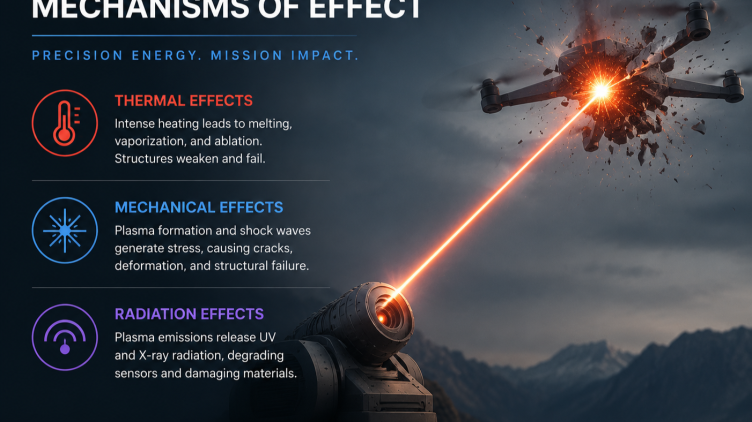
High-energy laser systems exhibit fundamentally different interaction behaviors with materials compared to conventional mechanical methods. From a physics and engineering perspective, these interactions can generally be summarized into three primary mechanisms:
1. Thermal Effects
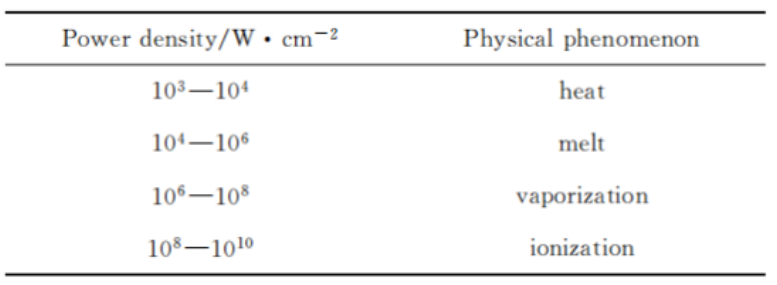
When a high-energy laser irradiates a material surface (e.g., metals or polymers), localized energy absorption leads to a continuous temperature rise. This may result in melting and, under higher energy density conditions, vaporization and material removal (ablation).
Such processes can significantly alter surface integrity and structural geometry, and in dynamic environments, may further influence the overall mechanical behavior of the target system. Thermal interaction typically requires sustained energy delivery over a defined exposure time.
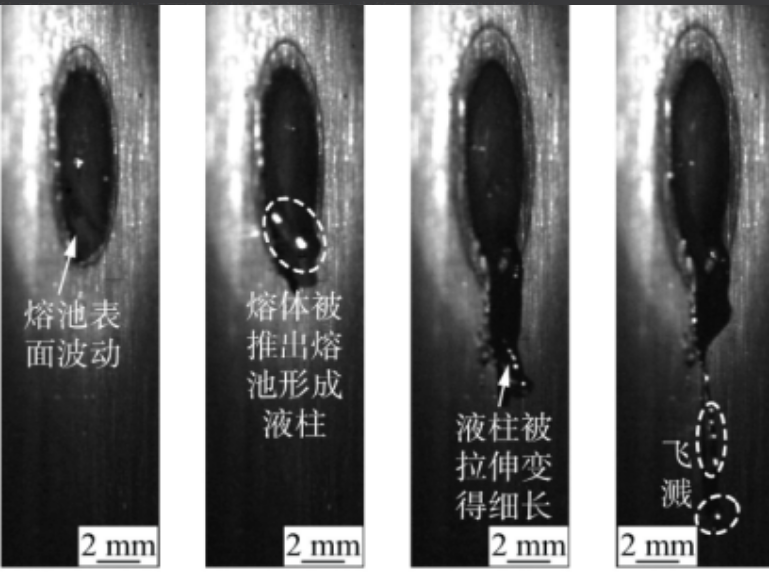
2. Mechanical Effects (Indirect Stress Response)
Although laser energy does not apply direct mechanical force, rapid heating and phase transition can generate localized plasma and shock waves. These effects may induce transient pressure loading and stress redistribution within the material.
In addition, thermal gradients can reduce material strength, promote micro-crack formation, and accelerate structural fatigue—especially in components already operating under mechanical load.
3. Radiation-Related Effects
Under certain high-energy interaction conditions, plasma formation near the surface may be accompanied by secondary electromagnetic emissions, including ultraviolet and high-energy radiation components.
These emissions can contribute to localized material modification and may also impact sensitive optical or electronic elements in nearby systems.
System-Level Considerations
In practical high-energy laser applications, these mechanisms rarely occur in isolation. The overall outcome depends on multiple factors, including energy density, exposure duration, material properties, and interaction geometry.
From an engineering standpoint, optimizing system performance is not only about power scaling, but also about precision energy delivery, beam control, and interaction stability.
Precision. Control. Energy shaping through light.