
Application Methods
Usage of Collimated Beams:Collimated beams are used for transmitting parallel light or electromagnetic radiation, ensuring that the light travels in the same direction without deviation, and are usually realized by means of a collimator.
1. How to generate a collimated beam?
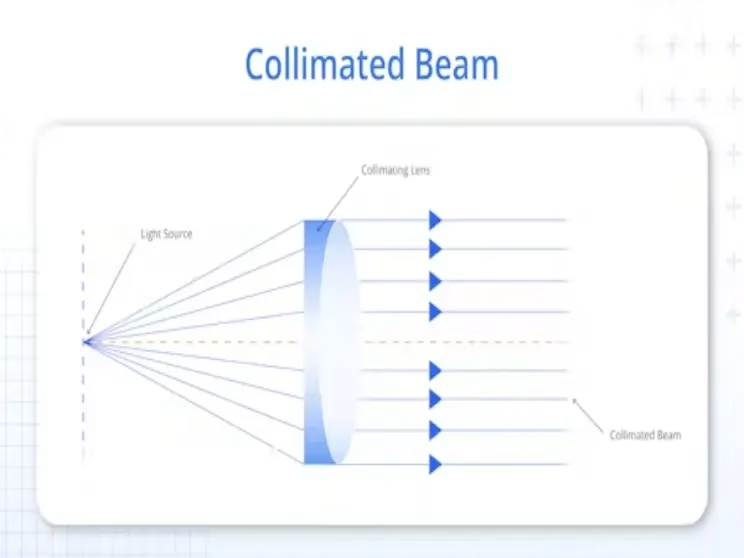
Single lens method: A point light source (e.g., laser) is placed at the focal point of a convex lens, and the diverging light is refracted into a parallel beam.
Lens group method: Multi-lens systems (e.g. collimating lens groups) are used in laser diodes, telescopes, etc. to optimize beam parallelism.
2. How does a laser cutter produce a collimated beam?
The laser beam is collimated by lenses or mirrors to form a parallel beam, which is then focused by a focuser into a small spot for cutting. The focuser adjusts the spot size to suit different needs.
3. Impact of Collimated Beam Quality on Laser Cutting
High quality collimated beam: reduces divergence, improves cutting speed, accuracy and consistency.
Low quality beam: results in energy dispersion, inaccurate cuts or material damage.
4. Precision Cutting in Laser Cutting
The collimated beam is focused into a micron-sized spot by the lens, and the high energy vaporizes or melts the material to achieve high-precision cutting.
5. Collimated Beams in Laser Welding
Collimated beams are kept focused over long distances to ensure weld depth and precision and reduce thermal distortion.
6. Collimated beams in gas lasers
Collimating lenses are used to focus and align the beam so that it is parallel, and are used in areas such as cutting, engraving and communications.
7. Collimated beams in fiber lasers
Collimated beams ensure that the light signal is transmitted efficiently through the fiber, preventing divergence and maintaining laser intensity and accuracy.
Application Scenarios
1. Laser Technology
Collimated beams are used for laser cutting, welding, drilling and marking, maintaining the beam diameter for precise processing and playing a key role in laser generation, manipulation and application.
2.Optical Communication
Collimated beams transmit data through optical fibers, maintaining efficient transmission over long distances and reducing signal loss, and are used in fiber optic transmission, free-space optical communication, and more.
3. Medical Imaging (CT and PET Scanning)
CT Scanning: Collimated X-ray beams generate precise cross-sectional images, improving resolution and reducing artifacts.
PET scanning: Collimator enhances imaging sensitivity and spatial resolution and reduces background interference.
4. Astronomy (Telescopes)
Collimated beams ensure light focusing and improve image quality and clarity for reflecting/refracting telescope calibration and astronomical imaging.
5. Industrial Inspection
Collimated beams are used for precise measurement of dimensions, surface defects and non-destructive testing to improve inspection accuracy.
6. Spectroscopy
Collimated beams analyze light-substance interactions and measure absorption, transmission and fluorescence properties.
7.Microscopy
Collimated beams provide a stable light source to produce high resolution images with reduced aberrations for laser scanning microscopes and optical tweezers.
In the next chapter we will discuss the advantages and limitations of collimated beams.