
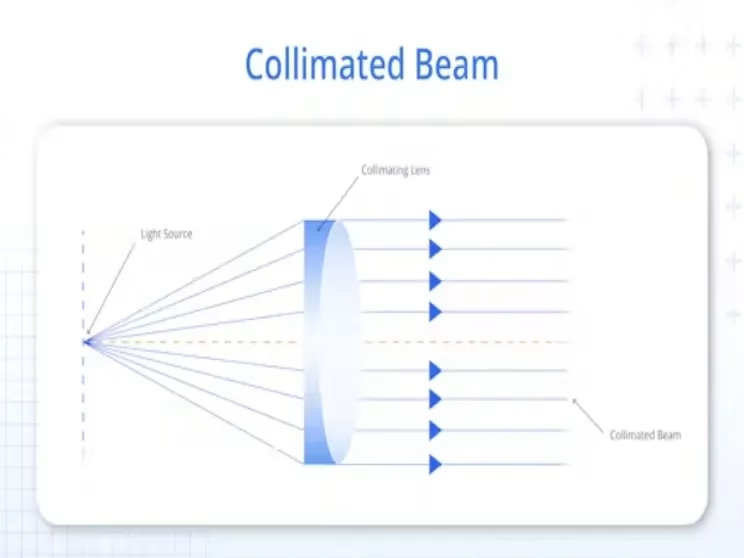
What are the benefits of using collimated beams?
1. Higher accuracy: The parallel nature of the beam ensures that the energy is concentrated in a very small area through the focusing lens, thus increasing the precision and accuracy of equipment such as laser cutting machines. Collimators maintain the integrity of the beam energy as much as possible by keeping all the energy in the same direction until it reaches the focusing lens and is concentrated. This is a way to avoid energy leakage.
2. Reduces divergence: The beam maintains its size over longer distances, making it ideal for long distance applications.
3. Reduced energy loss: The parallel nature of collimated beams minimises energy loss during beam propagation. This improves energy efficiency and extends the life of the laser.
4. Versatility: Collimated beams are used in a wide range of applications including: laser cutting, welding, drilling and marking, as well as medical, scientific and industrial applications. Collimated beams can also be used in various types of lasers, including gas lasers, fibre lasers and solid state lasers.
5. Reduced Beam Aberrations: Collimated beams help reduce beam aberrations caused by atmospheric turbulence or other environmental factors. This results in better beam quality and more reliable results.
What are the limitations of using collimated beams?
1. Complexity: Generating a collimated beam of electromagnetic radiation can be a complex process that requires precise alignment of the optics, which can make it difficult to achieve in some applications.
2. Cost: The technology for utilising collimated electromagnetic energy beams (whether optical, electronic or X-ray) is both complex and expensive. In some cases this may limit the use of instruments or equipment, but in many cases there is no better alternative and the advantages of such techniques outweigh the cost.
3. Beam quality: Although collimated beams have high beam quality, it is difficult to maintain this quality over long distances or through different media, which can lead to a degradation of the beam quality.
Are collimated beams susceptible to diffraction?
Yes, collimated beams are susceptible to diffraction. Diffraction is the bending or spreading of a wave when it encounters an obstacle or slit of comparable size to its wavelength. Even though collimated beams are highly parallel and have very little divergence, they still diffract when passing through small apertures or lenses. The degree of diffraction depends on the wavelength of the radiation and the size of the aperture or lens. Diffraction causes the beam to spread out and lose collimation, which affects its performance.
Can collimated beams be affected by atmospheric turbulence?
Yes, collimated beams are affected by atmospheric turbulence. As the beam travels through the atmosphere, it encounters changes in refractive index caused by changes in temperature, pressure, and humidity. These changes in refractive index cause the beam to bend or scatter, resulting in distorted or reduced beam collimation. The effect is a loss of refraction or parallelism or collimation. In this case, the cause is atmospheric turbulence. For laser systems that rely on collimated beams (e.g., remote sensing or laser communications), atmospheric turbulence can be a significant factor limiting their range of action and accuracy. However, techniques such as adaptive optics can be used to mitigate the effects of atmospheric turbulence on collimated beams.
Can a collimated beam with zero divergence be produced?
No, a collimated beam with zero divergence cannot be produced. The defining characteristic of a collimated beam is that its rays are parallel and do not diverge significantly. If the divergence angle of a beam is infinite, this means that the light rays spread out in all directions and no longer remain parallel.