
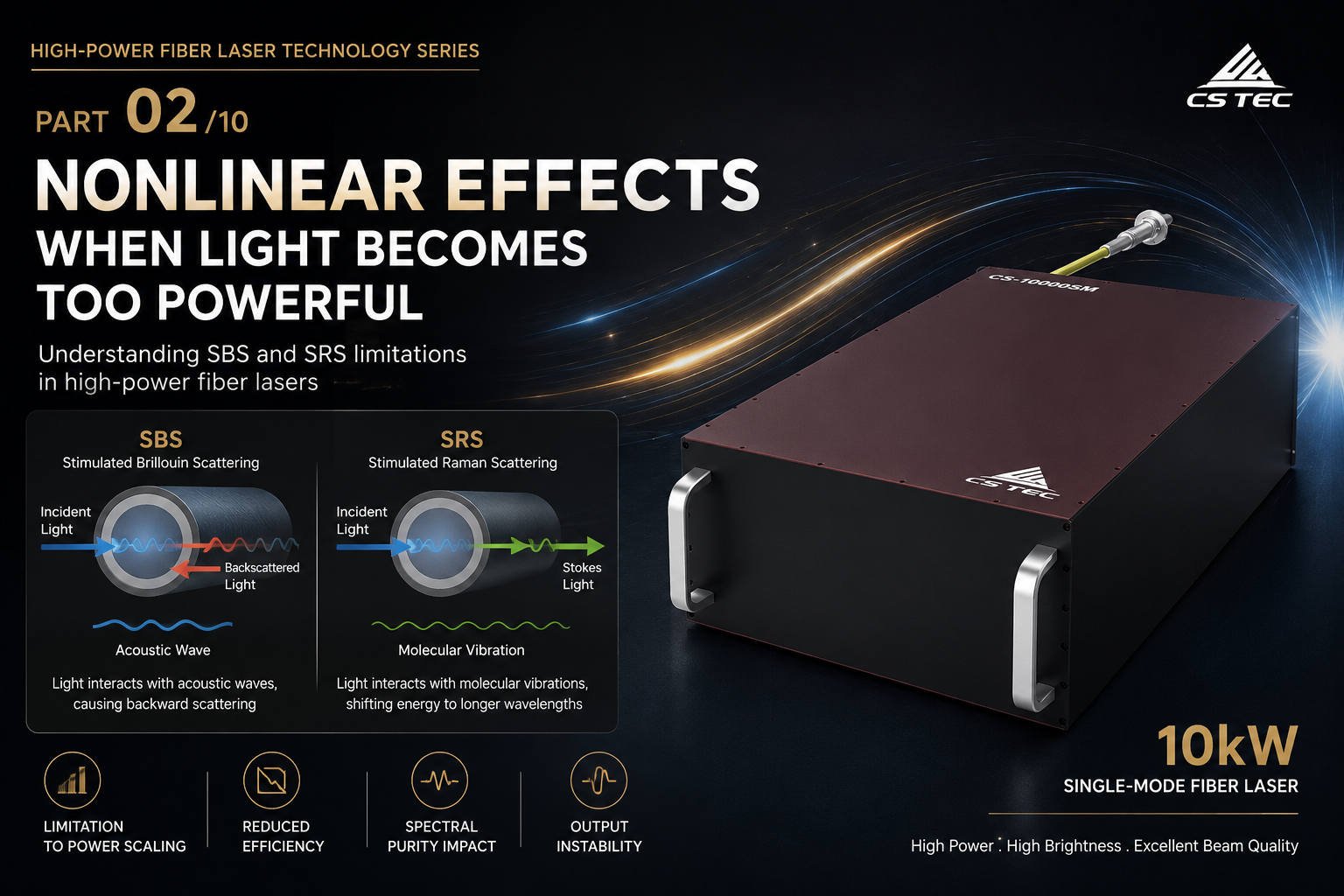
Nonlinear Effects in High-Power Fiber Lasers: When Light Becomes Too Powerful
Introduction
As the output power of a fiber laser increases, maintaining stable and high-quality laser output becomes increasingly difficult.
One of the fundamental limitations is nonlinear optical effects.
At relatively low optical power, light propagates through the fiber in a predictable manner. However, as the optical intensity inside the fiber increases, the interaction between the optical field and the fiber material becomes increasingly significant.
For high-power single-mode fiber lasers, two nonlinear effects are particularly important:
- Stimulated Brillouin Scattering (SBS)
- Stimulated Raman Scattering (SRS)
Understanding and controlling these effects is essential for further power scaling.
1. What Are Nonlinear Effects?
In an ideal linear optical system, the response of the material remains proportional to the optical field.
However, when the optical intensity becomes sufficiently high, the optical properties of the fiber can interact with the propagating light.
This can cause part of the optical energy to be transferred into other directions, frequencies, or propagation states.
In a high-power fiber laser, these effects can limit:
- Output power
- Spectral stability
- Conversion efficiency
- Beam quality
- Long-term system reliability
This is one reason why simply increasing pump power cannot indefinitely increase the output of a single-mode fiber laser.
2. Stimulated Brillouin Scattering — SBS
Stimulated Brillouin Scattering (SBS) is a nonlinear scattering process involving the interaction between light and acoustic waves in the fiber.
At sufficiently high optical intensity, part of the forward-propagating laser energy can be scattered backward.
This backward-propagating light can create several problems:
- Reduced forward output power
- Increased optical feedback
- Output instability
- Increased risk to optical components
The effect becomes particularly important when the laser operates with high power and narrow spectral characteristics.
A simple analogy is water flowing through a pipe.
At a normal flow rate, the water moves smoothly. When the flow becomes extreme, disturbances can develop and affect the stability of the system.
In a fiber laser, SBS represents a similar type of limitation—but at the level of light and optical materials.
3. Stimulated Raman Scattering — SRS
Another important nonlinear effect is Stimulated Raman Scattering (SRS).
Unlike SBS, which is strongly associated with backward scattering, SRS can transfer optical energy toward longer wavelengths through interactions with molecular vibrations in the fiber.
As a result, part of the original laser energy can be converted into unwanted spectral components.
This may lead to:
- Reduced spectral purity
- Reduced conversion efficiency
- Power transfer to unwanted wavelengths
- Additional limitations on power scaling
For applications requiring high brightness and precise laser processing, controlling unwanted spectral components is particularly important.
4. Why Are SBS and SRS More Challenging at High Power?
The key factor is optical intensity.
As the power density inside the fiber increases, nonlinear effects become increasingly significant.
This creates a fundamental engineering challenge:
How can we increase output power without allowing nonlinear effects to dominate the optical system?
This question becomes even more important for single-mode fiber lasers because a high-quality beam is concentrated into a relatively small mode area.
Higher power + small mode area = extremely high optical intensity.
Therefore, power scaling requires careful optimization of the entire optical architecture.
5. Approaches to Suppressing Nonlinear Effects
Several engineering approaches can help manage nonlinear limitations.
Cascaded Pumping
Cascaded pumping can improve energy conversion efficiency and optimize how pump energy is transferred through the gain system.
This can help reduce unnecessary optical and thermal load within the gain fiber.
Optimized Gain Fiber
The design of the gain fiber—including its core structure, doping profile, and mode characteristics—plays an important role in balancing:
- Beam quality
- Power handling
- Nonlinear limitations
- Efficiency
Pump Wavelength and Architecture
The selection of pump wavelength and pumping architecture also influences the overall energy conversion process and thermal load.
For high-power systems, these parameters must be considered together rather than optimized independently.
6. Why Nonlinear Suppression Matters for 10kW Single-Mode Lasers
The objective of a high-power single-mode fiber laser is not simply to achieve a higher numerical output.
The laser must simultaneously maintain:
High Power
High Brightness
Stable Beam Quality
Reliable Operation
Suppressing nonlinear effects is therefore one of the foundations of high-power single-mode laser development.
A successful power-scaling architecture must control optical intensity, energy conversion, spectral behavior, and thermal effects as an integrated system.
Conclusion
SBS and SRS demonstrate an important principle in high-power fiber laser development:
More optical power also means greater physical challenges.
When the optical intensity reaches extreme levels, the fiber itself becomes part of the limiting physics.
Overcoming these nonlinear effects requires optimized pumping architecture, gain fiber design, and system-level engineering.
But nonlinear effects are only one part of the challenge.
Even if the laser can overcome SBS and SRS, another fundamental problem remains:
Can the laser maintain a stable single-mode beam at extreme power levels?
In the next article, we will examine Transverse Mode Instability (TMI)—one of the key barriers to maintaining high-quality single-mode output at high power.
Next Article
PART 03 — Transverse Mode Instability (TMI): The Hidden Barrier of Single-Mode Scaling