Background
Carbon Fiber Reinforced Polymer (CFRP) has become indispensable in aerospace, aviation, and the rapidly growing eVTOL industry. However, achieving clean, high-quality cutting of CFRP remains a major manufacturing challenge.
For decades, manufacturers have been forced to choose between two imperfect solutions:
- CO₂ lasers, which provide good cutting quality but suffer from low efficiency, high operating costs, and poor integration flexibility.
- 1 μm ytterbium fiber lasers, which excel in metal processing but often cause delamination and thermal damage when cutting CFRP.
Today, 2 μm thulium fiber lasers are emerging as a third option—one that aligns much better with the underlying physics of CFRP processing.
Why Is CFRP Difficult to Cut?
CFRP is a composite material consisting of:
- Carbon fibers – high strength, high stiffness, and high thermal conductivity.
- Polymer matrix – typically epoxy, PEEK, or BMI resin.
These two components exhibit fundamentally different optical and thermal properties.
To achieve a clean cut, both materials must absorb laser energy and be removed at similar rates. If the carbon fibers absorb significantly more energy than the surrounding matrix, the matrix can carbonize or vaporize unevenly, causing fiber pull-out and delamination between laminate layers.
Why Do 1 μm Fiber Lasers Struggle?
At wavelengths around 1070 nm, carbon fibers absorb laser energy efficiently.
However, epoxy-based matrices are largely transparent at this wavelength.
As a result:
- Carbon fibers are ablated first.
- The surrounding resin receives much less direct energy.
- Delamination propagates along laminate interfaces.
- Fiber pull-out occurs at the cut edge.
- Heat-affected zones (HAZ) extend laterally into the material.
The final cut often exhibits poor edge quality and inconsistent geometry.
Why CO₂ Lasers Work—But Are Losing Their Advantage
CO₂ lasers have long been the preferred solution for CFRP cutting because polymer matrices absorb 10.6 μm radiation effectively.
However, they present several limitations:
Low Efficiency
Typical electro-optical efficiency is below 8%.
A 3 kW CO₂ laser system may draw more than 37 kW from the power grid.
Beam Delivery Constraints
CO₂ laser radiation cannot be transmitted through standard silica optical fibers.
Instead, articulated mirror arms are required, making robotic integration difficult.
High Maintenance Costs
Laser tubes and optical components require periodic replacement, creating ongoing maintenance expenses.
For manufacturers transitioning from prototype production to high-volume eVTOL manufacturing, CO₂ technology increasingly resembles a solution from a previous generation.
Why 2 μm Is the Right Wavelength
The key advantage of 2 μm lasers lies in the interaction between laser wavelength and polymer chemistry.
Stronger Matrix Absorption
Polymer materials contain C-H and O-H molecular bonds that exhibit strong absorption bands between 1.7 μm and 2.2 μm.
As a result, the resin matrix absorbs significantly more laser energy at 2 μm than at 1 μm.
Improved Fiber-Matrix Energy Balance
At 2 μm, both the carbon fibers and polymer matrix absorb energy more uniformly.
This balanced energy coupling allows simultaneous material removal, reducing:
- Delamination
- Fiber pull-out
- Excessive thermal damage
Better Cutting Quality
In cutting trials on Toray T300 aerospace-grade CFRP (3 mm thickness), the Wuhan CS Tec 1 kW 2 μm fiber laser achieved:
- Cutting speed: 1 m/min
- Kerf width: < 0.3 mm
- Heat-affected zone: tens of micrometers
These results demonstrate significant improvements in edge quality and process stability.
Fiber Delivery Maintained
Unlike CO₂ systems, 2 μm fiber lasers retain all the advantages of fiber delivery:
- Easy robotic integration
- Flexible beam routing
- Compact machine architecture
- Reduced maintenance requirements
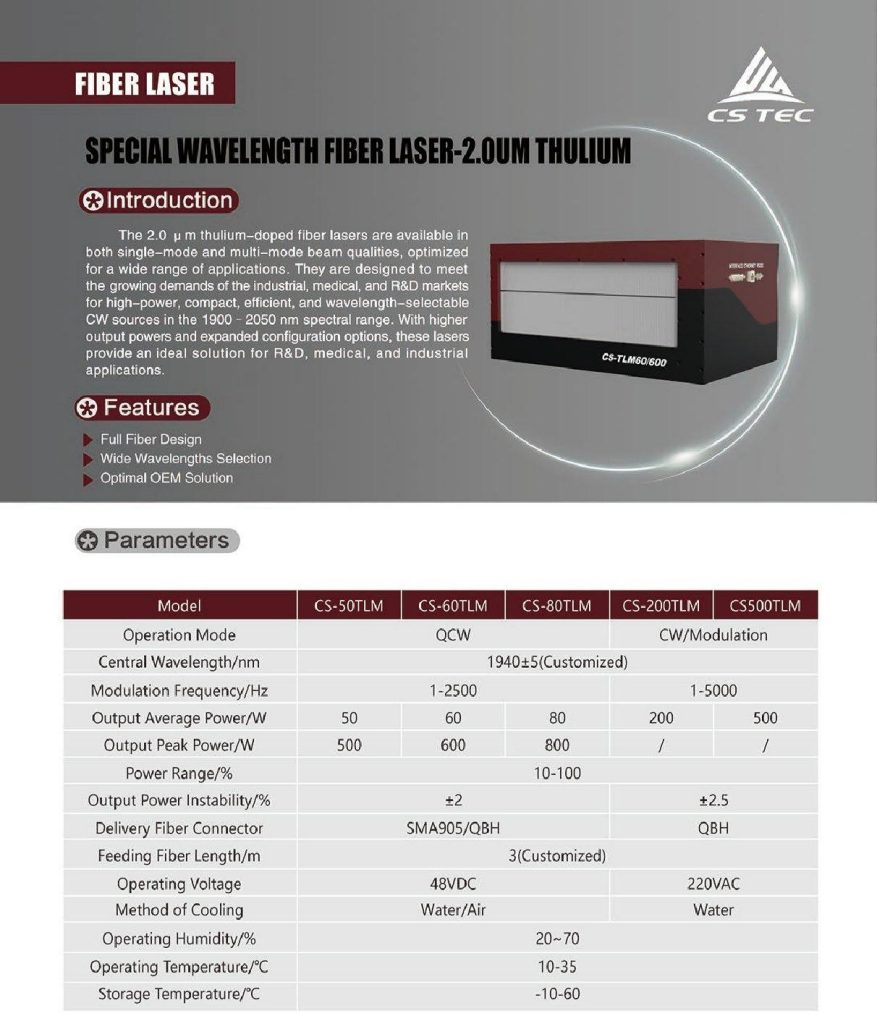
Wuhan CS Tec 2 μm Fiber Laser Solutions
Wuhan CS Tec’s 2 μm fiber laser platform combines:
- High peak power
- High electro-optical efficiency
- Excellent reliability
- Compact system design
- Stable high-power operation
Fully Customizable Platform
Power Customization
From hundreds of watts to kilowatt-class output, tailored to specific application requirements.
Wavelength Customization
Precise wavelength selection across the 1940–2040 nm range.
System Integration
All laser solutions can be integrated with Wuhan CS Tec’s proprietary high-efficiency direct-cooling thermal management system, ensuring reliable operation even in demanding industrial environments.
Tailored Solutions for Advanced Applications
Whether your application involves:
- Medical laser systems
- Remote sensing and LiDAR
- Advanced composite processing
- Scientific research
- Specialty industrial manufacturing
Wuhan CS Tec can provide customized 2 μm laser solutions designed to address the unique challenges of your application.
2 μm fiber lasers are not simply another wavelength option—they may represent the next generation of laser processing technology for CFRP and advanced composite materials.