

The agriculture sector is undergoing a quiet transformation. From precision irrigation to crop disease monitoring, from soil nutrient analysis to yield forecasting, laser-based sensing technology is becoming one of the most important tools driving the modernization of agriculture. Among these technologies, 1470 nm laser diodes are finding an increasingly prominent role thanks to their unique optical properties — particularly their position near the peak of water absorption in the near-infrared spectrum.
Why 1470 nm?
Water absorbs near-infrared light strongly in the 1450–1500 nm range, with 1470 nm sitting close to the absorption peak. This means that a 1470 nm laser interacts with biological tissue and vegetation differently from other wavelengths — it is sensitive to moisture content in a way that shorter near-infrared wavelengths are not. For agriculture, this matters enormously: water content is one of the most critical indicators of crop health, irrigation status, and stress response.
When a 1470 nm laser illuminates a crop canopy, the reflected spectrum carries information about leaf water content, chlorophyll concentration, and nitrogen levels. Healthy crops and stressed or diseased crops reflect this wavelength differently, producing measurable spectral signatures that remote sensing systems can use to generate field-level health maps. The contrast between a well-irrigated crop and a water-deficient one, invisible to the human eye and to shorter-wavelength sensors, becomes clearly distinguishable at 1470 nm.
Crop Monitoring and Precision Agriculture
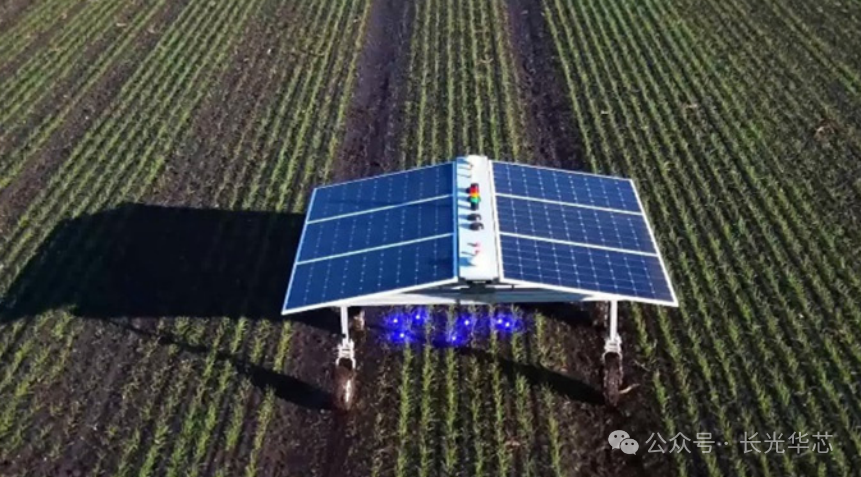
In precision agriculture applications, 1470 nm laser sources are used in hyperspectral imaging systems mounted on drones, tractors, and fixed field sensor arrays. These systems scan crop rows continuously during the growing season, generating spectral data that is processed into actionable agronomic recommendations: which field zones need additional irrigation, where disease pressure is emerging before visual symptoms appear, which areas show nutrient deficiency patterns.
The ability to detect crop stress at an early stage — before yield loss has already occurred — is the core value proposition. Traditional field scouting identifies problems after they are already visible; 1470 nm spectral sensing identifies them in the latent stage when intervention is still effective.
Solar Panel Inspection
Beyond crop monitoring, 1470 nm laser diodes have found application in the inspection of photovoltaic (PV) solar panels. Electroluminescence (EL) imaging, which uses laser or LED illumination to reveal internal defects in solar cells, benefits from near-infrared wavelengths that penetrate the panel encapsulant and excite luminescence from defect sites.
At the large-scale end of this application — utility-scale solar farms covering thousands of hectares — airborne and satellite-borne near-infrared sensors using 1470 nm illumination can identify panels with hidden cracks, delamination, or cell failure across entire arrays in a single overflight. The economics of this approach are compelling: a manual inspection of a 100 MW solar farm would require weeks; an aerial sensor sweep can cover the same area in hours, flagging the specific panels that warrant ground-level maintenance attention.
Technical Characteristics
The 1470 nm band offers several characteristics that make it particularly well-suited for these sensing applications.
At 1470 nm, the water absorption coefficient is high enough to produce measurable spectral contrast in biological tissue and vegetation, while still allowing useful penetration depth into leaf structures — unlike wavelengths at the very peak of water absorption, which would be absorbed almost entirely at the surface. This balance between surface sensitivity and tissue penetration makes 1470 nm effective for measuring internal leaf properties, not just surface reflectance.
The power-current (P-I) characteristics of 1470 nm laser diodes allow stable operation across a range of output powers relevant to field sensing applications, from low-power continuous-wave illumination for close-range spectroscopy to higher-power pulsed operation for long-range remote sensing. The spectrum at operating temperature is sufficiently narrow to enable wavelength-resolved spectral analysis when used in conjunction with appropriate optical filters or spectrometer systems.
Looking Ahead
As agricultural operations scale and the pressure to improve water use efficiency and reduce chemical inputs intensifies, the demand for precise, continuous, non-destructive crop monitoring is growing steadily. 1470 nm laser diodes, combined with increasingly capable data processing platforms, are positioned to become a standard sensing tool across precision agriculture, forestry monitoring, and large-scale infrastructure inspection.
The same optical property that makes water strongly absorptive at 1470 nm — a fundamental characteristic of molecular physics, not an engineered feature — gives this wavelength a durable advantage in any application where water content is a meaningful variable. In agriculture, that covers most of what matters.