
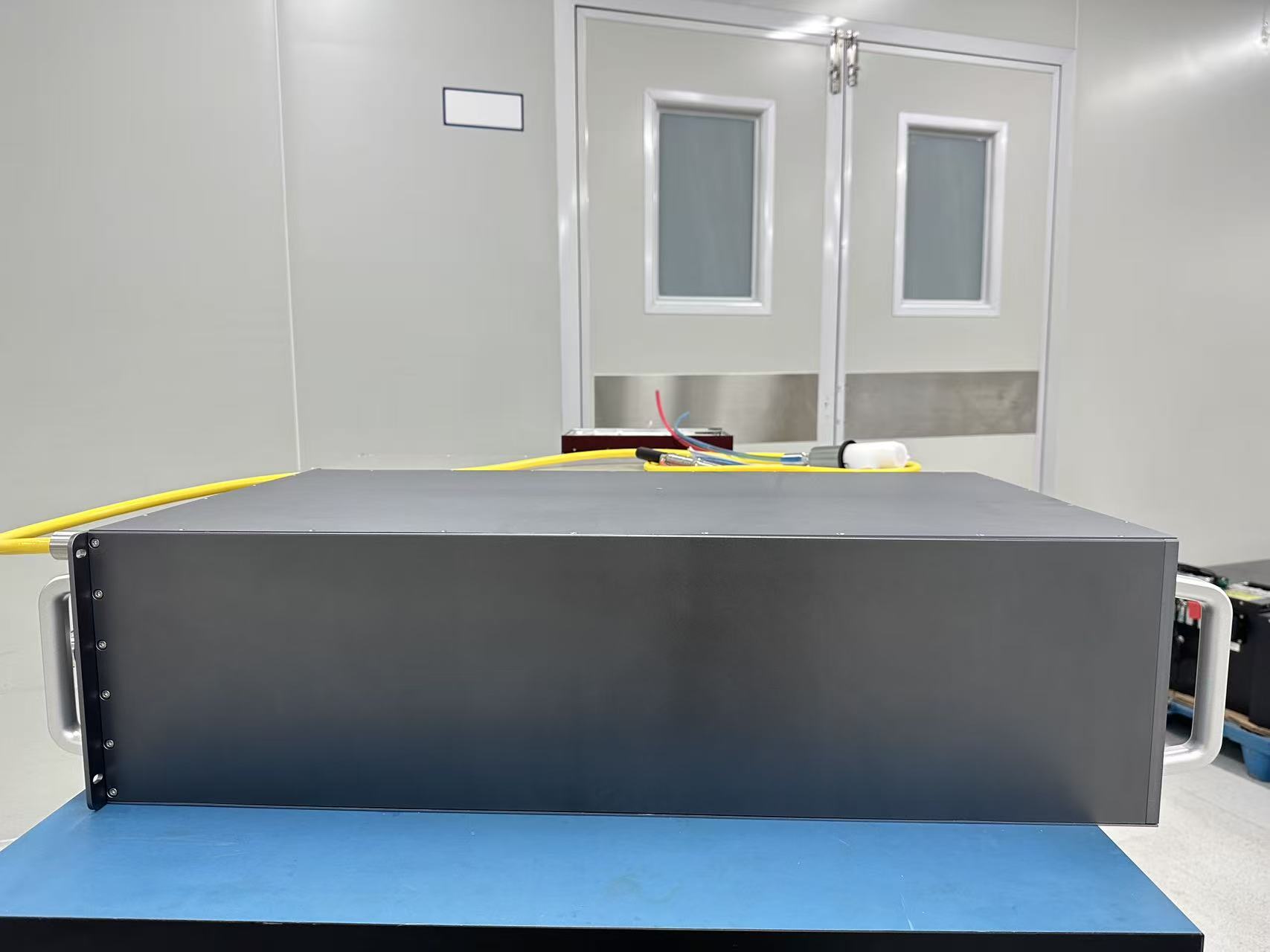
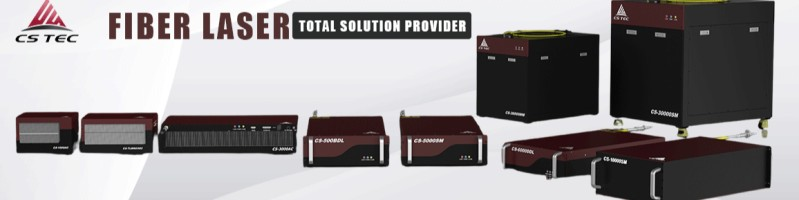
This article is based on the paper “High-Reliability 10 kW Near-Single-Mode Fiber Laser Based on Self-Developed Fiber (Brief Report)”, published in Chinese Journal of Lasers, Vol. 53, No. 10, May 2026. The work was carried out by a research team from the National University of Defense Technology (NUDT). Notably, the same team previously demonstrated an 8.3 kW near-single-mode fiber laser in 2025, and this latest achievement represents a significant extension of their earlier work.
Background
The power scaling of laser-diode (LD) pumped fiber lasers is fundamentally limited by nonlinear effects such as stimulated Raman scattering (SRS) and transverse mode instability (TMI). To overcome these challenges and further increase output power, research institutions and laser manufacturers worldwide have been actively exploring innovative fiber designs and system architectures.
In 2025, IPG Photonics demonstrated a 7.2 kW LD-pumped near-single-mode fiber amplifier, while Raycus Laser reported near-single-mode fiber amplifier output exceeding 10 kW.
However, long-term operational stability under such high-power conditions remains a critical challenge due to effects such as photodarkening. Therefore, this work focuses not only on achieving higher output power but also on ensuring reliable long-duration operation.
Experimental Setup
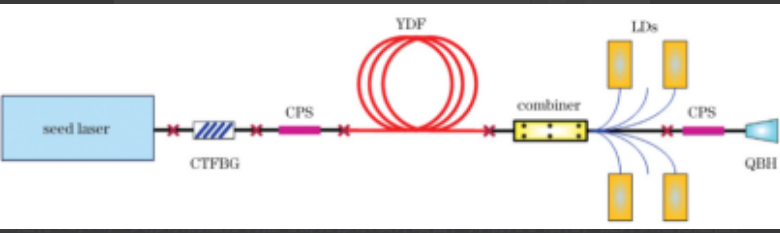
The laser system adopts a Master Oscillator Power Amplifier (MOPA) architecture with backward pumping. A 1080 nm fiber oscillator serves as the seed source, while the amplification stage employs a self-developed ytterbium-doped fiber (YDF) pumped by 981 nm laser diodes.
A chirped and tilted fiber Bragg grating (CTFBG) and a cladding power stripper (CPS) are inserted between the seed source and amplifier stage to suppress Raman components and remove residual cladding pump light.
The self-developed partially doped YDF features:
- Effective mode area (EMA): approximately 500 μm²
- Doping area ratio: approximately 50%
The custom fiber design plays a key role in achieving both near-single-mode operation and high reliability.
First, the combination of low numerical aperture (NA) and partial doping design helps maintain near-single-mode propagation while increasing the TMI threshold.
Second, the optimized Yb/Al/P co-doping composition, combined with the partial doping structure, effectively suppresses photodarkening and enhances long-term operational stability.
Additional optimization was carried out on fiber coiling, splicing techniques, and component selection to further ensure high beam quality and stable operation.
Experimental Results
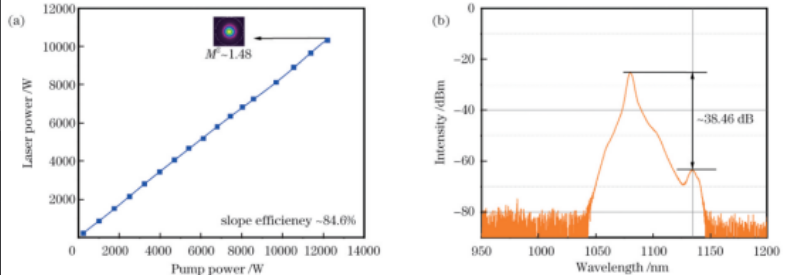
At a pump power of 12.20 kW, the fiber laser achieved a maximum output power of 10.32 kW, corresponding to a slope efficiency of approximately 84.6%. The measured beam quality factor (M²) was approximately 1.48, indicating near-single-mode performance.
The output spectrum showed a stimulated Raman scattering suppression ratio of approximately 38.46 dB, demonstrating effective suppression of nonlinear effects.
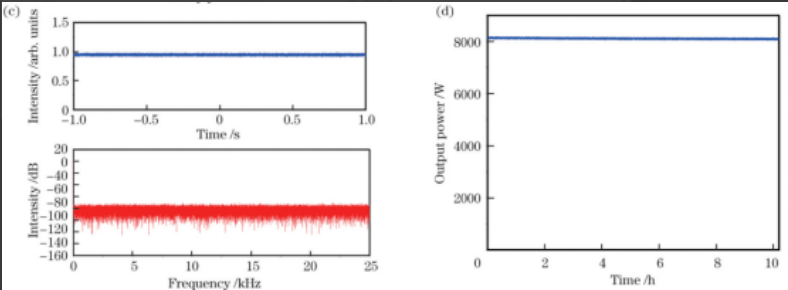
Temporal and frequency-domain analyses at maximum power revealed no significant power fluctuations and no characteristic TMI peaks, confirming that TMI remained effectively suppressed even at the highest output level.
To evaluate long-term reliability, the laser was operated continuously at 8.1 kW for 10.2 hours. The output power exhibited only a slight gradual decrease without significant fluctuations. The measured power instability was only 0.68%, demonstrating excellent operational stability and providing strong evidence of the system’s reliability under high-power conditions.
Conclusion
By combining a self-developed partially doped ytterbium fiber, low-NA design, optimized co-doping composition, and system-level engineering improvements, the research team successfully demonstrated a 10.32 kW near-single-mode fiber laser with high reliability and excellent beam quality.
This achievement represents an important milestone in high-power fiber laser technology and provides valuable insight into overcoming the challenges of TMI, SRS, and photodarkening for future power scaling beyond the 10 kW level.